Isiyaku Ahmed
Stakeholders at a two-day Kano State Debt Sustainability Analysis (DSA) and Medium-Term Debt Management Strategy (MTDS) workshop have called for stricter fiscal discipline, increased Internally Generated Revenue (IGR), and responsible borrowing as essential pillars for sustainable economic growth and development in the state.
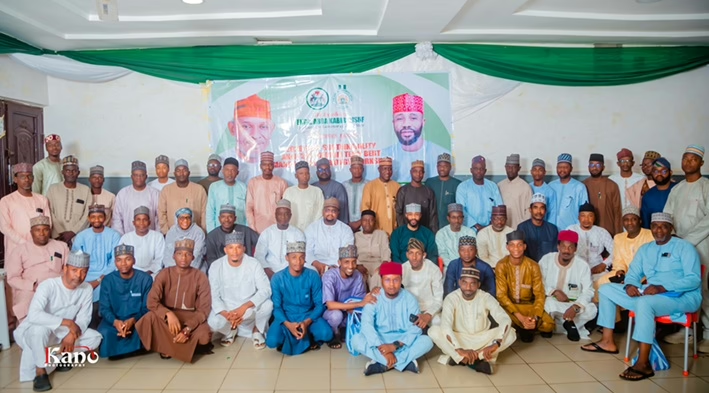
The workshop, organized by the Kano State Public Debt Management Office (PDMO), was held from June 27 to 28 at B. Nakowa Modern Guest Lodge, Dutse, Jigawa State. It brought together representatives of the Kano State Government, the State House of Assembly, Ministries, Departments and Agencies (MDAs), development partners, consultants, academics, civil society organizations, and the media.
At the end of the workshop, stakeholders adopted a communiqué reaffirming their commitment to prudent public financial management, enhanced revenue generation, and sustainable debt practices that would strengthen Kano State’s fiscal resilience.
The stakeholders commended Governor Abba Kabir Yusuf for his commitment to fiscal discipline, transparent financial management, and sustainable economic development by institutionalizing responsible debt management.
According to the communiqué, the Kano State Public Debt Management Office Law, 2021, provides a strong legal framework for responsible borrowing, transparency, and accountability. It urged all Ministries, Departments, and Agencies to strictly comply with the provisions of the law in all debt-related transactions.
The stakeholders also identified the Debt Sustainability Analysis (DSA) and Medium-Term Debt Management Strategy (MTDS) as critical policy tools for guiding borrowing decisions, mitigating debt risks, and maintaining long-term fiscal sustainability.
They resolved that future borrowing should be limited to projects with clear socio-economic benefits, proven affordability, and value for money, while ensuring that the state’s debt portfolio remains within sustainable limits.
The communiqué further emphasized the need to significantly improve Internally Generated Revenue to reduce dependence on borrowing and strengthen the state’s financial capacity to fund development programs.
To improve public debt management, stakeholders called for closer collaboration among the Public Debt Management Office, the Ministry of Finance and Economic Development, the Kano Internal Revenue Service (KIRS), the Office of the Accountant-General, and other relevant institutions in debt planning, monitoring, reporting, and fiscal risk management.
Stakeholders also agreed that debt sustainability considerations should be fully integrated into annual budget preparation, medium-term fiscal planning, and public investment decisions to promote sound fiscal governance.
The workshop underscored the importance of transparency, accountability, legislative oversight, and citizen participation in enhancing public confidence in government borrowing and overall financial management.
Stakeholders further acknowledged the contributions of development partners, academia, consultants, civil society organizations, and the media in promoting evidence-based policymaking, transparency, and accountability in public finance.
During the two-day program, participants reviewed eleven technical papers covering debt sustainability analysis, loan negotiation, fiscal risk management, public financial management reforms, debt restructuring, revenue mobilization, fiscal transparency, institutional coordination, and the application of Maqasid al-Shari’ah principles to public debt management.
The technical sessions culminated in the preparation of a draft Kano State Debt Sustainability Analysis and Medium-Term Debt Management Strategy for the 2024/2025 fiscal period.
The stakeholders adopted the technical sessions’ recommendations as the basis for finalizing the policy documents, and the Kano State Public Debt Management Office will incorporate stakeholders’ observations before submitting the final DSA and MTDS to the state government.
The workshop concluded with stakeholders reaffirming their commitment to support a transparent, prudent, and sustainable public debt management framework that will increase fiscal resilience, promote responsible borrowing, and accelerate Kano State’s socio-economic development for the common good of present and future generations.