
Ghazali Ibrahim
A protest against insecurity. A crackdown by state-sponsored thugs. A police investigation that dismissed video evidence as “digitally manipulated”.
For months, families of kidnapping victims in Nigeria’s Kwara State waited for answers. When they approached the government through a peaceful protest, they were violently attacked.
Despite footage clearly showing the attackers, the police later concluded that the videos had been manipulated and closed the case without any arrests. Some victims also reported receiving threats after the incident.
This investigation examined what happened that day. Drawing on multiple videos obtained exclusively by this newspaper, eyewitness accounts, digital verification techniques, and interviews with people captured in the footage, we found no evidence that the videos had been digitally altered. We also traced and identified some of the men seen attacking protesters and who they worked for.
For weeks, families of abducted victims in Oke-Ode waited in quiet desperation, clinging to their phones, visiting police stations, and hoping for news that never came. By late December, the silence and inaction had become unbearable. What followed was a peaceful protest that would end in violence outside the Kwara State Government House in Ilorin.
On the morning of 27 December 2025, Lola, not her real name, stood a few metres from the gates of the Government House, clutching a placard. She had not slept the previous night. Her husband was among those abducted in the Oke-Ode kidnapping wave that had rattled the agrarian community in Ifelodun Local Government Area.
She was not alone. Around her were other women, many carrying similar grief, each with a story shaped by loss, fear, or uncertainty.
At first, the protest was calm. Security personnel at the Government House engaged the demonstrators, asking questions and urging restraint. The women explained their plight. They wanted help. They wanted action.
Then the mood shifted.
According to Lola, unfamiliar men began to appear from different directions.
“When we got there, security officials came out and asked why we were protesting, and we told them,” she said. “Not long after, some touts came from the direction of the APC secretariat. They arrived in tricycles. At first, they gathered in front of the deputy governor’s lodge. Then they charged at us with whips, shouting that we wanted to destroy the governor’s name and that we should leave.”
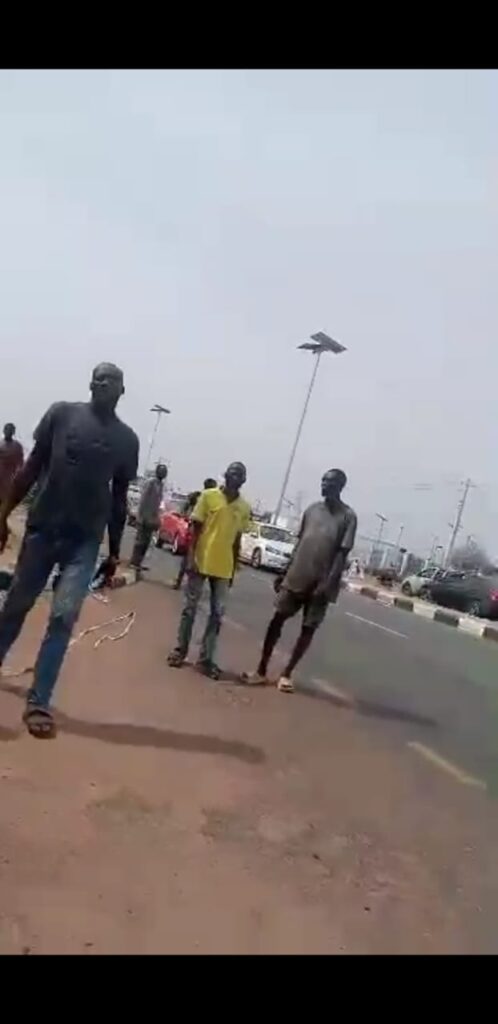
What began as a peaceful gathering quickly descended into chaos. The attackers wielded canes and horsewhips. Protesters fled in different directions.
An eyewitness who was driving past the area that morning described a similar scene.
“I was coming from the University of Ilorin after a programme,” he said. “I saw people in front of the Government House and became curious. Before I understood what was happening, a group of tough-looking men descended on them. I was in my car, opposite the Government House. They were shouting that the protesters should not destroy the governor’s name and were whipping them.”
He added that he noticed several motorcycles parked near the deputy governor’s lodge, but could not confirm if they belonged to the attackers.
The protest was driven by a worsening security crisis in Kwara, once regarded as relatively insulated from widespread violence. In recent months, however, communities along the state’s border areas have faced repeated attacks by bandits.
Between January 2025 and February 2026, more than 300 people were reported killed across the state, a sharp increase compared to previous years.
Among the protesters that day was a woman in a blue hijab, her voice breaking as she addressed the authorities in a video later obtained by this newspaper.
“Have mercy on us,” she said. “They have nearly kidnapped all of us in Oke-Ode. We are poor people. We have nothing. We have reached our limit. Please have mercy on us.”
Another woman spoke of her abducted husband.
“They kidnapped my husband at Agbekun. It has been one month. Please help us.”
Police Claim ‘Manipulated’ Video; Evidence Suggests Otherwise
In a statement issued on 27 January 2026, the Kwara State Police Command said it had concluded its investigation into the incident, describing the widely circulated video as “digitally manipulated.”
The command’s spokesperson, Adetoun Ejire-Adeyemi, said a forensic review showed the footage was not a continuous recording of a single video.
According to the statement, “a forensic analysis of the viral video conclusively established that it is a digitally manipulated composite. The footage was deliberately spliced, merging unrelated scenes of violent altercations with clips from a separate peaceful protest to falsely portray an incident at the Government House.”
The police further stated that some of the clips circulated alongside the video did not originate from the protest.
“Further review revealed that some images being shared in connection with this incident originated from unrelated events that occurred several months earlier,” the statement added.
The command also said investigators had been unable to trace individuals featured in the footage.
“All efforts by the investigative team to locate and interview the purported victims, particularly the two women featured in the video, have so far been unsuccessful,” it said.
However, findings by this newspaper raise questions about those conclusions.
Scene Analysis
This newspaper exclusively obtained multiple video clips recorded at different moments before and during the attack. A frame-by-frame review shows continuity in participants, clothing, and background elements, including the Government House gate and surroundings.
Individuals seen during the peaceful phase of the protest appear in subsequent clips recorded during the attack, suggesting the events occurred on the same day and at the same location.
The viral video, while edited into a single sequence, appears to be a compilation of short recordings taken in real time rather than a merger of unrelated incidents.
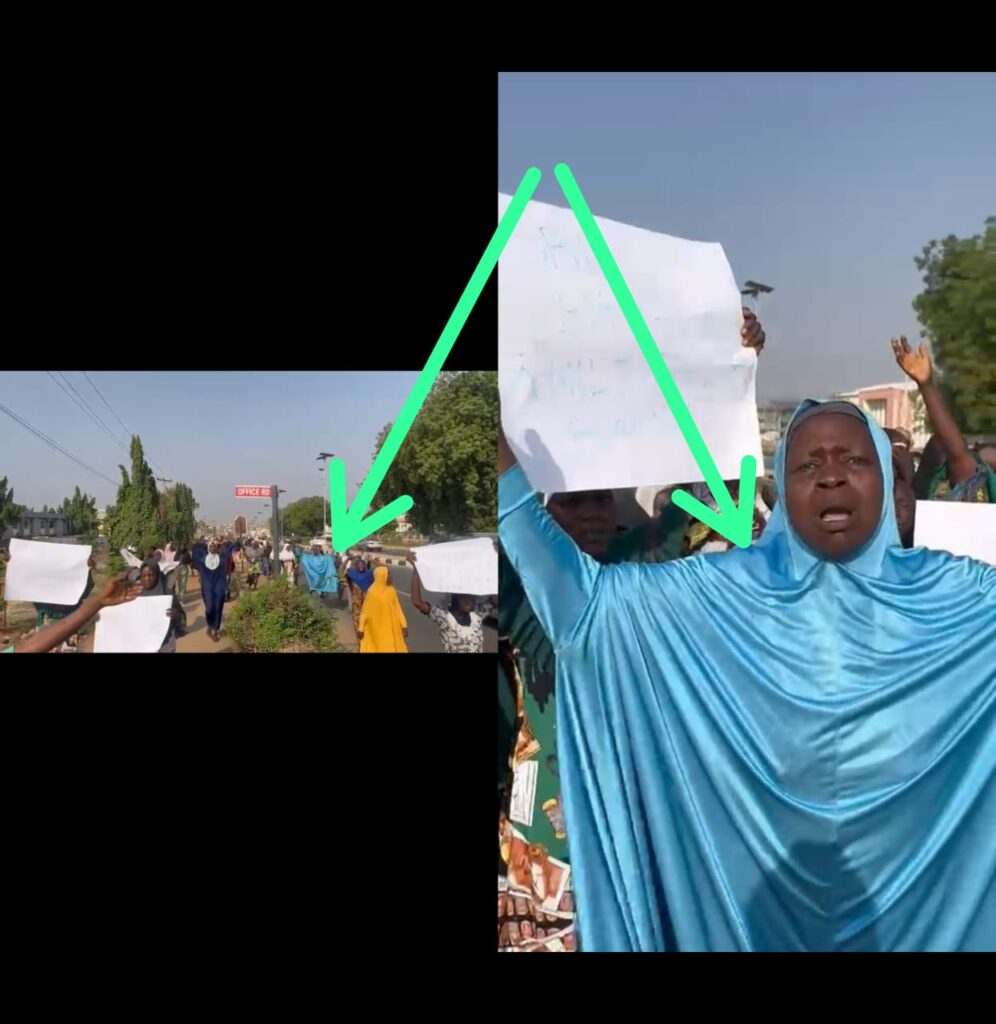
No evidence was found indicating that footage from separate dates or locations was introduced into the sequence.
Reverse Image and Metadata Checks
To test the police’s claim that some clips predated the protest, this newspaper conducted reverse image searches using tools such as Google Images and TinEye.
Key frames, including those showing a woman in a blue hijab who appeared prominently in the footage, were extracted and analysed.
The searches returned no prior records linking the images to earlier events. Instead, results consistently traced back to the same protest footage that circulated online after the incident.
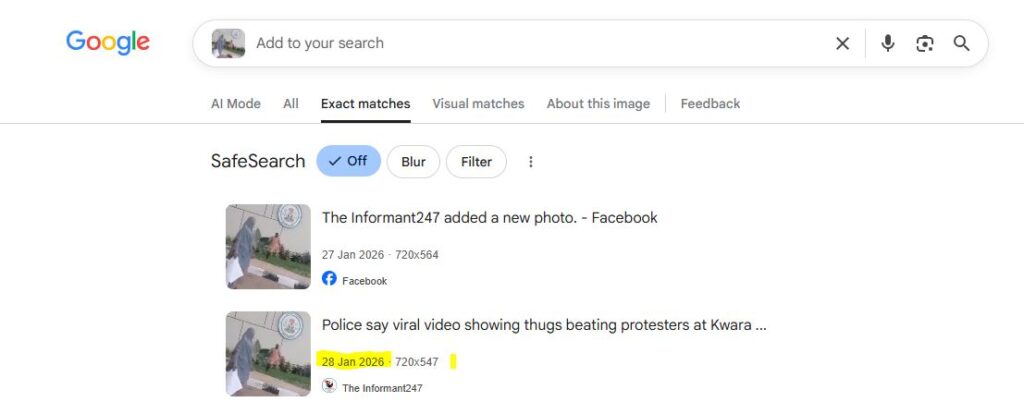
No independent or earlier incidents were identified to support the claim that the visuals originated months before.
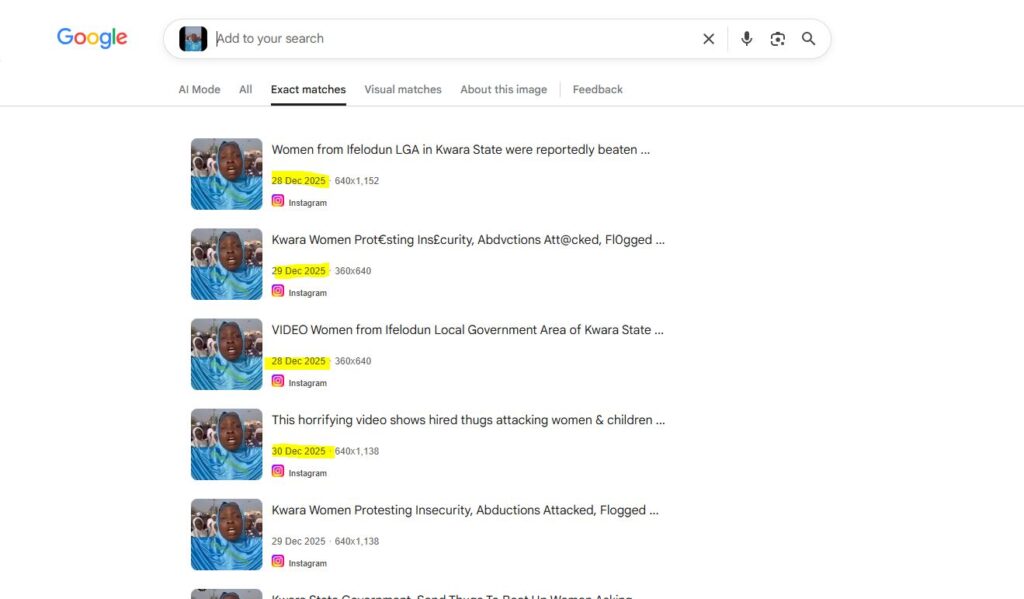
One of the individuals who recorded part of the footage told this newspaper that the clips were taken sequentially during the protest.
“We recorded in short clips because it was not a continuous scene,” the source said. “When the protest began, I brought out my phone and recorded discreetly. The next day, we sent the clips to a blog, and they joined them together so it would be easier to post. Nothing was manipulated, and everything happened that same day.”
The source asked not to be named, citing fear of victimisation.
Contrary to the police statement, this newspaper traced and interviewed two individuals who appeared in the video.
Both confirmed they were present at the protest and during the attack. They declined to be named, also citing safety concerns.
Gaps in the Police Investigation
The police statement did not indicate whether the officers visible in the footage were questioned as part of the investigation.
There was also no reference to a review of CCTV recordings from Government House, which could have provided additional verification of the incident.
Similarly, the command did not disclose any efforts to identify or track the attackers, despite clear visual evidence showing their faces.
Who are the attackers?
Following the attack, this newspaper sought to identify the men seen in the video attacking the protesters outside the Government House.
A review of the footage shows several individuals whose faces are clearly visible, some wielding canes and horsewhips, others issuing threats as protesters fled.
To establish their identities, this newspaper conducted interviews with multiple sources familiar with political activities around Ilorin, including traders, politicians, and residents who knew the people in the clip.
Across at least five independent sources, a consistent account revealed that the attackers are members of a violent political thug group popularly formally known as “Peace Team Kwara,” and believed to enjoy massive support from the state government and ruling All Progressives Congress (APC) in the state..
Sources said the group’s headquarters is at the APC state secretariat, located a short distance from the Government House.
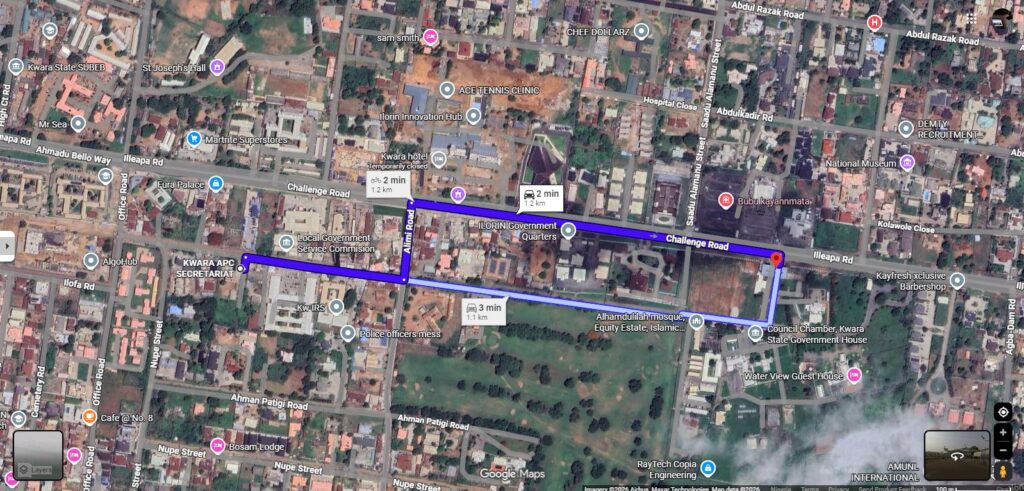
In the attack video, the tall man seen directing the thugs was identified, by sources who spoke to The Informant247, by the nickname “Tosho Bottle.” His real name was given as Shuaib Abdulhamid Omotosho.

Multiple sources independently identified him from still images extracted from the footage. This newspaper is also able to get his clearer photograph.
To further verify these claims, this newspaper visited the APC state secretariat in Ilorin on a weekday afternoon.
At the time of the visit, they were seen gathered outside the premises. Some were seated on tricycles, while others sat on benches nearby. A few were observed taking hard drugs and smoking.
“They are usually here, Tosho bottle, Capo and others,” a trader around the APC secretariat told this newspaper. “When politicians have campaigns or programmes, they call them. Sometimes they follow them around. People know them as APC boys.”
The trader added that the group are also used as informal security by officials of the party.
“We don’t have issues with them. They buy things and pay. But they are always around. they are like private security for the APC people,” the trader said.
Sources told this newspaper that the group operates using tricycles and a small commercial bus, popularly known as a “korope”.
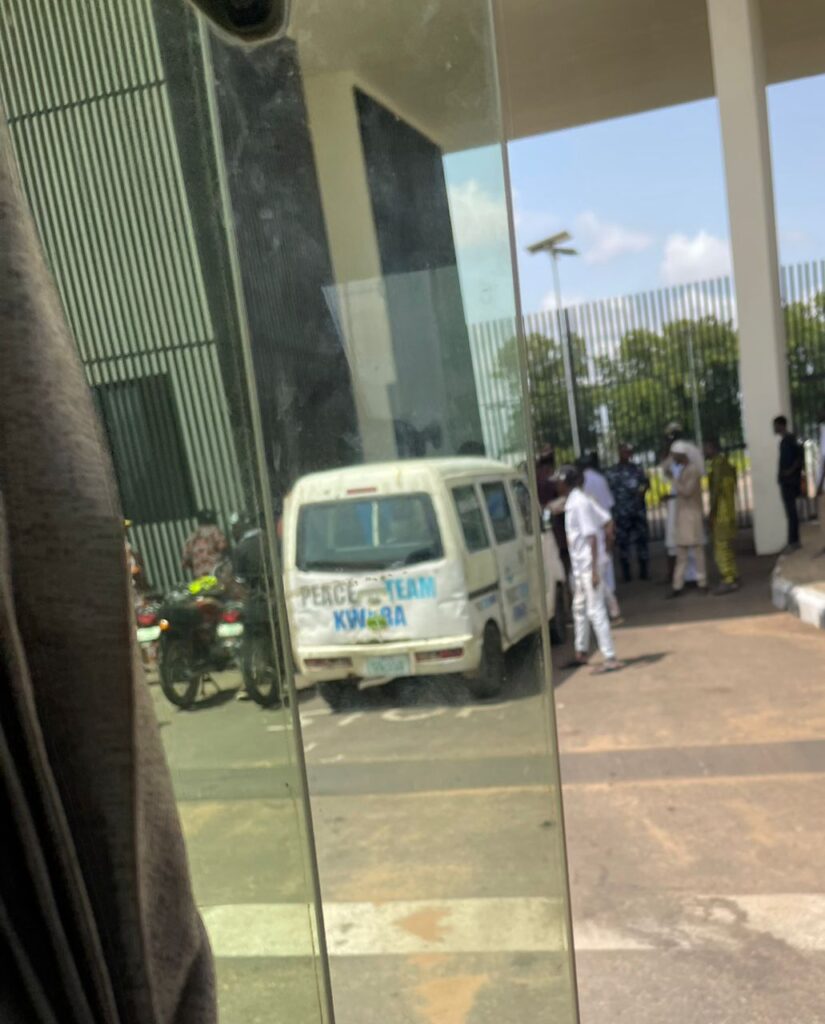
Some said these items were provided through political empowerment from the government, although this claim could not be independently verified. Their roles include mobilising for political rally and also suppressing and attacking opposition voices.
In the video footage captured in front of the party secretariat, they were seen with tricycles, consistent with eyewitness accounts that some of the attackers arrived in such vehicles.
No Official Accountability
Despite the attackers’ visibility in the video, the Kwara State Police Command did not name any suspects or announce any arrests in its official statement on the incident.
The statement also did not indicate whether any individuals captured in the footage had been identified, invited to be questioned, or placed under investigation.
When contacted for reactions to the incident, the Kwara state APC chairman, Sunday Fagbemi, distanced the party from any connections with the attackers. “Thuggery is alien to APC. We don’t breed or encourage it,” he said.
On the other hand, Rafiu Ajakaye, the chief press secretary to the Governor (now former), refused to comment. “I’m not in a position to give comments. Go and meet the police,” he said. When this newspaper confirmed that it had reached the police prior to his call, he said, “Speak to the commissioner of communication.”
Efforts to reach the “commissioner of communication” proved abortive at the time of writing this report. However, a call was placed through to the SSA on communication Abdullateef Ibrahim, which rang out.
Kwara State command spokesperson Adetoun Ejire-Adeyemi declined to talk on the phone when called. She did not respond to the questions sent to her on WhatsApp after she asked this newspaper to reach out via text.
This investigation was produced with support from Civic Media Lab
For this investigation, we have secured all elements with the SafeBox Network of Forbidden Stories