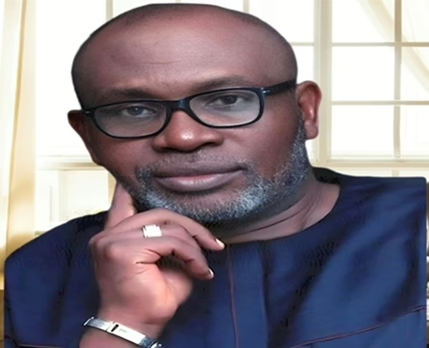
Rekpene Bassey
There are scandals that disgrace individuals. There are scandals that embarrass governments. Then there are scandals so extraordinary that they expose the architecture of the state itself.
The controversy surrounding Prince Adeniyi Adeyemi Matthew belongs squarely in the third category.
The State House statement issued on July 1, 2026, by presidential spokesman, Bayo Onanuga, was clearly intended to settle the matter. Running through a detailed chronology, it portrays Adeyemi as the architect of an elaborate scheme built on forged documents, fictitious presidential agencies and false claims of official appointment.
If those allegations are ultimately proved in court, they would undoubtedly rank among the most audacious acts of scam in Nigeria’s recent history.
However, the statement accomplishes something its authors perhaps never intended.
In painstakingly narrating the alleged fraud, it also exposes an unsettling portrait of institutional fragility. Read carefully, the document becomes less an indictment of one man than an unintended audit of governance itself.
The real question is therefore no longer whether an individual forged documents. That is for the courts to determine. The larger question is infinitely more consequential.
How could the Nigerian state have become so permeable that an alleged impostor could appear to function as part of the Presidency itself? This question should trouble every citizen far more than the personality of the accused.
According to the Presidency’s account, Adeyemi allegedly established what appeared to be a presidential institution, occupied office space within the Federal Secretariat, held meetings attended by diplomats, corresponded with ministries, sought diplomatic privileges, presented himself as a presidential appointee, operated numerous bank accounts; including one allegedly opened through official government processes, and maintained this elaborate façade until suspicions eventually emerged.
If that narrative is substantially accurate, then Nigeria has not merely uncovered an alleged fraud. It has uncovered a profound failure of institutional self-protection.
The Presidency understandably asks Nigerians to focus on the alleged deception. But the statement itself directs attention elsewhere.
Every successful deception requires a failed safeguard. Every forged document requires someone who failed to verify it.
Every false identity requires someone who accepts it. Every institutional breach reveals another checkpoint that did not function.
That is why the statement deserves to be read not only as a criminal complaint but also as a diagnostic report on the condition of the Nigerian state.
The first anomaly concerns the Federal Secretariat. Government office complexes are among the most regulated public spaces in the country.
Offices are allocated through bureaucratic procedures. Security personnel control access. Administrative officers oversee occupancy. Visitors are logged. Identity is supposedly verified.
If an individual was indeed able to establish and operate an office under the banner of a fictitious presidential agency, then the question extends well beyond his alleged conduct.
Who authorised the space?
Who processed the documentation? Who issued access credentials? Who ignored the warning signs?
Buildings do not legitimise occupants on their own. Institutions do. The chronology presented by the Presidency is equally revealing.
The alleged scheme did not first collapse because intelligence services detected unusual activity. Nor because internal auditors uncovered irregularities. Nor because security agencies intercepted forged communications.
Instead, the Presidency states that concerns arose after the Nigerian Investment Promotion Commission reportedly discovered another organisation performing similar functions.
If accurate, this means the fraud was exposed largely because bureaucratic jurisdictions collided; not because institutional oversight worked as intended.
That distinction should concern policymakers. Resilient states detect fraud proactively. Weak institutions often discover it accidentally.
Perhaps the most astonishing aspect of the Presidency’s narrative concerns the financial system.
According to the statement, investigators found dozens of bank accounts allegedly linked to the suspect, including accounts reportedly opened in the names of fictitious government entities.
Even more striking is the assertion that an account was allegedly opened through processes involving the Office of the Accountant-General and the Central Bank.
That claim deserves rigorous public scrutiny. Financial governance within the government is designed around layers of authentication precisely to prevent such occurrences.
If those safeguards failed, responsibility cannot end with the alleged applicant. Who verified the supporting documents? Which officers processed them? Were established procedures bypassed? If so, by whom? Have internal investigations identified any officials whose conduct warrants disciplinary or criminal action? Until those questions are answered, the institutional story remains incomplete.
The diplomatic dimension raises similar concerns. The Presidency says ambassadors attended meetings organised by the purported agency before the Ministry of Foreign Affairs sought clarification.
Diplomatic engagement is rarely casual. Missions generally seek confirmation before engaging organisations claiming presidential authority.
If those meetings occurred substantially as described, they point either to an unusually sophisticated deception or to troubling weaknesses in verification procedures. Both possibilities warrant careful examination.
Another conspicuous gap lies in the treatment of accountability. The statement meticulously catalogues the alleged actions of the accused but says comparatively little about those within the government whose actions, or omissions, may have enabled the alleged scheme to flourish.
No major institutional deception succeeds entirely in isolation. Complex fraud typically advances through a combination of forged credentials, procedural weaknesses, human error and, in some instances, insider assistance.
That is not an accusation against any specific official. It is an observation about how sophisticated institutional fraud ordinarily operates.
If investigators ultimately establish that multiple government systems were penetrated, then accountability must extend beyond the alleged architect of the scheme to include any officials found to have acted negligently, recklessly or corruptly. To do otherwise would risk treating symptoms while ignoring causes.
The Presidency is correct to remind Nigerians that the matter is sub judice. Courts, not commentators, will determine criminal liability. But judicial proceedings cannot answer every question of public administration.
A conviction, if one occurs, would establish the culpability of the accused. It would not, by itself, explain how the alleged deception maneuvered so many institutional checkpoints.
That explanation belongs not in the courtroom alone but in public administration, legislative oversight and executive accountability. Nigeria therefore requires more than a successful prosecution. It requires an institutional reckoning.
There should be an independent forensic audit of every government interaction involving the alleged fictitious agencies; comprehensive investigations into how office space, administrative recognition and financial documentation were processed; internal reviews across affected ministries and agencies; parliamentary oversight hearings; and, ultimately, a publicly released report identifying both procedural failures and reforms.
The objective should not be merely to punish alleged wrongdoing. It should be to ensure that no similar scheme could succeed again.
History is unforgiving toward states that mistake prosecution for reform. Modern governments earn public confidence not simply by exposing fraudsters but by demonstrating that their institutions can withstand fraud.
If the allegations set out by the Presidency are ultimately substantiated, then the greatest victim of this affair will not be the reputation of one office or one individual. It will be public confidence in the integrity of the Nigerian state.
For that reason, this controversy deserves to be remembered not simply as the case of an alleged phantom agency.
It may come to be seen as the moment Nigeria was compelled to confront an uncomfortable truth: that the greatest threat to public institutions is not always the ingenuity of those who seek to deceive them, but the weakness of the systems that allow deception to pass for authority.
The trial may determine whether Prince Adeniyi Adeyemi Matthew committed the offences alleged against him. History, however, will ask a different question.
How did a state entrusted with safeguarding the authority of the Presidency become vulnerable enough that a phantom institution could, even temporarily, appear authentic?
Until that question is answered with transparency, accountability and meaningful reform, the shadow embarrassment cast by this affair will extend far beyond the courtroom. It will linger over the institutions whose credibility is now on trial alongside the accused.
Bassey is the President of the African Council on Narcotics and a Security Specialist.