Ahmed Yahaya Joe
“History does not repeat itself, but it rhymes.” – Mark Twain (1835-1910)
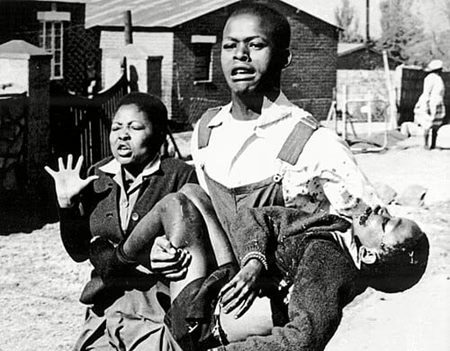
The tumultuous events of 16th June 1976 will remain indelible in annals of history as captured through the camera lens of Sam Nzima (1934-2018) featuring Mbuyisa Makhubu (b.1957) as he bravely evacuated a 13-year-old Zolile Hector Pieterson as he muttered “I must save this bleeding boy,” shot by South African police.
Alongside is the 15-year-old elder sister of the victim, Antoinette Sithole, now 65. The grisly scene was at Orlando West near their school, Phefeni High, in Soweto township in the province of Gauteng on the outskirts of Johannesburg.
Pieterson was soon pronounced dead at a nearby clinic alongside 175 other teenagers summarily executed for daring to protest against the planned introduction of Afrikaans as a language of instruction in Black schools.
Afrikaans is to date still perceived by the Black majority in South Africa as the language of the oppressor.
But Mandela, an amateur pugilist but adroit political animal political had a different take.
He understood the imperative in the strategic thinking of Sun Tzu;
“Know thy enemy and know yourself.” – Sun Tzu (544-496 BC)
So, he studiously learned Afrikaans during his 27-year long imprisonment in a bid to tactically understand the Afrikaner mindset.
He believed that to influence, negotiate with, and ultimately win over the white minority, he needed to speak their Germanic language that evolved from Dutch settlers in Southern Africa in general since the 17th century.
Sadly, unlike the young lions of Soweto, Mandela foresaw such a psychologically difficult endeavour as a compulsory tool in post-Apartheid connectivity and harmonious intercommunal relations in the future Rainbow Nation rather than being a symbol of oppression or even surrender.
“No one leaves home unless home is in the mouth of a shark.” – Warsan Shire, Bless the Daughter Raised by a Voice in Her Head (2022)
Considered to be one of the most influential pictures of the 20th century, Mr. Nzima’s snap shot galvanized the world into a state of heightened anti-Apartheid activism.
That ignoble system subsequently became history 18 years later with Black majority rule.
The South African government struck back at the photographer with so much official vengeance that he fled to Botswana. The same state sanctioned harassment and brutal intimidation pushed out Makhubo of South Africa.
Upon his close shave escape, he ended up in one of our Federal Government Colleges, from where, in a 1978 letter back home to South Africa wrote to his family members he was planning on “walking from Nigeria to Jamaica.”
(See details in the Time magazine edition of June 15, 2016)
The Soweto uprising also culminated in the push factor for Thabo Mathabatha, a lanky, accomplished and prize-winning sprinter who arrived at Federal Government College (FGC) Kano as part of Nigeria’s effort to train a future corps of post-Apartheid era elite.
His good self and 85 others, including Makhubo, as earlier mentioned, were spread across Nigeria’s federal Unity Schools system.
They were the pioneer beneficiaries of the South Africa Relief Fund (SARF) set up by the General Obasanjo-led junta financed by what was back then known as “Mandela Tax” – our parents and esteemed seniors in the public service and even military officers donating 2% of their monthly salaries.
Nigeria’s undergraduates also gave up their lunch meal tickets, with members of the private sector and captains of industry not left out with hefty donations.
By June 1987 SARF had raked on a reported equivalent of USD 10.5 million into its coffers paying the way for hundreds of other South African youth including those from present-day Zimbabwe and Namibia to evacuated by air and sponsored to study in Nigerian universities, polytechnics and colleges of education and nursing with monthly allowances.
Interestingly, former President Thabo Mbeki (1999-2008) served as the ANC resident representative at large from the now defunct Federal Government Special Guest House at Victoria Island carrying a Nigerian passport among other 300 issued to his comrades between 1977-1984.
Home was understandably a mouth of sharks for them, no different for many of ours currently embattled in South Africa.
Here we at least back in the day among others shared in common with our comrades from South Africa the lyrics and beat of Ozzidi in “Fire in Soweto” by Sonny Okosun (b.1947) and the musical reinvention of General Murtala Mohammed’s “Africa has come age” speech by Mariam Makeba (b.1932) during FESTAC lest we forget the lead singing Ipi Tombi’s Margaret Singana of “Where is the Love” fame.
We were all an integral part of the Ofege generation.
At this stage, the point must be made that, admittedly, our people can be very challenging in Diaspora.
This writer is hereby neither embarking on an attempt to sweep under the carpet the spate of undocumented and or criminally inclined Nigerians, including those ostensibly on the lam in South Africa, as recently recounted by a senior lawyer in his own words from personal experience;
https://www.thecable.ng/the-pastor-who-led-armed-robbers-to-my-house/
Nor is this writer defending the “level of behavioural crudity” (due apologies to Prof. Awotona formerly of the Jos school of architecture) of those Nigerians properly documented and engaged in legitimate pursuits.
Rather, this is a desperate shout-out to the Thabo Mathabathas to renounce their ominous silence by lending their moderating voices to de-escalate what is clearly more of “Afrophobia” than xenophobia.
Kudos, Julius Malema (b.1981) for stepping up for Pan-Africanism and his consistency in advocating for more inclusiveness in South Africa despite not being politically convenient for the Economic Freedom Fighters.
Despite his relative youthfulness, he apparently understands the conundrum of home is a mouth of shark better than his seniors, who were direct beneficiaries of SARF; “I want to challenge you, say Zimbabweans, take your jobs, Nigerians take your jobs. You march, close shops, and beat them.
“Tell us, after doing that, how many jobs have you created?”
Mr. Malema was not even born when Thabo Mathabatha first arrived at our clime. Their continued silence is neither golden nor understandable. It is neutrally repugnant.
Admittedly, as Nigerians, we can be very challenging in Diaspora exporting our proclivities and negative tendencies without any compunction.
That, however, is not to say that we do not have compatriots swimming above the waters.
Regardless, why do we always have a propensity to be victims of all kinds of negative profiling in Diaspora?
Take, for instance, the sweeping generalization of our people in Sunderland by the newly elected Reform UK councillor of the Hylton Castle ward in the recent past: “The number of Nigerians in town should be melted down to fill potholes.”
Not even the award-winning British-Nigerian thespian, Cynthia Erivo is spared in what can be described as reverse discrimination.
This was ahead of her portrayal of the abolitionist Harriet Tubman (1822-1913) of the Underground Railway fame in a 2019 biopic entitled “Harriet” simply because of her background was “not suitable enough” arguing that an African-American of slavery should have given the role.
It is widely believed that even the hashtag #BoycottHarriet was amplified not necessarily by African-Americans but by other faceless, manipulative voices.
Perhaps we are perennially used for target practice abroad because of what we refer to as our “swagger” which Achebe rightly dismisses as “crude showiness” and “noisy exhibitionism” including “disregard for humility and quietness” the sage writer adds.
(See details in p.76 There was a Country: A Personal History of Biafra (2012)
On 17th April 1978 the Obasanjo junta despite fully understanding the context and background for setting up SARF overreacted with the same trigger-happy gunfire impunity to “Ali Must Go” as the Apartheid-regime Prime Minister (1966-1978) Balthazar Johannes Vorster regime at South West Township (Soweto) barely 2 years prior.
A total of 9 undergraduates were shot dead.
The protests had started against the backdrop of the federal military government upwardly reviewing university hostel accommodation fees to N90 per session and the cost of meal tickets to N2 – an increase of 50 kobo across board.
Indeed, history rhymes as Mr. Twain reminds us in our title quote because in 1986, 10 years after the Soweto protests, the same scenario played out on some Nigerian campuses again!
Why can’t Nigeria and South Africa forge a sustainable alliance to bolster our mutual strengths?
Enough of the interminable infighting between the largest economic pillars in sub-Saharan Africa, particularly against the background of Senator Adams Oshiomhole’s opportunistic populism for positing a Field Marshal Idi Amin-like nationalisation.
Under better pretences, otherwise known as statecraft, Nigeria should not succumb to this kind of chicanery driven by “faceless manipulative voices” that the former national trade union leader has obviously fallen under the influence of.
Unfortunately, both our nations are apparently led by broods of rapacious elites who are skilful practitioners in political obfuscation.
Ours, in the weaponization of ethnicity and religion as smokescreen.
They’re using the subterfuge of “Kwerekwere” (derogatory slur for African migrants in the Xhosa language) and deployment of “Dudula” (Force them out in the Zulu language) as a calculated distraction.
In South Africa, right now it not be entirely out of place to wager the South African alumni from Nigeria’s Unity Colleges might be wondering with a sense of despondency how the land assets of the schools they had previously attended are now increasingly alienated by well-heeled speculators with the knowledge and permission of the same federal government that hosted and educated them decades ago.
This is because the Federal Government College (FGC) Kano Alumni Association (FGCKOSA) of which the erstwhile sprinter Mathabatha is an esteemed member by association has since taken legal action over a controversial 33-hectare land concession, which represents nearly 40% of their alma mater’s territory, to a private developer.
Could this have taken place without the knowledge and permission of the Federal Ministry of Education, including other highly placed political operators with vested interests in the land grab?
Meanwhile, it could be recalled that in 2025; “The Federal Government College Kaduna Old Students Association (FGCKADOSA) has expressed concern that a suit filed by the Federal Ministry of Education to protect the college’s land from encroachment has been abandoned.
In a statement signed by Seyi Gambo and Binta Mora, president and secretary, respectively, the association said the case, marked KDH/KAD/409/2023, which has the minister of education and federal ministry of education as claimants and Kaduna State Urban Planning and Development Agency (KSUPDA) and Kaduna state government as respondents, was filed on April 19, 2023, but now risks being struck out.
FGCKADOSA said the matter was instituted by the ministry’s legal department to protect the integrity of the college’s land, noting that recent developments suggest that the case is not being pursued.”
Although the Kaduna old students have since reportedly reached an amicable out of court settlement with the Kaduna State Government, it remains to be seen how things would eventually unravel in or out of court with the FGC Kano old students.
“Domino effect is a situation in which one event causes another similar event, which in turn causes another event, and so on.” – Collins Dictionary
Did the trauma of the brazen killing of Nigerian students by Nigeria’s authorities in 1978 psychologically trigger Mbuyisa Makhubu to relapse into the trauma of seemingly being back in the mouth of a shark again?
Could his deliberate choice of a Caribbean island nation as another safe bolt zone been a bid to get away far away from Africa?
While Mbuyisa Makhubu remains missing to date, have really, as members of the Ofege generation that had attended Unity Schools back in the day, carefully assessed the impact of the domino effect on our South African comrades?
Did Nigeria really judiciously spend USD 60 billion on the anti-Apartheid struggle from 1960 to 1994?
Ahmed Yahaya Joe can be reached on: ahyajoe@gmail.com