Isiyaku Ahmed
The Kano State Led Accountability Mechanism (KanSLAM) and the Center for Communication and Social Impact (CCSI) on Friday agreed to develop a joint advocacy plan to improve health sector financing and Primary Health Care (PHC) service delivery in Kano State.
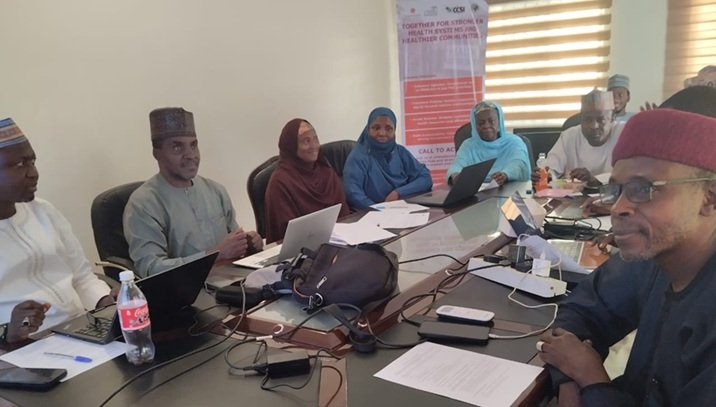
The agreement was reached at KanSLAM’s first bi-monthly meeting supported by CCSI. Participants reviewed funding challenges, budget performance, family planning commodity availability, and strategies for strengthening engagement with relevant government institutions.
The meeting focused on increased budgetary allocations, timely release of approved funds, and effective use of resources to improve healthcare delivery across the state.
It was held under the Advocacy Solutions for Improved PHC Delivery and Outcomes in Kano Project, funded by the Gates Foundation. A consortium led by EngenderHealth implements the project, with CCSI, the International Society of Media and Public Health (ISMPH) and LISDEL as members.
Members of the KanSLAM Executive Committee and CCSI representatives attended.
Participants expressed concern over the slow release of approved health funds. They noted that only a small portion of the Drug Revolving Fund had been released in the first nine months of the year.
The Local Government Area (LGA) Internally Generated Revenue (IGR) contribution to health had not been released at all, and no funds had been released for family planning commodities in about six months.
The meeting stressed the need for consistent availability of family planning commodities across health facilities. It called for closer examination of budget provisions, actual releases, and procurement and distribution arrangements.
Participants named inadequate health sector funding, delayed budget releases, weak implementation and accountability mechanisms, and shortages of essential health commodities as issues requiring urgent advocacy.
They also raised concern over the need for better infrastructure, equipment and human resources at PHC facilities. The meeting noted that budget allocations alone would not guarantee improved healthcare delivery without timely releases and effective use of approved funds.
In his welcome remarks, Atiku Mohammed Yola, CCSI’s Advocacy Coordinator for the project, stressed the need for stronger collaboration between civil society organizations and government institutions to address persistent gaps in health financing and service delivery.
He said effective advocacy must be backed by credible evidence, constructive engagement with policymakers and sustained monitoring of government commitments.
The Secretary of KanSLAM, Nura Haladu, reaffirmed the mechanism’s commitment to accountability in the health sector. He called for a coordinated approach involving the Kano State Government, the State House of Assembly and other health sector stakeholders to address funding gaps.
He urged participants to identify clear priorities and develop practical interventions with measurable outcomes.
To build the evidence base, the meeting agreed to obtain and analyze updated budget performance data. This will cover approved allocations, actual releases, expenditure rates, and funding for PHC services and family planning commodities.
Participants will also gather further evidence on funding and supply gaps to guide engagement with relevant government agencies.
The Kano State Ministry of Health, the State House of Assembly, the Primary Health Care Management Board, the Ministries of Finance and of Budget and Economic Planning, development partners and civil society organizations were identified as key stakeholders for engagement.
KanSLAM and CCSI will coordinate their advocacy messages and build relationships with legislators and government officials able to champion increased health financing.
Participants further agreed to identify advocacy champions from relevant legislative committees, government institutions, civil society organizations, and other influential groups to support policy dialogue, legislative oversight, and stronger budget commitments.
The two partners also agreed to plan their attendance at upcoming technical working group meetings on Reproductive, Maternal, Newborn, Child and Adolescent Health plus Nutrition (RMNCAH+N), Family Planning, and Gender, Youth and Social Inclusion (GYSI).
They will use these platforms to press for increased financing and timely releases.
Among the agreed action points are the collection and review of health sector budget performance data, gathering evidence on family planning commodity availability, and developing a joint advocacy implementation plan.
The partners will also coordinate their participation in the forthcoming health sector coordination meeting, engage relevant government and legislative stakeholders, monitor funding releases and budget implementation, and review progress at subsequent bi-monthly meetings.
Participants resolved to finalize the joint advocacy plan with clear objectives, timelines, responsibilities, and measurable indicators to track progress.
The meeting concluded with a renewed commitment by KanSLAM and CCSI to pursue evidence-based advocacy, strengthen stakeholder engagement, and promote greater accountability in health sector financing and service delivery in Kano State.