23 years after its passage and subsequent domestication across states, policy makers and stakeholders in the child protection space are now galvanizing efforts and expertise towards reviewing the Child Rights Act (CRA).
The objective is to bring the Act up to speed with vast technological shifts, while addressing existing gaps.
The seriousness and urgency of the push for a robust legislation that supports the protection of children and prevent their exploitation by predators, was apparent at the recent National Validation Workshop on the review of the draft bill.
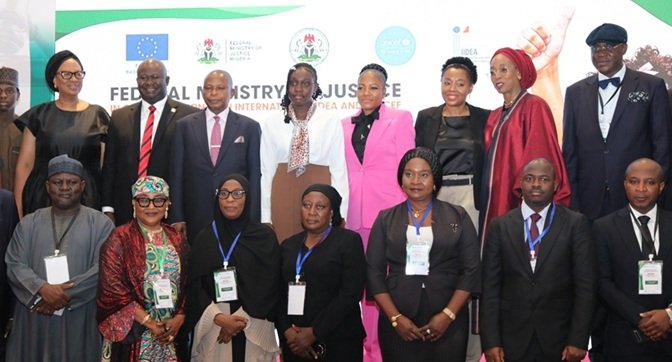
Big wigs in the Federal Ministry of Justice, National Human Rights Commission, civil society and development partners recently gathered in Abuja to provide perspectives and strategies for an effective amendment of the over two decades old law.
The importance of the review process was underscored with the presence of the Attorney-General and Minister of Justice, Chief Lateef Fagbemi (SAN), the representative of the Minister of Women Affairs and Social Development, Imaan Sulaiman-Ibrahim, the Chairperson of the CRA Review Committee, Justice Suzzette Nyesom-Wike and the Director, Administration of Criminal Justice and Reform at the Federal Ministry of Justice, Mrs. Leticia Ayoola-Daniels. Convened by the Federal Ministry of Justice, the review process is being supported by global partners like the International Institute for Democracy and Electoral Assistance (International IDEA) as well as the United Nations Children Fund (UNICEF).
Specifically, review has received insights and inputs from the European Union (EU) Support to End Sexual and Gender-Based Violence (ESGBV) Programme, a four-year programme (2025–2029), funded by the European Union and implemented by International IDEA.
Apparently, the cardinal objectives of the draft CRA bill review align with the goals of the ESGBV program, which seeks to strengthen the prevention of and response to sexual and gender-based violence (SGBV) through legal reform, institutional capacity building, enhanced access to justice and protection services, and positive social norm change.
At the federal level in Nigeria, the programme currently supports efforts to strengthen the implementation, enforcement and monitoring of legal and policy frameworks relevant to SGBV prevention and response.
Apparently, the technical expertise being provided by International IDEA through its ESGBV programme is proving pivotal as the Federal Ministry of Justice undertakes the review of Nigeria’s principal legislation for the protection and promotion of children’s rights and welfare.
Stakeholders have been quite enthusiastic that the review offers an opportunity to address gaps in the legal and institutional response to SGBV involving children, including prevention, protection, reporting, investigation, adjudication, survivor support, rehabilitation and reintegration.
International IDEA has been supporting the review process, including technical assistance to the SGBV Subcommittee by examining the adequacy of the Act’s SGBV-related provisions and developing recommendations for legislative reform.
At the National Validation workshop, which held on November 24, International IDEA’s Head of Nigeria Programmes, Danladi Plang provided an overview of the roadmap for the legal reform.
He said: “We are particularly happy about the efforts being made by the Ministry of Justice to ensure that this law that is more than 20 years old, is reviewed, taken into consideration the realities of our times.
For International IDEA, we are proud to have supported this process, under two of our current programmes; the EU Support to End Sexual and Gender-Based Violence and the Rule of Law and Anti-Corruption (RoLAC) program.
“At International IDEA, our support has been targeted at strengthening the prevention and response to Sexual and Gender-Based Violence against children. We are encouraged that the Committee has included a substantial portion of the recommendations that we have made on this bill.
“As recommended by the Federal Ministry of Justice, this reform extends beyond the creation of offences and contributes to the creation of a comprehensive protection framework, encompassing protection, safeguarding, prevention, reporting, investigation, survivor support, confidentiality, accountability and child friendly justice services.”
Plang further stressed that among the other reforms, the review process has also focused on strengthened protection against sexual offences targeting children in particular.
He noted that there are a few provisions addressing exploitation, grooming, child sexual abuse; and institutional safe guarding obligations for organisations working with children.
Plang listed mandatory reporting mechanisms, protection for those who report, child-friendly investigation procedures, enhanced processes, enhanced access to medical and psycho-social services and medical support for child victims, as some of the other key elements.
“The bill also introduces important safeguards relating to confidentiality, and integrated referral pathways. Particularly significant for us at International IDEA, is the recognition that effective child protection requires more than criminal sanctions.
“The draft bill adopts a holistic approach that strengthens institutional responsibility, mandates safeguarding measures and promotes interagency coordination and provides practical mechanisms for supporting victims.”
Subsequently, the workshop presented findings and recommendations arising from the review, and obtained feedback on proposed amendment provisions.
Apart from the Federal Ministry of Justice officials, Attorney-Generals from States were also on present to provide feedback and declare their support for the review process.
As the consultation process intensifies, the next stage is the legislative process, where lawmakers will call for further inputs through public hearings.