Rekpene Bassey
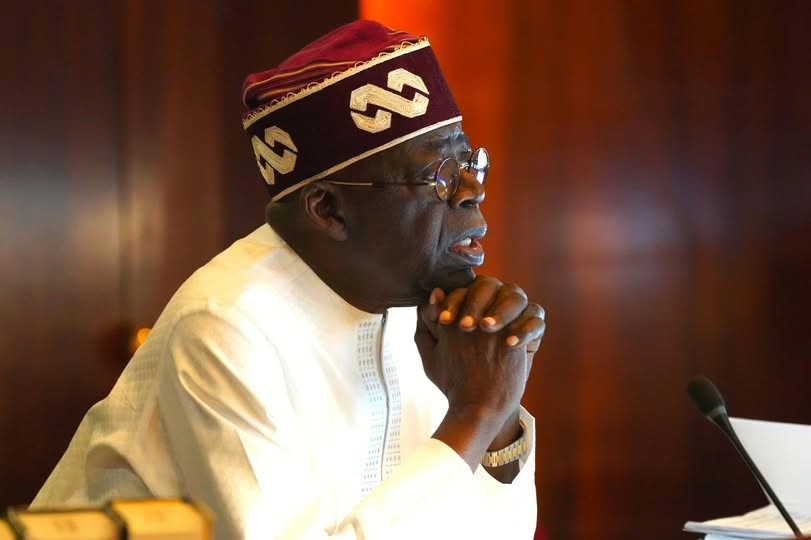
President Bola Ahmed Tinubu’s third anniversary May 29 address was not merely a commemorative speech. It was an argument about suffering.
More precisely, it was an attempt to redefine suffering itself; to persuade Nigerians that the pain they currently endure is not evidence of national decline, but the birth pangs of national recovery.
In moments of deep economic anxiety, governments often become narrators before they become rescuers. They seek first to shape the meaning of hardship before they can successfully overcome it.
Tinubu’s speech belongs squarely within that tradition. It was carefully constructed as both a defence of economic shock therapy and a moral appeal for collective endurance. Its underlying thesis was unmistakable: Nigeria stood dangerously close to fiscal catastrophe in 2023, painful reforms were unavoidable, and history would ultimately vindicate today’s sacrifices.
It is the language of reformist states everywhere. Pain now, prosperity later. Yet beneath the speech’s disciplined optimism lies the defining contradiction of contemporary Nigeria: the widening gulf between macroeconomic recovery and lived human experience.
The President spoke repeatedly of stabilization. Investor confidence is returning, he argued. Public finances are improving. Infrastructure projects are multiplying. The stock market has surged dramatically.
Oil and gas reforms are attracting investment once again. Roads, railways, energy projects, telecom expansion and housing initiatives now form the architecture of what the administration calls “Renewed Hope.”
On paper, many of these claims are valid. Nigeria’s fiscal condition was undeniably deteriorating before the subsidy removal and exchange-rate unification. Fuel subsidies had evolved into a vast and corrosive fiscal black hole; economically irrational, corruption-ridden and structurally unsustainable.
Multiple exchange-rate windows created one of the largest rent-seeking ecosystems in modern Nigerian economic history. In this regard, Tinubu is historically correct: the old system could not continue indefinitely without risking deeper fiscal collapse.
But economics is never merely statistical. Nations do not experience recovery through spreadsheets. Citizens encounter the state through the marketplace, the transport stop, the electricity bill, the school fee invoice and the price of food.
And here lies the administration’s greatest political vulnerability. For millions of Nigerians, the economy today does not feel like recovery. It feels like survival.
The address celebrates macroeconomic stabilization while the social foundations beneath ordinary households remain deeply strained. Inflation has ravaged purchasing power. Food prices have altered consumption patterns across the country.
Protein is increasingly becoming a luxury in many homes. Salaries have collapsed in real value. Small businesses struggle beneath energy costs, currency volatility and declining consumer demand.
The middle class, historically fragile in Nigeria, is shrinking under the weight of prolonged economic pressure.
This is the paradox of Tinubu’s Nigeria: state finances may be recovering while social confidence deteriorates.
In many ways, the speech reflects a broader philosophical tension at the heart of modern governance itself. Every reformist administration eventually confronts the same question: How much suffering can a democratic society absorb in the name of future prosperity?
Technocrats often believe societies behave like economic models; endure temporary pain now and growth will later distribute rewards. But societies are emotional organisms as much as economic ones.
Citizens measure legitimacy not by bond ratings or capital inflows, but by whether life itself feels bearable.
This is why the speech’s most important line may have been its most restrained:
“We have not solved every problem, and we are not yet where we want to be.”
That sentence reveals an administration acutely aware of the dangers of appearing detached from reality. Tinubu wisely avoids triumphalism. Instead, he advances what might be called a transitional narrative; not prosperity yet, but movement toward recovery.
Politically, this is a far more intelligent posture than exaggerated declarations of success. It lowers expectations while preserving credibility. It acknowledges pain without surrendering the reform agenda. Still, the speech underestimates the psychological dimensions of prolonged hardship.
Economic crises do not merely empty pockets; they exhaust emotional reserves. Over time, inflation becomes more than a financial phenomenon. It becomes existential. It alters family structures, delays marriages, fuels migration pressures, deepens cynicism and gradually erodes faith in institutions.
When citizens begin to feel that effort no longer guarantees dignity, societies enter dangerous moral territory. And nowhere is this more consequential than in the relationship between economy and security.
The security section of the speech was notably cautious. Understandably so. Nigeria today faces layered and overlapping crises simultaneously: insurgency in the Northeast, industrial-scale banditry in the Northwest, farmer-herder conflicts across the Middle Belt, kidnapping economies, oil theft networks and rising urban criminality linked increasingly to economic desperation.
The administration insists progress is occurring, and in some respects it is. Military operations have intensified. Certain highways are safer than before. Intelligence coordination appears improved. Investments in surveillance and logistics have expanded.
However, the deeper structural drivers of insecurity remain stubbornly unresolved. Poverty, displacement, state fragility and unemployment continue feeding violence faster than kinetic operations alone can extinguish it.
Banditry in parts of northern Nigeria has evolved beyond ordinary criminality into something closer to alternative governance. Entire communities live under systems of informal taxation imposed by armed groups. Kidnapping has become an economic industry. In such conditions, insecurity ceases to be merely a security problem; it becomes evidence of contested sovereignty.
Tinubu’s speech carefully avoids directly confronting some of the most politically combustible aspects of this crisis; especially resource conflict, ethno-rural tensions and governance failures at subnational levels. This omission is deliberate. Naming such realities too explicitly risks inflaming already volatile national divisions. But avoidance does not dissolve them.
Indeed, one of the speech’s most revealing characteristics is not what it says, but what it leaves unsaid. It says relatively little about inflation’s devastating human consequences. It speaks only cautiously about unemployment. It avoids sustained reflection on institutional distrust, governance opacity and public anger over perceived elite excess amid widespread hardship.
This matters because reform requires moral legitimacy as much as economic logic. Citizens can endure sacrifice when they believe leadership shares in it.
But when austerity appears asymmetrical, harsh for the public and soft for the political class, resentment deepens. Across history, reform collapses not simply because populations reject pain, but because they reject unequal pain.
And yet, despite these vulnerabilities, the speech succeeds strategically in important ways. It restores coherence to the administration’s narrative.
The government now presents a clearer ideological framework: crisis inherited, painful reforms undertaken, stabilization emerging, recovery ahead. It reassures investors that policy continuity remains intact. And perhaps most importantly, it appeals to something profoundly Nigerian; the mythology of endurance.
Tinubu repeatedly invokes sacrifice, resilience, survival and collective destiny because Nigeria itself has long been sustained psychologically by narratives of endurance. Ours is a country perpetually convinced that tomorrow must somehow redeem today. Some kind of emotional assurance.
There is something almost philosophical in this national habit. Nigerians survive conditions that would psychologically fracture many societies because hope here often functions less as optimism than as necessity. But hope is not infinitely renewable.
At some point, reform must become tangible. Citizens must begin to feel improvement not as presidential rhetoric but as lived reality; in cheaper food, stable electricity, safer roads, meaningful employment and restored purchasing power.
Because economies can recover statistically while societies decay emotionally. Markets may rise while despair deepens. Governments may stabilize fiscally while legitimacy weakens socially. Infrastructure may expand while trust contracts.
And in the end, perhaps the greatest danger confronting Nigeria today is not inflation alone, nor insecurity alone, nor even unemployment alone. It is the widening psychological distance between official optimism and ordinary experience.
Tinubu’s challenge now is no longer simply to defend reform. It is to humanize it.
History rarely judges governments solely by whether reforms were economically correct. It judges them by whether citizens survived those reforms with dignity intact.
That is the test before this administration. Let us put it starkly. The burden of hope in Tinubu’s Nigeria is a test far more difficult than balancing a national balance sheet.
Bassey is the President of the African Council on Narcotics and a Security Specialist.