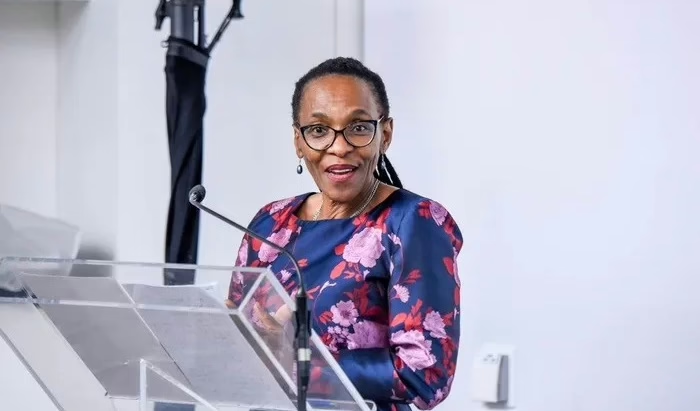
More than three decades into South Africa’s constitutional democracy, Chief Justice Mandisa Maya has warned that the Judiciary remains without full institutional independence, saying fragmented administration, resource constraints and delays in reform implementation are undermining efforts to create a single judicial system.
Speaking at the opening of the 2026 Judiciary Conference in Durban on Tuesday, Maya said the Judiciary had travelled a long road since the advent of democracy and had largely upheld its constitutional responsibilities, but institutional independence remained an unfinished project.
“As we have consistently pointed out over the years, this constitutional guarantee has yet to be realised fully because the South African judiciary enjoys only adjudicative independence and institutional independence remains an unfulfilled goal,” Maya said.
The conference, held under the theme “Towards a Single, Institutionally Independent, and Accountable Judiciary”, is focused on advancing reforms aimed at creating a unified judicial system with greater administrative and operational independence.
Maya said while the Constitution established judicial authority as one institution, the administration of superior courts and magistrates’ courts remained divided.
“We have a constitution that establishes judicial authority as one authority. Yet, in practice, the administration of the superior courts and the magistracy remains fragmented,” she said.
She said achieving a single Judiciary was not about improving the status of judicial officers, but ensuring courts could effectively serve the public.
“The project of a single, institutionally independent and accountable Judiciary is therefore not a project of status. It is a project of constitutional functionality,” Maya said.
Maya warned that courts continued to face challenges including failing infrastructure, inadequate translation services, limited research support, unreliable digital systems, security concerns and administrative structures that made accountability unclear.
She said these problems affected ordinary South Africans who relied on courts to resolve disputes and enforce their rights.
“If courts cannot function effectively, the vindication of rights is delayed, rights are weakened and public confidence in the courts is compromised and the rule of law is weakened,” she said.
Maya said progress had been made towards achieving institutional independence following President Cyril Ramaphosa’s commitment in June 2025 to take steps towards strengthening judicial independence.
She said the first phase of reforms had been completed, with shared and retained services relating to the Superior Courts transferred from the Department of Justice and Constitutional Development to the Office of the Chief Justice on April 1, 2026.
The next phase would involve legislation aimed at achieving full institutional independence and establishing a single Judiciary.
However, Maya said the process had encountered difficulties, with the Judiciary and Executive still needing to agree on the institutional model required to give effect to the reforms.
“The pressing task now, which has unfortunately hit a snag, is to agree on the institutional model and its precise terms to build the institutional, administrative, and financial systems that will give full effect to this independence,” she said.
She said the Department of Justice had indicated that the legislative process would begin in July 2026, with a draft Bill expected to be submitted to Cabinet in the fourth quarter of the 2026/27 financial year.
Maya stressed that judicial independence did not mean the Judiciary should operate without oversight or outside constitutional checks and balances.
“It is not a claim that the Judiciary should operate outside the Constitution’s system of checks and balances, insulated from scrutiny and a state within the State entitled to unlimited resources,” she said.
She said independence and accountability had to work together, warning that public confidence depended on a Judiciary that maintained ethical standards and was able to account for its performance.
“Accountability is not the enemy of independence but the very condition that helps independence gain public trust,” Maya said.
Maya said the Judiciary’s review of the Judicial Code of Conduct and the Norms and Standards for judicial performance was aimed at strengthening accountability while recognising the challenges faced by courts.
“Not every delay is misconduct,” she said, adding that some delays were caused by complex matters, heavy workloads and systemic failures.
However, she warned that repeated and unjustified delays could not become normalised.
“It must be fair to both the judicial officers and the litigants. It must protect independence and protect the public,” Maya said.
She also highlighted the Judiciary’s adoption of a Sexual Harassment Policy in August 2025, saying the institution could not promote constitutional values of dignity and equality without addressing misconduct internally.
“Our judicial system cannot credibly insist on dignity, equality and freedom for its citizens if it has no adequate means to censor humiliation, intimidation, coercion and sexual harassment within its institution,” she said.
Maya said the conference needed to ensure that previous resolutions were translated into action through clear timelines, responsibilities and implementation plans.
She acknowledged that achieving full institutional independence would require careful planning, cooperation and commitment from all stakeholders.
“The to-do list is long and requires the highest level of maturity and painstaking care to fulfil,” Maya said.
She said the ultimate purpose of judicial reform was to ensure that courts remained accessible and effective for the people they served.
“The Constitution does not protect courts as monuments. It protects courts because people need justice,” Maya said.
(IOL Politics)