Yusuf Ishaku Goje
Kaduna State government has commendably been consistent in terms of fiscal transparency by publishing its 2026 approved budget ahead of the 31 January deadline, a timeline originally established by the State Fiscal Transparency, Accountability & Sustainability (SFTAS) program.
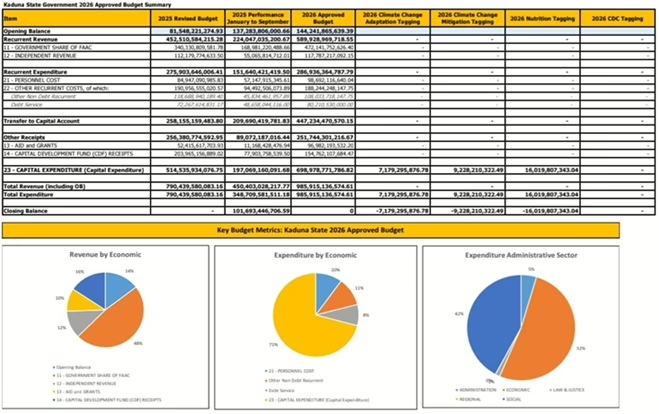
The approved budget stands at a substantial N985.9 billion, with the government allocating N698.9 billion, representing 70.89% of the total, to capital expenditure, leaving just 29.10%, or N286.9 billion, for recurrent costs.
The financial backbone of this ambitious plan remains recurrent revenue, which contributes N589.9 billion to the pot. This figure is heavily underpinned by the Government Share of FAAC, amounting to N472.1 billion, while Internally Generated Revenue (IGR) provides a complementary N117.7 billion, split between tax (N72.4 bn) and non-tax (N24.4 bn) revenues.
Furthermore, the state anticipates other receipts totaling N251.7 billion, made up of N96.9 billion in aid and grants and a significant N154.7 billion from the capital development fund.
Fiscal maneuvering remains a delicate balancing act; the administration intends to service N80.2 billion in debt while simultaneously drawing down N145.7 billion in loans/borrowing.
These borrowings are focused on high-impact infrastructure: the African Development Bank loan for Special Agro-industrial Processing Zones (N28.09bn), the World Bank loan for Rural Access and Agricultural Marketing (N26.8bn), and the AFD loan for Bus Rapid Transit infrastructure (N26.0bn).
Perhaps the most progressive aspect of the 2026 budget is its deepened commitment to participatory governance.
The state has successfully integrated the Community Development Charter (CDC), ensuring that the budget reflects the actual needs of the people rather than just top-down directives. This inclusion is quantified by a N10.5 billion allocation for CDC projects across 255 wards in all 23 Local Government Areas.
Furthermore, the CDC inclusion extends to the agricultural sector, with N12.4 billion set aside for farm inputs and fertilizers under the Sustainable Agricultural Program, alongside about 173 specific CDC projects dedicated to bolstering education and health facilities.
Sectoral allocations further highlight the level of the government’s investment in human capital development.
The education sector has secured the largest share, receiving N243.9 billion, or 24.74% of the total budget. The health sector follows with 14.66% (N144.5 billion), and agriculture with 10.99% (N108.3 billion).
Even the state’s newest Ministry has been integrated into the fiscal framework with an initial allocation of N500.1 million.
When viewed through the lens of economic classification, the priorities become even clearer: the construction of roads takes the lead with N163.3 billion, followed closely by a massive N165.8 billion combined investment in the construction (N86.6 bn)and rehabilitation (N79.0 bn) of public schools, and N71.9 billion for the rehabilitation of healthcare centers.
However, a granular look at the expenditure reveals contrasting priorities that may spark public debate. While the investment in school infrastructure is robust, the budget allocates N4.2 billion for the purchase of teaching and learning aids, a figure dwarfed by the combined N14.7 billion set aside for the purchase of motor vehicles (N8.5bn) and international transport and travel estacodes (N6.2bn).
Geographically, the distribution of funds also highlights disparities. Zone Two is the primary beneficiary with N111.8 billion, significantly outpacing Zone Three (N36.7bn) and Zone One (N28.7bn).
At the local government level, Kaduna North leads with N55.1 billion, whereas Kaura Local Government is allocated a meager N412.5 million.
Most notably, a massive N808.6 billion is categorized under state-wide expenditure, a broad classification that covers the majority of the capital projects.
In conclusion, the Kaduna State 2026 budget is a mathematically impressive document that heavily favors capital infrastructure and human development sectors like education and health.
The timely publication and the significant ratio of capital to recurrent expenditure are strong indicators of a government intent on rapid development.
However, the true measure of this budget’s success will lie in the equitable execution of projects across all zones and the prudent management of the massive “state-wide” allocation.
If the government can match its spending on physical infrastructure with equal dedication to equipping those facilities and balancing regional disparities, this budget could indeed serve as a transformative blueprint for the state.
Goje is an active citizen, civil society member and OGP enthusiast