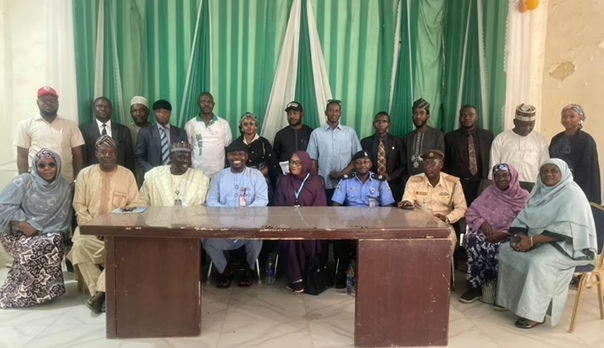
Stakeholders in Kano State have called for the urgent establishment of a legal and regulatory framework to govern real estate activities, warning that unregulated property transactions are fueling insecurity across communities.
The call formed part of a communiqué issued at the end of a recent one-day roundtable discussion on “Strengthening Community Security Through Regulation of Real Estate and House Agents in Kano State.”
The communiqué, issued at the end of a one-day roundtable, was signed by Comrade Muhammad Sani Garba, Lead Convener and Executive Director of the Know Your Neighbor Community Development Initiative (KYNCDI).
The forum brought together representatives of security agencies, community leaders, legal practitioners, real estate professionals, and relevant government institutions.
Participants said the meeting was convened in response to growing concerns over security challenges linked to the unchecked buying, selling, and renting of properties in the state.
According to the communiqué, stakeholders identified the absence of a comprehensive legal and regulatory framework as a major factor undermining effective property management and oversight.
They noted that houses, shops, and other premises are frequently rented or sold without proper identification of occupants, credible guarantors, or verifiable documentation, making it difficult for authorities to monitor residents or trace individuals when necessary.
The participants warned that such anonymity has inadvertently provided safe havens for criminal elements, worsening insecurity in many communities.
They also highlighted weak coordination among real estate practitioners, community leaders, and security agencies, as well as the lack of standardized and enforceable practices in the sector.
To address the challenges, stakeholders resolved that a comprehensive legal and institutional framework should be developed to regulate real estate and house agents in Kano State.
They recommended mandatory registration and licensing of all practitioners under a designated regulatory authority, with annual renewal of licences and operation from identifiable office locations.
The communiqué further called for compulsory documentation in all property transactions, including valid identification, passport photographs, and verifiable guarantor details of all parties involved.
Other proposals include the creation of a centralized, secure, and digitized database for tenants, landlords, buyers, sellers, and agents, accessible to authorized agencies, as well as the introduction of strict sanctions, ranging from fines to prosecution, for non-compliance.
Participants also stressed the need for stronger collaboration among stakeholders, the promotion of the “Know Your Neighbor” principle to enhance community-based intelligence, and continuous training and public awareness campaigns for real estate practitioners and citizens.
They urged the adoption of technology-driven solutions such as biometric verification and digital platforms to improve transparency and efficiency in property transactions.
The stakeholders urged the Kano State Government to urgently initiate the drafting and enactment of laws regulating real estate and house agents, and to establish or designate a regulatory body to oversee implementation and enforcement.
They also called for collaboration among relevant ministries, departments, and agencies to integrate the proposed framework into existing governance and security systems, while empowering traditional institutions, civil society organisations, and community groups to support local monitoring and reporting.
Real estate practitioners were equally advised to develop and enforce ethical standards within the profession.
In conclusion, participants reaffirmed their commitment to supporting the development and implementation of a robust regulatory framework aimed at improving transparency, accountability, and security in property transactions.
They expressed confidence that the proposed measures would enhance crime prevention, strengthen intelligence gathering, and promote safer communities across Kano State.