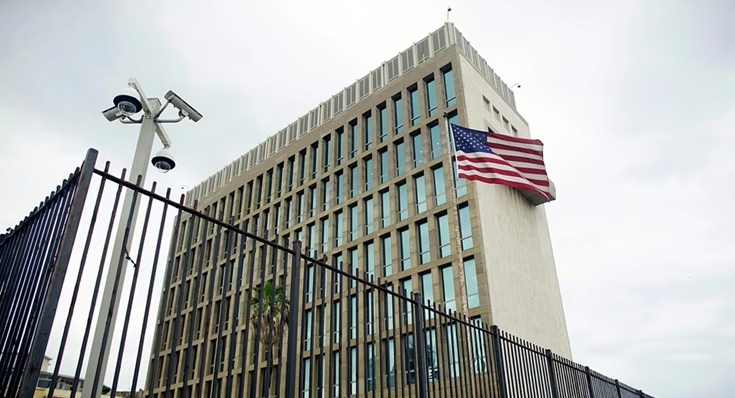
The U.S. Embassy in Paris issued a security alert on Monday, urging Americans to avoid demonstrations in France as recent protests turned violent, and warned that scattered protests could continue even with local curfews.
“Following the October 17 protests that turned violent, media report the Prime Minister’s office introduced partial curfews for Monday, October 19 and Tuesday, October 20 in several cities across France, including Lille,” it said.
“Media report more curfews may follow for parts of Paris and in prefectures across the country, and that scattered protests could continue,” the U.S. Embassy added.
The alert urged travelers to avoid demonstrations and exercise caution near large gatherings.
It also advised checking Paris transit operator RATP for Paris Metro station closures and other transit disruptions, confirming flight schedules with carriers, and monitoring local news and resources for curfew updates.
The embassy recommended the following English-language news outlets: France 24, Radio France Internationale, and The Local. If traveling, it advised planning alternative routes and allowing extra travel time.
The U.S. security alert followed violence and looting during the 17 October 2026 demonstrations. Paris authorities said rioters endangered lives, vandalized businesses, and damaged public spaces across several neighborhoods.
Mayor Emmanuel Grégoire condemned the destruction, saying it undermined the right to demonstrate and hurt shopkeepers and their employees.
“I want to express my deep anger and strongest condemnation of the scenes of violence and looting we witnessed today in the streets of Paris. Nothing, absolutely nothing, can justify endangering lives, ransacking businesses, or destroying public property,” Grégoire said.
Prime Minister Sébastien Lecornu said on 19 October 2026 that far-left groups were seeking to organize further disorder, citing intelligence briefings.
“It’s now clear that we have a far-left movement that wants to create chaos, to say the least, profound chaos in the country leading up to the presidential election,” Lecornu said, adding: “There’s a whole network that could even be mobilized to challenge the very timing of the presidential election and the holding of the presidential election itself.”
The demonstrations were described as protests against the cost of living and gasoline prices. The General Confederation of Labor (CGT) estimated 800,000 people demonstrated.
The labor federation supported the Oct. 17 demonstrations, citing stagnant wages, rising expenses, and government budget decisions. It also said students were demanding better education and equal opportunities.
Before departing the White House for Kansas on Oct. 19, President Donald Trump told reporters that immigration was responsible for the unrest in France.
“They let people into their country that don’t love their country. They don’t love their buildings. They don’t love their art,” he said.
“What’s happening in France has to do with immigration. Not schools, not anything,” Trump added. “It’s immigration.”
Trump said he had urged Macron during his first term to close France’s borders.
In his Oct. 18 address, French President Emmanuel Macron urged political parties, professional organizations, and labor unions to “unequivocally condemn all violence and call for calm,” according to a translation of his speech.
“Those who destroyed must pay, those who looted must repay, and those who sought to bring down the Republic will have to answer for it,” he said.
Macron blamed the destruction on “seditious elements from ultra-left splinter groups, joined by many criminals,” and singled out the burning of Limoges Town Hall.
He also said students, teachers, employer groups, unions, and elected representatives would work with the government that week on proposals to address young people’s concerns.
Protests also took place in Belgium, Portugal, and Italy amid rising living costs. In Albania, protesters rallied against perceived government corruption, job shortages, and poor education standards. Spain has also seen demonstrations over housing costs.
(NTD)