Isiyaku Ahmed
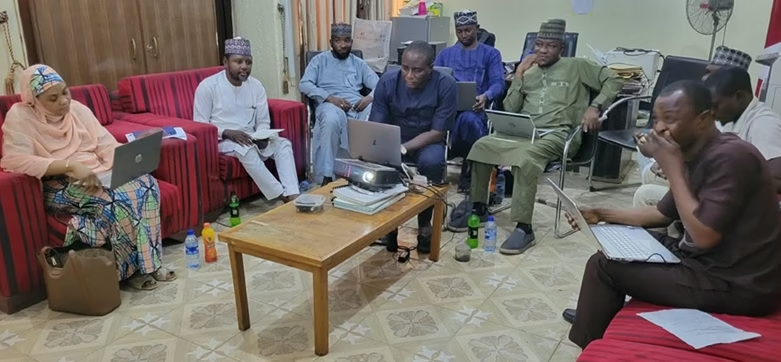
The Kano State Government, through the Office of the Auditor-General, has commenced a two-day technical session to validate and develop the 2025 Citizens’ Accountability Report (CAR).
The session, which began on Monday at Al-Ihsan Hotel, Kaduna, is aimed at strengthening transparency, citizens’ participation, and accountability in the management of public resources.
The CAR is a key public financial management reform under the World Bank-supported State Fiscal Transparency, Accountability and Sustainability (SFTAS) program.
It provides simplified summaries of the state’s audited financial statements, using graphics and tables to make financial information easier for citizens to understand.
Declaring the validation and publication exercise open, the Auditor-General for Kano State, Mallam Rabi’u Yusuf, called for greater transparency, accountability and citizens’ participation in the management of public resources.
Mallam Yusuf described the CAR as an important tool for helping citizens understand how public funds are planned, received and utilized, while also providing a platform for government institutions, civil society organizations and citizens to engage on public financial management and service delivery.
He said the validation exercise would enable stakeholders to scrutinize the information in the report, make observations and ensure that the final document is accurate, relevant and accessible to the people of Kano State.
The AuG commended ministries, departments and agencies that contributed to the report’s preparation, and representatives of civil society organizations and academia, for their continued interest in promoting openness, accountability and citizens’ participation in governance.
He also acknowledged the contributions of the Office of the Accountant-General, Ministry of Finance and Economic Development, Ministry of Planning and Budget, Ministry of Public Procurement, and the Kano State Internal Revenue Service (KIRS).
The AuG particularly commended the directors and staff of the Office of the Auditor-General for their dedication and professional contributions to preparing the report.
He expressed appreciation to Governor Abba Kabir Yusuf for providing the necessary financial support for the successful implementation of the exercise, saying the gesture demonstrated the government’s commitment to transparency, accountability and responsible management of public resources.
Mallam Yusuf also appreciated the Speaker of the Kano State House of Assembly and members of the legislature, particularly the Public Accounts Committee, for their support to the Office of the Auditor-General.
He urged participants at the validation exercise to approach the process with openness and constructive engagement, stressing that the collective objective was to ensure that the final report was credible, accessible and useful to the people of the state.
The AuG reaffirmed the commitment of his office to working with relevant stakeholders to strengthen accountability and public confidence in the management of public resources.
He subsequently declared the validation and publication exercise of the Kano State Citizens Accountability Report for 2025 officially opened.
A civil society advocate, Akibu Hamisu, has highlighted the importance of the Citizens’ Accountability Report (CAR) as a tool for tracking how public funds are generated, allocated and utilized.
Hamisu said the report provides an opportunity to monitor citizen-nominated projects and promote greater accountability in implementing government budgets.
He called for broader stakeholder participation during the final presentation of the CAR, urging relevant authorities to take corrective measures where unaccounted expenditure is identified.
Hamisu also commended the Office of the Auditor-General for its continued efforts to sustain the CAR process and promote fiscal transparency in the state.
Participants at the technical session included officials from the Auditor-General for Local Government Audit, the Ministry of Finance and Economic Development, the Ministry of Planning and Budget, and the Kano State Internal Revenue Service (KIRS).
Others included representatives of the Ministry of Procurement, Project Monitoring and Evaluation, the Focal Person on Public Financial Management (PFM) Reforms, civil society organizations, members of the civil society organizations, directors and technical staff of the Office of the Auditor-General.
The session is expected to culminate in the production of a validated CAR that will enhance public understanding of government finances, strengthen confidence in public spending, and promote a culture of fiscal transparency and accountability across Kano State.