Patience Robinson, Kaduna
The Kaduna State Government has achieved a milestone in its effort to eradicate educational exclusion, confirming that over 36,000 out-of-school children have now been successfully restored to formal schools across the state under the Reaching Out-of-School Children (ROOSC) Project.
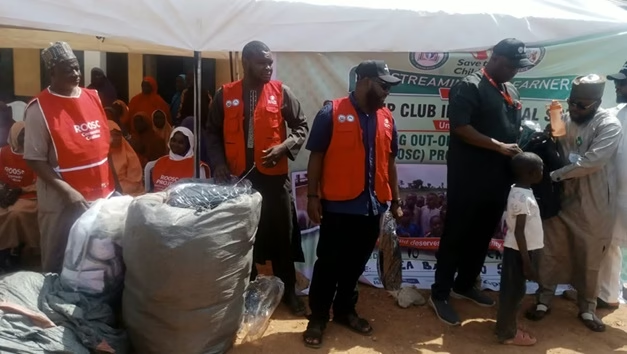
The announcement was made at LGEA Primary School, Babban Saura, during a ceremony to mark the official mainstreaming of a fresh cohort of over 15,000 learners into formal primary classrooms across 14 local government areas (LGAs).
Speaking at the event, Ezra Angai, the Coordinator for the Kaduna State ROOSC Project, said that the mainstreaming exercise brings the total number of children successfully restored to learning pathways under the current administration to over 36,000.
He disclosed that, Governor Uba Sani had tasked the team to return 100,000 out-of-school children back to school, and as result of the four year objective, over 36,000 children have been mainstreamed across different learning pathways.
Angai explained that the state achieved these results through data-driven strategies rather than guesswork, noting that initial mapping identified 187,719 out-of-school children across 360,000 households.
To bridge the learning gap before formal enrollment, the project established Catch-Up Clubs (CuC), three-month remedial program implemented with support from Save the Children International as a technical partner.
The CuC framework evaluates the foundational literacy and numeracy levels of ach child, ensuring appropriate placement from Primary One upward, while alternative pathways like radio learning and integration with Alaramas and Tsangaya traditional schools reach remote communities.
Reiterating the state’s commitment, Dr. Mubarak Muhammad, Executive Chairman of the Kaduna State Universal Basic Education Board (SUBEB), emphasized that the initiative aligns with the Governor’s declaration of a state of emergency on education in 2023, when out-of-school figures surpassed 535,000.
“What we have witnessed today is part of an ongoing statewide effort. The government has provided learning kits as motivation for these young learners, and we will continue expanding classroom infrastructure, building teacher capacity, and fostering a conducive learning environment for better learning outcomes across the state,” Dr. Mubarak noted, adding that SUBEB was actively conducting monitoring exercises.
To facilitate a seamless transition into formal education, Save the Children International managed the remedial preparation and physical integration process. Emmanuel Mbrusa, Project Director for Save the Children’s ROOSC Project, explained their role in handing over the prepared cohorts directly to local school administrators and Education Secretaries to ensure long-term retention and tracking.
The mainstreaming event drew widespread commendation from school leaders, parents, and community custodians, alongside calls for expanding infrastructure to accommodate the surging enrollment.
The Head Teacher of the School, Rabi’atu Yahya Abdullahi, expressed gratitude to SUBEB and SCI for bringing neighborhood children off the streets and back into classrooms.
However, she appealed for urgent infrastructural support, noting that the school which was established in 1976, currently serves 2,005 learners with only 12 functional classrooms and requires perimeter fencing.
Similarly, the District Head of Baban Saura, Dauda Hashimu, appreciated the Kaduna State Government and partner organizations for prioritizing local youth, pointing out that the school grounds possess ample land for constructing additional blocks of classrooms.
Parents of the newly enrolled pupils, Jummai Adamu and Samaila Musa, applauded the ROOSC initiative, the government, and donor partners for empowering vulnerable children and offering them a foundation for a brighter future.
The ROOSC Project is sustained through a multi-partner funding coalition comprising the Islamic Development Bank (IsDB), the Kuwait Fund for Arab Economic Development, Education Above All (EAA), the Global Partnership for Education (GPE), Save the Children International, and UNICEF.