Isiyaku Ahmed
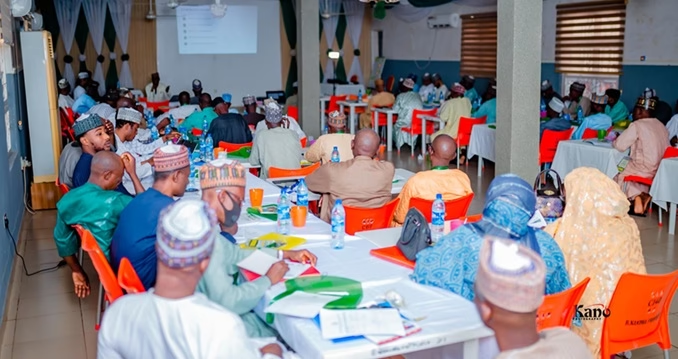
The Kano State Debt Management Office (KSDMO) has commenced a two-day capacity-building workshop aimed at operationalizing Debt Management Offices across the state’s 44 Local Government Areas (LGAs) to promote transparency, accountability and sustainable public debt management.
The training, held on Saturday and Sunday in Dutse, Jigawa State, was designed to equip designated local government debt management officers with the knowledge, skills and practical tools needed to effectively identify, document, monitor and report debt obligations in their respective councils.
The initiative is also expected to improve compliance with the Kano State Debt Management Law, strengthen debt data management and digitalization, promote ethical conduct and transparency, and establish a coordinated framework for effective debt governance at the grassroots.
In his opening remarks, the Director-General (DG) of the KSDMO, Dr Hamisu Sadi Ali, said the program was aimed at making the debt management offices at the local government level functional and capable of supporting sustainable public debt governance.
Ali recalled that the Kano State Government established Debt Liaison Offices in all 44 local government areas in January 2025 as part of measures to strengthen debt governance and improve financial management at the grassroots.
He said the recommendations in the report and communiqué from the 2025 exercise included the need for an annual capacity-building program for officials in the 44 local government debt offices.
“The current workshop is therefore a follow-up to that commitment, providing an opportunity to assess progress, identify implementation challenges and develop practical solutions to improve debt management at the local government level,” he said.
The KSDMO boss stressed that establishing the offices was only the beginning, noting that their effectiveness would depend largely on the competence, professionalism and commitment of the officers entrusted with their responsibilities.
He said participants would deliberate on fiscal federalism, the structure and governance of debt management offices, ethics and professional conduct, compliance with the Kano State Debt Management Law, digital debt reporting, project appraisal, debt transparency and accountability, financing instruments and performance monitoring.
According to him, the participants would also assess the establishment and performance of the 44 local government debt offices, document achievements and challenges, draw lessons from their experiences and develop a 2026–2028 roadmap for strengthening their operations.
Ali urged the participants to use the workshop as an opportunity for honest assessment, knowledge sharing and practical problem-solving.
“Effective debt management depends on the quality of information generated, professionalism of officers, compliance with applicable laws and regulations, transparency and accountability in borrowing decisions, as well as effective monitoring of debt obligations,” he said.
He encouraged the participants to actively engage the resource persons, ask questions and share experiences from their respective local government areas so that the workshop could produce practical solutions capable of being implemented beyond the training room.
In a goodwill message, the Commissioner for Local Government and Chieftaincy Affairs, Hon. Mohammed Tajo Othman, represented by the Director of Administration and General Services, Sani Alhassa, said functional Local Government Debt Management Offices would strengthen financial stability, transparency and accountability at the grassroots.
Othman said sound debt management was essential to preserving the financial credibility and capacity of local governments to deliver meaningful development to citizens.
He explained that properly functioning debt offices would enhance the identification, documentation, monitoring and management of existing and emerging debt obligations while promoting fiscal discipline and responsible use of public resources.
The Commissioner urged designated Debt Management Officers to actively participate in the sessions, share experiences and acquire practical knowledge that could be applied to the financial management challenges confronting their respective councils.
He assured the participants that the ministry remained committed to strengthening the local government financial management system and promoting responsible management of public resources for sustainable grassroots development.
Isiyaku Ahmed, the Executive Director of the Community Initiative for Climate Engagement and Development (CICEND), representing civil society organizations, commended the Kano State Debt Management Office (KSDMO) for organizing the capacity-building workshop for state debt officers.
“This training will significantly enhance the participants’ knowledge and skills in debt management, transparency, and accountability,” Ahmed stated.
He urged the participants to apply their newly acquired knowledge to their daily responsibilities to improve public debt management and service delivery.
Ahmed added that civil society organizations remain deeply committed to supporting initiatives that promote the responsible management of public resources.
Also speaking, the Head of the Kano State Civil Service, Hajiya Bilkisu Shehu Maimota, represented by the Permanent Secretary, Establishment, Abba Adamu Danguguwa, commended the KSDMO for extending capacity-building initiatives to the local government level.
She described the workshop as an important step towards strengthening the capacity of public servants and improving service delivery.
Hajia Maimota observed that although Kano State had several laws, policies and institutions governing public administration, some of the relevant frameworks had not been adequately localized at the local government level.
She identified the gap as a challenge that could affect effective implementation and service delivery, stressing the need to equip civil servants with relevant knowledge and skills continuously.
“I am particularly pleased with the initiative because of the need to continually equip civil servants with relevant knowledge and skills to meet the changing demands of public administration,” she said.
Hajia Maimota also commended the KSDMO for engaging resource persons from outside the state, saying exposure to wider professional experiences and expertise would enrich participants’ understanding of debt management.
The HoS urged participants to take full advantage of the two-day program by asking questions, sharing practical experiences and engaging resource persons on challenges encountered in their respective local government areas.
She then declared the workshop opened.
The workshop is expected to conclude with participants having a clearer understanding of their institutional responsibilities and improved capacity in debt reporting, transparency, risk management, compliance and sustainable financing.
Beyond the technical sessions, the program provides an opportunity for officers from the 44 LGAs to compare experiences and identify common challenges affecting debt documentation, reporting and monitoring.