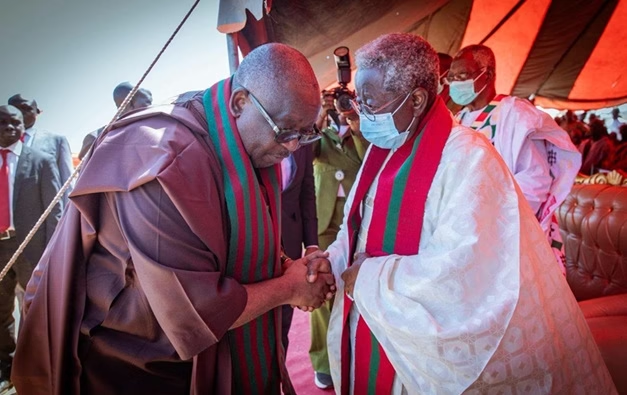
Plateau State Governor, Caleb Manasseh Mutfwang, has reaffirmed his administration’s commitment to restoring peace in Berom communities, facilitating the return of internally displaced persons (IDPs) to their ancestral homes and accelerating infrastructure development across the area.
He pledged on Sunday at the 2026 WUSAL BEROM Annual Fellowship held at the WUSAL BEROM Prayer Ground, Vwei, Mararaban Jama’a, in Jos South Local Government Area.
Speaking on the theme, “Vog Yei Ting” (Be Strong in Heart), Mutfwang acknowledged the security challenges confronting Berom communities and commended the resilience of residents, particularly youths under the Berom Youth Moulders-Association, for their efforts to protect their communities.
He also sympathised with families who had suffered losses from persistent attacks, particularly widows, and called for unity, patience and sustained support for government efforts to tackle insecurity.
The governor maintained that the crisis should not be given a religious interpretation, insisting that it was a matter of criminality and terrorism.
“What we are dealing with is criminality and terrorism, and we will continue to deal with it as such,” he declared.
He warned against cattle rustling and other criminal activities capable of worsening insecurity, assuring that those involved would be brought to justice irrespective of their positions or affiliations.
On security, Mutfwang disclosed that an additional 1,000 Plateau indigenes were undergoing training at Shere Hills as forest guards following approval by President Bola Ahmed Tinubu.
He said the personnel would be deployed to their respective communities after training to strengthen local security and protect vulnerable settlements.
Addressing the resettlement of displaced persons, the governor said the Ministry of Humanitarian Affairs and Poverty Alleviation had commenced consultations with local government chairmen in affected areas to identify at least one community in each local government area for the initial phase of the return programme.
He, however, stressed that government would not encourage the return of displaced persons to communities where their lives remained at risk.
In a major intervention for vulnerable women, Mutfwang announced a proposed allocation of N10 million to each of the 13 districts in Berom land to support widows affected by insecurity.
He said a committee to be chaired by Ngo Sarah Ochekpe would oversee the initiative, describing the allocation as seed funding that could attract additional support depending on its impact.
The Governor also provided an update on the distribution of the ₦1.5 billion intervention jointly provided by Nigeria’s First Lady, Senator Oluremi Tinubu, and the Plateau State Government for victims of insecurity.
According to him, the first phase of the distribution had commenced, with affected households in Riyom, Barkin Ladi, Mangu and Bokkos already receiving assistance, while the remaining funds would be extended to other deserving communities.
On infrastructure, Mutfwang disclosed that more than 11 road projects were ongoing across Berom land, adding that he had signed at least 10 certificates to facilitate the return of contractors to construction sites and accelerate work following delays caused by the rainy season.
He further revealed that President Tinubu had approved the reconstruction and dualisation of the Zawan Junction–Shendam Road.
The Governor said the contractor had been nominated, while the design and procurement processes were being awaited.
He also announced that work had commenced on the Akwanga–Jos road project, explaining that upon reaching Jos, the road would connect through Bisichi and the Dogonahawa axis towards Jos East and the Bauchi Road corridor.
Mutfwang described the projects as important opportunities for improved connectivity and economic development.
On the Greater Jos Master Plan, which covers substantial parts of Berom land, the governor assured residents that the development initiative was not intended to impoverish them.
He said affected communities would be introduced to improved agricultural methods requiring less land while offering higher productivity and better economic opportunities.
He appealed to community leaders and traditional rulers to support the development process and encourage peaceful engagement with residents.
The Governor also directed the relevant committee, through Engineer Eugenia Davo, to prepare the design and proposal for an access road leading to the WUSAL BEROM Prayer Ground, expressing optimism that the venue would have a more befitting appearance by the next annual fellowship.
Mutfwang commended the Berom Bible Translation Trust for completing the translation of the Bible into the Berom language, describing the achievement as a milestone for the ethnic nationality.
He recalled accompanying the Gbong Gwom Jos, His Majesty Da Dr. Jacob Gyang Buba, to London the previous year to deposit a copy of the translated Bible in the library of Bibles.
The governor also urged parents and community leaders to intensify efforts to tackle drug abuse among youths, calling on mothers to combine prayers with lawful community action to protect their children from substance abuse.
He appreciated the Berom Nation for supporting his administration and called for greater unity among political, traditional and community leaders, stressing that collective responsibility was essential for the development of Berom land and Plateau State.
Earlier, the Senator representing Plateau North, Pam Mwadkon Dachungyang, acknowledged the challenges confronting the people, particularly insecurity and economic hardship.
He appealed to constituents to continue praying and supporting their leaders, assuring them of his commitment to effective representation.
In his welcome address, Chairman of the 2026 WUSAL BEROM Planning Committee, Rev. Dr. Daniel Saje, described the annual fellowship as a sacred gathering that brings Berom sons and daughters together to worship in their indigenous language, promote unity, and support Bible translation across denominational lines.
He said the theme, “Vog Yei Ting,” called for courage, spiritual strength and positive influence in families and communities, particularly at a time when the Berom Nation was facing significant challenges.
The fellowship attracted traditional rulers, religious leaders, political office holders, elders, youths and other Berom stakeholders, with discussions centred on worship, cultural preservation, unity and the advancement of Bible translation work.