Musa Na Allah, Sokoto
Religious tension has mounted in Sokoto State following alleged controversial remarks by Sheikh Musa Ayuba Lukuwa concerning the biological parents of Prophet Muhammad (SAW), as a coalition of Islamic organisations and concerned citizens has demanded that the cleric be investigated and prosecuted if found to have violated the law.
The controversy has generated widespread debate across religious, social and community circles, with petitions reportedly submitted by several Islamic groups, including descendants of Sheikh Usmanu bin Fodio, Ansar under the leadership of Sarkin Kudun Dange, Saidu Ahmad Muhammad, the National Chairman Council of Sufism in Nigeria led by Professor Abubakar Abubakar Yagawal, and Concerned Citizen/Human Rights Advocate, Comrade Husaini Muhammad Gwadabawa.
The development has assumed considerable significance in Sokoto, a city deeply associated with the intellectual and spiritual legacy of Sheikh Usmanu bin Fodio and the Islamic scholarship that has profoundly influenced religious thought across Nigeria and the wider West African sub-region.
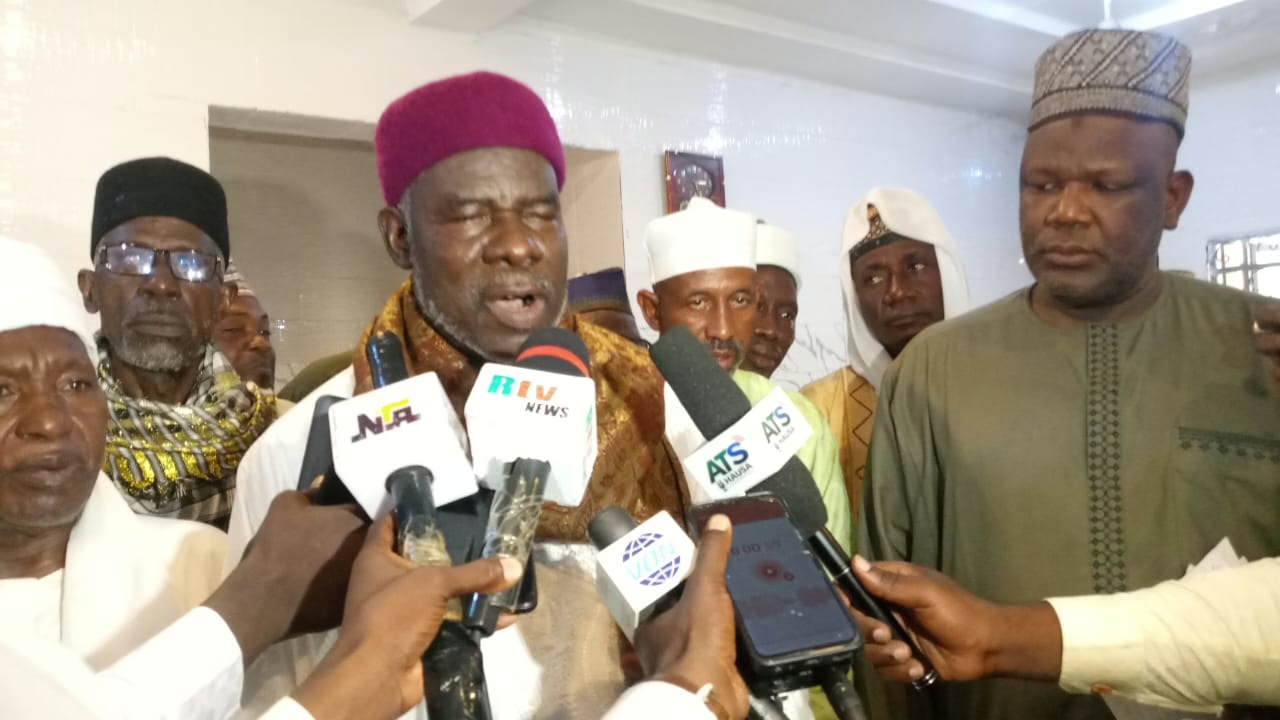
Addressing a press conference in Sokoto on Monday, the National Council of Sufism in Nigeria, comprising adherents of the Tijjaniyya and Qadiriyya traditions, condemned what it described as the alleged offensive remarks, insisting that the honour and sanctity of Prophet Muhammad (SAW) occupy an inviolable position in the faith of Muslims.
The council said its members were prepared to make considerable sacrifices in defence of the honour of the Messenger of Allah, but emphasised that any response to the controversy must be pursued strictly through lawful and constitutional channels.
It consequently called on the Federal Government, Sokoto State Government and relevant security agencies to conduct a thorough investigation into the allegations and, where sufficient evidence exists, ensure that Sheikh Lukuwa is brought before a competent court to face the appropriate legal process.
The council warned that religious tolerance should not be misconstrued as a licence for individuals to make pronouncements capable of provoking religious sentiments, inflaming passions or undermining matters regarded as sacred by millions of Muslims.
It also urged security agencies to handle the matter with firmness, professionalism and impartiality, stressing that highly sensitive religious disputes must be subjected to established legal mechanisms rather than allowed to degenerate into confrontation or disorder.
The Islamic organisations further appealed to Muslim scholars, traditional rulers, community leaders and the general public to exercise maximum restraint, arguing that differences in theological interpretation should be resolved through scholarship, dialogue and the courts rather than through street action.
The controversy has simultaneously reignited concerns over the responsibilities of religious leaders in an era in which sermons and religious pronouncements can be instantly disseminated through social media, potentially transforming a local dispute into a national or international religious controversy within hours.
For the descendants of Sheikh Usmanu bin Fodio and the other organisations supporting the petition, the issue goes beyond an ordinary theological disagreement, touching upon what they consider the dignity, honour and sanctity of Prophet Muhammad (SAW).
They stressed that their demand was not for mob justice, intimidation or extrajudicial punishment, but for accountability, due process and the application of the law if competent authorities establish that an offence has been committed.
The organisations therefore called on Muslims across the state and beyond to remain calm and refrain from actions capable of worsening the situation, while challenging government and law-enforcement authorities to demonstrate that even the most emotionally charged religious disputes can be resolved through justice, transparency and the rule of law.
As reactions continue to reverberate across Sokoto and beyond, attention is now turning to the relevant authorities and legal institutions to establish the facts surrounding the allegations and determine whether the statements attributed to Sheikh Lukuwa amount to an offence under applicable Nigerian law.
The unfolding controversy has once again thrust Sokoto into the centre of a sensitive national debate over the responsibilities of religious authorities, the limits of public speech, religious sensitivities and the imperative of maintaining public order in a pluralistic society.
For many of the groups involved, the immediate demand remains unequivocal: investigate the allegations, establish the facts and, where the law is found to have been breached, allow the courts to determine the appropriate course of action.