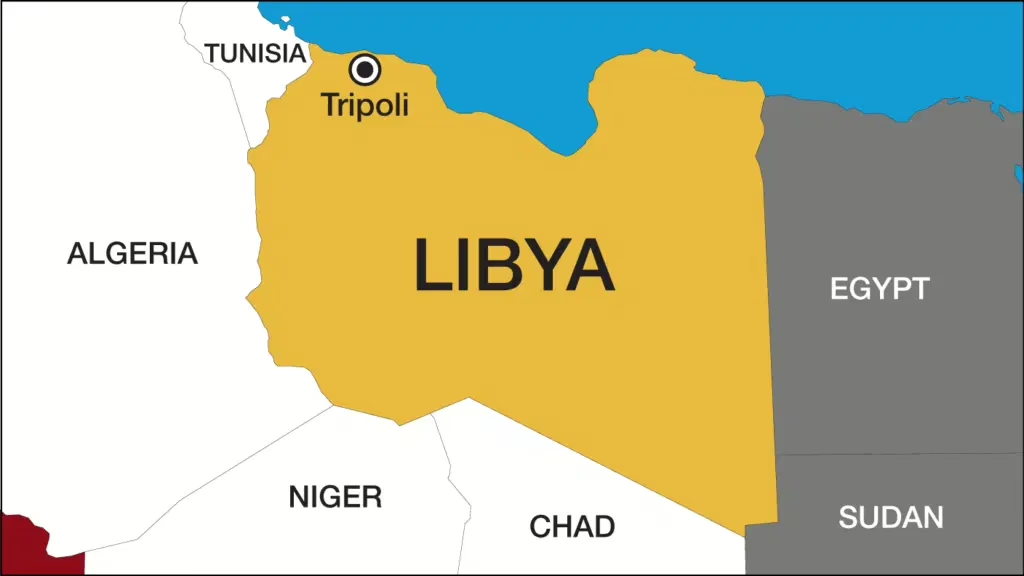
A South Africa-based human rights organization has called on Libyan authorities to release Sudanese nationals held in arbitrary detention and dismantle trafficking and extortion networks targeting refugees fleeing Sudan’s war, according to a statement extended to Sudans Post.
The Human Rights Association (HRA), an initiative of the WeCare Foundation in Cape Town, said Sudanese refugees in Libya are facing widespread abuses including arbitrary detention, forced labor, sexual violence and extortion amid a worsening humanitarian crisis linked to Sudan’s ongoing conflict.
“Sudanese refugees are arriving in Libya after surviving a war that has killed thousands and displaced millions,” HRA Chairman Saad Kassis-Mohamed said. “Once they arrive, they face arbitrary arrest, detention without charge, forced labour, extortion, and sexual violence.”
The group urged Libyan authorities to cooperate with the United Nations in protecting Sudanese refugees and facilitating voluntary repatriation or resettlement for those unable to return home safely.
The statement comes amid growing international concern over the treatment of migrants and refugees in Libya, which has become a major transit point for people fleeing conflict and poverty across Africa and attempting to reach Europe through the Mediterranean.
According to the United Nations refugee agency (UNHCR), more than 240,000 Sudanese refugees have arrived in Libya since the outbreak of war in Sudan in April 2023, many entering through the southeastern border region of Alkufra.
UNHCR said more than 86,000 Sudanese refugees had been formally registered in Libya as of November 2025.
Reports by the UN Office of the High Commissioner for Human Rights (OHCHR) and the United Nations Support Mission in Libya (UNSMIL) have documented what the agencies described as a “a brutal and normalized reality” targeting migrants, asylum seekers and refugees across Libya.
“The OHCHR and UNSMIL have described what is happening in Libya as a violent and normalized business model,” Kassis-Mohamed said. “The HRA calls on the Libyan authorities to dismantle that business model, to release every Sudanese national held against their will.”
The joint report, published in February 2026 and based on interviews with nearly 100 individuals from 16 countries, documented arbitrary detention, torture, trafficking, forced labor, sexual violence and extortion carried out by armed groups and criminal networks operating inside Libya.
Sudanese refugees were identified among the groups most severely affected.
The report said four Sudanese girls aged between 12 and 17 reported attempted rape in Tripoli and Bir al-Ghanam, while Sudanese women interviewed in UNHCR focus groups described harassment, discrimination, and unpaid labor.
UN agencies have also reported that Sudanese refugees intercepted at sea while attempting to reach Europe are often forcibly returned to Libya, where many face renewed detention and abuse.
“Sudanese girls aged twelve have been subjected to attempted rape in Tripoli,” Kassis-Mohamed said. “These are not isolated incidents.”
In June 2025, Libyan authorities announced the rescue of around 1,300 Sudanese migrants stranded near the tri-border region after days in desert conditions with limited access to food and water. Separate reports indicated that eastern Libyan authorities deported around 700 Sudanese migrants during the same year.
The HRA statement further alleged that some Sudanese refugees holding valid UNHCR registration documents had been detained in Libya and that their documents were deliberately destroyed by guards or detaining authorities.
“Their registration cards are taken and deliberately destroyed by the guards who detain them,” Kassis-Mohamed said. “The HRA calls on the Libyan authorities to cooperate fully with the United Nations in ensuring that those who cannot return home can reach safety.”
UN assessments have repeatedly described detention conditions in Libya as overcrowded and lacking adequate medical care, with reports of disappearances, extortion, and deaths linked to untreated illnesses.
Libya has remained politically fragmented and insecure since the 2011 uprising that toppled Muammar Gaddafi, with rival administrations, armed factions, and trafficking networks continuing to operate across parts of the country.
The HRA called on Libyan authorities to immediately release Sudanese nationals held without charge, end forced expulsions and cooperate fully with UN agencies investigating abuses against migrants and refugees.
(Sudan Post)