Olu Allen
Sometimes, the most important political statements are never spoken.
They are installed.
Quietly.
Without press conferences.
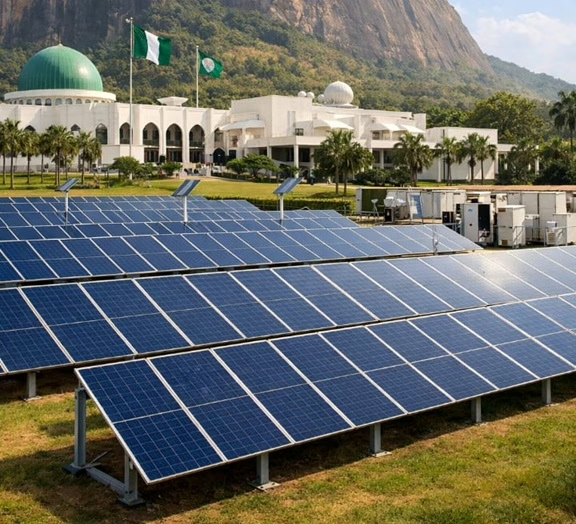
That is why Nigerians should look twice at the decision to solar-power the Aso Rock Presidential Villa.
On the surface, the official rationale is impeccable. Solar energy reduces the nation’s fuel bill, showcases a commitment to climate goals, and insulates the seat of power from the national grid’s erratic heartbeat. It is, by all accounts, a sensible facilities management decision.
But politically, symbolically, and economically, it transmits a far more profound message, one that no government press statement will ever encode: Those who run the country no longer expect the system to work for the country. They have built an ark, not for a flood of water, but for a flood of failure.
The Grid That Failed a Nation, And the Logic of Exit
For over three decades, the script has been the same. Each new administration promises to rewrite it: more megawatts, better transmission, private sector magic. Yet, for millions of Nigerians, electricity remains a lottery, a sporadic visitor announced by the roar of generators.
Diesel fumes have become the perfume of urban Nigeria, a daily tax on productivity paid by those who can least afford it.
It is one of the nation’s great paradoxes: a country swimming in gas, baked by sunlight, and carved by rivers, yet perpetually in the dark.
But the solarisation of the Presidential Villa introduces a new and dangerous twist. Instead of fixing the system for everyone, the state is engineering a sophisticated exit from it.
History is brutally clear on what happens next. Public schools decay when the elite’s children are in London. Public hospitals crumble when leaders fly to Germany for treatment. Why? Because the urgent, personal pain of failure vanishes. The squeaky wheel, no longer ridden by the powerful, receives no grease.
Sceptics will argue that this is a necessary, practical step for national security and efficiency. A president cannot govern in a blackout, they will say.
True. But this misses the point. The message is not in the act itself, but in the silence surrounding its broader implications. If this were truly about leadership, the Villa’s massive solar purchase would be tied to a plan for local manufacturing or used to subsidise mini-grids for the surrounding community. Instead, the quiet installation signals insulation, not inspiration.
The Unseen Revolution: The Market Does Not Wait
While Abuja debates, the Nigerian market is already voting with its wallets. Across the nation, a quiet, grassroots revolution is underway. Households and businesses are financing solar panels, inverters, and lithium batteries.
For those who can afford the upfront cost, electricity is being redefined. It is no longer a public utility; it is a private infrastructure decision. The national grid is becoming an expensive, unreliable backup plan.
This looks like a collection of individual choices, but it is the early formation of something tectonic: a decentralised energy ecosystem.
The Billion-Dollar Opportunity Most Investors Are Underestimating
The real story here is not generation, it is financing. The barrier is not the technology, but the upfront cost. A reliable residential solar system can run several million naira, an impossible lump sum for most.
This chasm creates the perfect landscape for a new kind of utility. The business model is simple, powerful, and already scaling in other parts of Africa: Energy-as-a-Service.
A company installs the panels, batteries, and inverters at zero upfront cost to the homeowner. The homeowner pays a predictable monthly subscription, a “solar salary” that replaces diesel and fuel costs. The household gets instant, stable power. The company gets a long-term revenue stream.
Financed across thousands of homes, this company becomes a de facto private electricity utility, bypassing the national grid entirely. This is not a futuristic dream; it is the business model of companies like Arnergy and Lumos, and it is the frontier of Nigeria’s energy future.
The Mini-Grid Nation and the Local Government Wildcard
The opportunity expands exponentially beyond individual homes. Entire communities can become power islands. A private company builds a solar mini-grid. Neighbourhood homes and small businesses connect, paying a tariff that undercuts diesel.
The operator manages the local distribution. The community unplugs from the failing monopoly.
Critics will warn of an “energy apartheid,” a future of gated communities powered by the sun, surrounded by communities left in the dark.
This is a legitimate danger. But it ignores the disruptive potential of local government. A forward-thinking council chairman could turn this model into an economic engine.
By partnering with a mini-grid developer, they could power a local market, an industrial cluster, or a district secretariat. Businesses stay open later, employment grows, and the local government gains a reliable revenue stream from the electricity tariffs. Electricity stops being a distant federal promise and becomes a tangible, local economic service, accountable to the people who use it.
The Politics of Perpetual Darkness and the Inertia of the Old
Why has the centralised grid failed for so long? It’s not merely corruption; it’s a fundamental structural mismatch.
A centralised grid is a natural monopoly built for dense, industrialised nations. In a country as vast and sprawling as Nigeria, it is inherently fragile, expensive to secure, and prone to cascading failure. Its maintenance is a Sisyphean task.
Furthermore, the crisis has become politically useful. Stable electricity is the ultimate political promise. As long as the grid stumbles, that promise can be recycled every four years, a convenient cudgel with which to beat the previous administration.
The solarisation of Aso Rock may be the quietest admission yet: the old system is beyond repair, at least for the foreseeable future.
The Future Nigerians Must Now Build
If that assumption holds, the future is not one grid. It is a network of thousands of power islands. Rooftop systems. Neighbourhood mini-grids. Industrial clusters. Private networks. Nigeria’s power sector will evolve not through grand, top-down reform, but through gritty, bottom-up adaptation.
The Final Irony
The solar panels glinting on the roof of Aso Rock may appear to be just another government contract, a simple energy upgrade. But they may also be a historical marker, a quiet monument to a pivotal moment.
Because when the palace stops trusting the grid, it sends a clear signal: the people must start building their own.
And in that moment lies both the profound tragedy and the immense opportunity of Nigeria’s electricity future.
While the state struggles in vain to keep the centralised lights on, a new economy, powered by markets, technology, and finance, is quietly being built in its shadow.
The palace has left the grid. The question is whether it will leave the people behind or finally create the policy environment for them to thrive beyond it.
Allen writes from Kano on public affairs and the promotion of good governance.