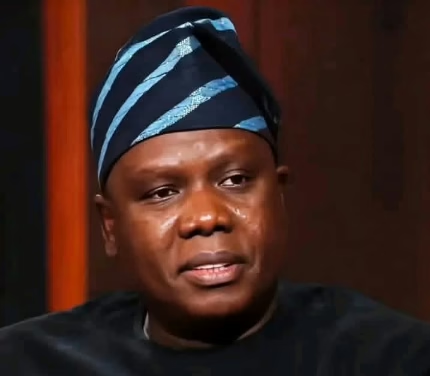
Shuaibu Usman Leman
What was intended as a routine defence of government policy quickly transformed into a stark lesson in political accountability.
The recent encounter between Daniel Bwala, Special Adviser to President Bola Tinubu, and a journalist Mehdi Hasan on Al Jazeera was less a strategic briefing and more a comprehensive public relations collapse.
Bwala maintains the discussion was meant to highlight the administration’s record on security, the economy, and anti-corruption.
However, Hasan instead prioritised Bwala’s own history, confronting him with scathing criticisms of the government made during his time in the opposition.
This is the essence of rigorous journalism. When a public official switches political allegiances, a journalist’s duty is to scrutinise that shift. Raising past remarks is not an “ambush”; it is a legitimate test of consistency.
Bwala’s characterisation of the interview as a trap suggests a troubling expectation, was he seeking a genuine dialogue or merely a compliant platform for government talking points?
Throughout the exchange, Bwala frequently dismissed or denied his previous statements. In the digital age, such a strategy is doomed to fail. Tweets, videos, and interviews constitute a permanent public record that does not simply vanish.
A more credible approach would have been to acknowledge the evolution of his views and explain the rationale behind his change of heart.
Transparency is always more persuasive than evasion. By attempting to dispute documented facts, Bwala inadvertently undermined his own authority.
Bwala’s claim that Al Jazeera engaged in “opposition-style journalism” fundamentally misunderstands the role of the independent press.
Journalism exists to challenge power, not to protect it.
International interviewers like Hasan are renowned for their uncompromising style.
The suggestion that global media should avoid “uncomfortable” questions highlights a systemic issue in Nigerian political communication, where many officials have grown accustomed to sycophancy rather than scrutiny.
For a spokesperson, optics are everything. As the interview went viral, the narrative shifted away from government policy and towards the spokesperson’s personal contradictions.
In the world of strategic communication, once you lose control of the message, the mission has failed.
This episode serves as a vital reminder for political communicators, that preparation must include a thorough audit of one’s own history.
Failing to anticipate that a journalist of Hasan’s calibre would research previous remarks suggests either a lack of foresight or a misunderstanding of the modern media landscape.
Neither reflects well on the administration.
Instead of projecting confidence, the interview left an impression of defensiveness.
Blaming the interviewer or the network cannot mask the underlying inconsistency. In modern politics, the past is never truly behind us; officials who cannot confront their own record head-on risk turning every interview into a disaster.
Leman is a former National Secretary of the Nigeria Union of Journalists (NUJ).