Stephen Enoch
In Kano State, citizens are increasingly engaging government institutions and demanding greater accountability.
Advocacy by a rights-focused organization has helped strengthen participation. Communities now interact more on access, services, and inclusion.
Government processes like accessibility audits, budget hearings, and policy checks are now seeing wider involvement.
Despite policy and implementation gaps, governance engagement is gradually shifting across the state. The Resource Center for Human Rights and Civic Education (CHRICED) is part of this change.
CHRICED’s Advocacy Impact on Persons With Disabilities in Kano
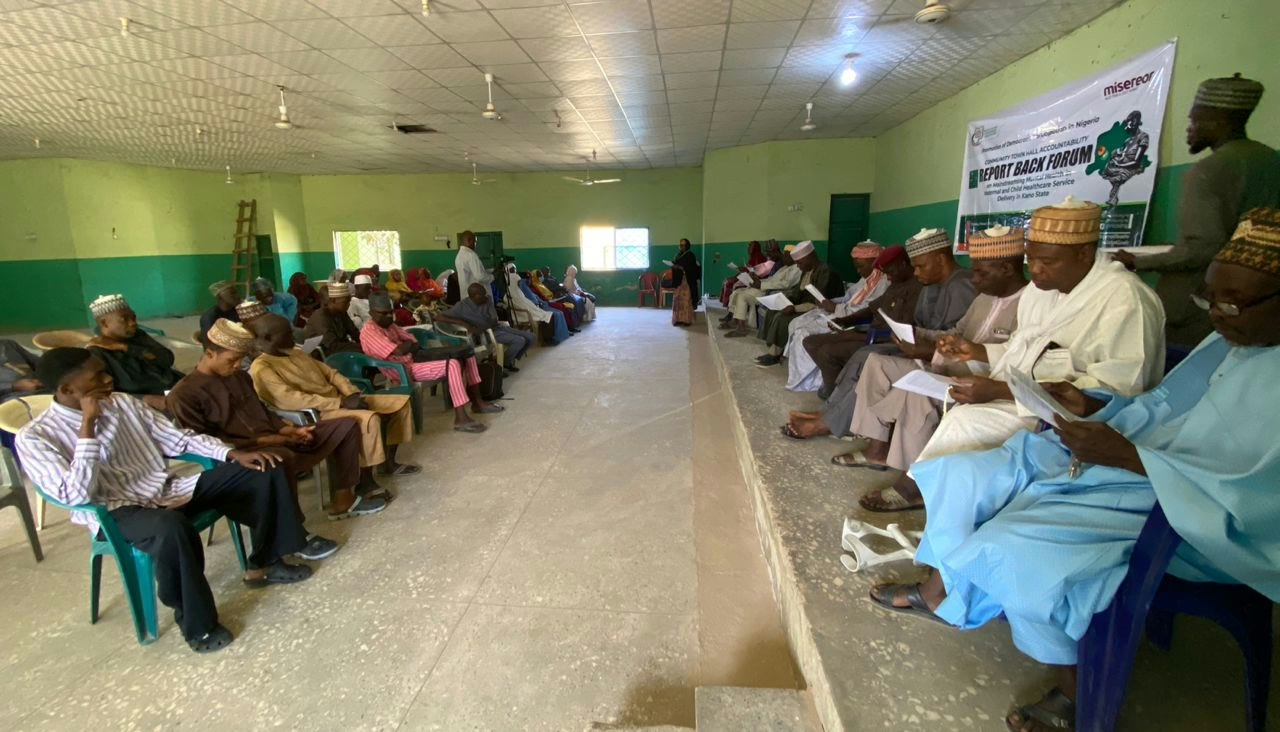
In Kano State, advocacy training supported by CHRICED has begun to reshape how persons with disabilities (PWDs) engage with government institutions and demand their rights.
Abdulrazak Ado-Zango explained that advocacy has to be a government-backed accessibility audit across ministries, departments, and agencies (MDAs) in the state.
“Based on the advocacy trainings we had, we were able to push for a project by the Ministry for Women Affairs, Children and Persons with Special Needs to assess accessibility in MDAs.
“PWD representatives across different disability clusters, including visual, hearing, and physical impairments, were actively involved in collecting data across ministries.
“The findings have now moved beyond documentation into policy action,” he said.
According to him, all these are outputs from CHRICED-led trainings and advocacy efforts for PWDs in the state.
Ado-Zango noted that the process has strengthened accountability, pushing institutions to share accessibility data and prompting other agencies to prepare for inclusive infrastructure planning.
Beyond infrastructure, he said CHRICED’s support has amplified the voices of PWDs in public discourse.

“We have started speaking more through the media. The narrative is changing. PWDs are now being included in community and state-level discussions,” he said.
He also highlighted ongoing policy gaps, including the delayed domestication of the inclusive education policy and the need for a more disability-sensitive climate change policy.
Despite these gaps, he stressed that advocacy efforts are yielding results.
He added, “We are now being included in most activities. Even during media sessions, our voices are being heard. It has triggered real change.”
Turning Community Voices into Tangible Change
Sunusi Garba, is a major stakeholder in Kafin maiyaki Community Development Association (KACODA) in Kiru Local Government Area (LGA).
For him, civic participation was once distant and unfamiliar.
Today, he stands as part of a growing movement of community advocates demanding accountability.
Garba told Stallion Times that he and other community members learned how to engage directly with governance processes, including participating in budget public hearings at the Kano State House of Assembly.
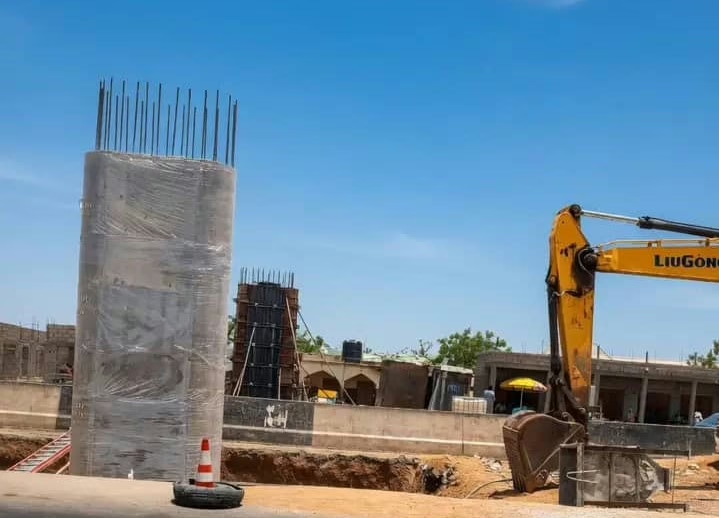
About 4 years ago, they seized that opportunity to demand a life-saving intervention: the construction of a bridge at Kwanar Dangora area of the state.
“The area had become notorious for heavy congestion, especially after Friday prayers, often leading to accidents and, in some cases, fatalities.
“We raised our concerns because lives were being lost.
“Today, that advocacy is bearing fruit, as a bridge is currently being constructed at Kwanar Dangora and this is an achievement the community takes pride in,” he stated.
According to him, their advocacy did not stop there.
Garba stated that during another budget hearing, they pushed for the establishment of a cottage hospital in Kafin Maiyaki, a community where the absence of a nearby health facility had cost lives.
“Victims of accidents often had to travel long distances to Zaria or Kaduna for treatment journeys many did not survive.
“Today, the cottage hospital in Kafin Maiyaki has not only been built but fully equipped, bringing critical healthcare services closer to the people, and we are happy that lives are saved with this hospital,” he revealed.
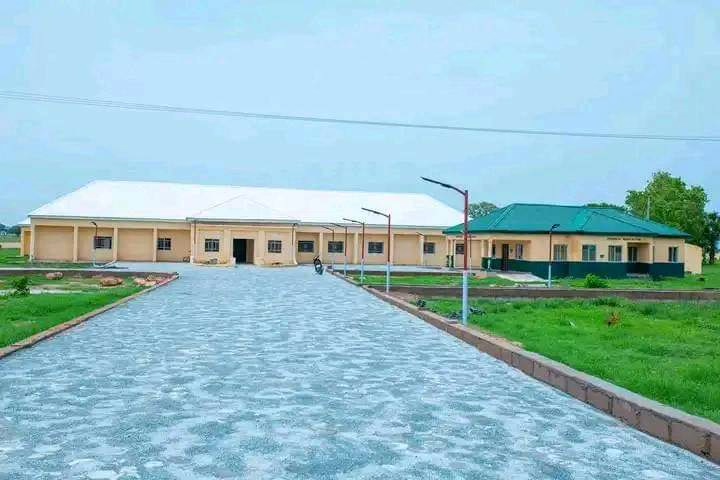
The Cottage Hospital
From Beneficiary to Rights Advocate
After years of support and training from CHRICED, Aisha Haruna has transformed into a bold human rights advocate, championing accountability and access to healthcare in her community in Kano.
In 2022, Aisha put her training into action.
Alongside a colleague, she investigated a constituency project reportedly executed by Hon. Abdullahi Lawan Ken-Ken, who claimed to have empowered 200 women with vocational skills and ₦50,000 each. What they found on the ground told a different story.
“The project was not as it was presented.
“We used the evidence from our budget tracking exercise and reality on the ground to prove that the empowerment didn’t take place.
“Other community members, mostly women, and I exposed this and raised awareness about accountability among ourselves,” Aisha revealed.
Challenges And a Replicable Path
Fear, silence, and entrenched cultural norms continue to hinder human rights advocacy in Kano State.
According to Omoniyi Adeoye, Senior Programme Officer at CHRICED, “there is a fear of violating entrenched socio-cultural norms and value systems, which discourages many victims from speaking out,” he said.
He added that a “culture of silence,” driven by intimidation and delayed justice, often leaves victims unable to secure redress.
Despite these barriers, advocacy efforts are beginning to yield results.
Adeoye noted that sustained engagement contributed to the passage of the Kano State Free Maternal and Child Healthcare Law in 2023, with ongoing work to develop a practical framework for its implementation.
Research and advocacy have also drawn attention to forced child begging and broader human rights violations affecting vulnerable groups.
Beyond policy wins, he emphasised the importance of building local capacity.
“We have been mentoring community-based organizations and equipping citizens with the skills to demand enforcement of their rights,” he stated.
According to him, this approach offers a model that can be replicated in other regions facing similar challenges.
This report was published under Humangle’s 2015 SCOJA Fellowship.