Olu Allen
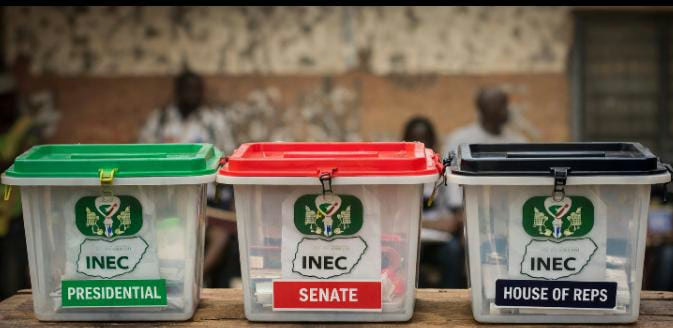
The All Progressives Congress (APC) is celebrating the Abuja council polls as a referendum on the performance of Bola Ahmed Tinubu. Their stalwarts speak with the confidence of men who believe the scoreboard tells the whole story.
But numbers without context are like a generator humming in a dying factory—loud enough to suggest production, too weak to power reality.
The Generator Metaphor Nigeria Must Confront
Imagine a factory built to run 18 hours daily. Now it sputters to life for two hours on diesel fumes. The owner points to those two hours and declares: “Production is up. The system works.”
That is the Abuja poll.
Yes, the APC won.
Yes, the structures held.
Yes, the machinery delivered.
But low voter turnout was not a footnote, it was the headline written in invisible ink.
Democracy does not merely measure who won; it measures who cared enough to show up.
Let us extend the metaphor. In Nigeria, we know the difference between a “Mikano”, the reliable industrial generator that powers entire factories, and the “I better pass my neighbor”, the small, portable generator that is noisy but weak, struggling to power a single room.
The APC celebrated as if they had commissioned a Mikano for the entire factory floor. But the Abuja poll was that small, personal generator running an extension cord to the Chairman’s office only.
It powered the victory party, but it left the assembly lines, the urban youth, the civil servants, the market women, the professionals, in absolute darkness and sweltering heat.
The party elite sat in the air-conditioned office, pointing to the lightbulb above their heads, declaring the national grid restored.
Meanwhile, the workers outside the door cannot see their hands in front of their faces. That gap, between the lit office and the dark factory, is the trust deficit.
The Path Not Taken: The Counterfactual of February 2026
When the amended Electoral Act was hurriedly signed in February 2026, stripping away confidence in real-time electronic transmission safeguards, the message to urban voters was not legal; it was psychological.
It said: “Trust us. The system is intact.”
But trust, once perforated, does not leak slowly. It collapses.
The 60-day window that could have changed everything
Had President Tinubu delayed the signing, acknowledging the widespread apprehension regarding the electronic transmission safeguards, he would have done more than just amend a law.
He would have purchased political insurance that no campaign rally could buy.
Let us conduct the forensic analysis of that counterfactual:
The Psychological Dividend: A delay for consultation would have signaled that the presidency feared the people’s perception more than the opposition’s ambition.
It would have transformed the narrative from “They are rigging the system” to “They are listening to the system.”
In politics, the appearance of hesitation to sign a flawed bill is often more powerful than the reality of signing a perfect one. The act of consultation itself would have been a deposit in the bank of legitimacy.
The Operational Flaw Exposed: Those extra weeks would have forced INEC to publicly stress-test the transmission infrastructure before the high-stakes environment of an election.
Currently, the system failed in silence, leaving citizens to imagine the worst. With delay and consultation, any glitch would have been exposed in a neutral environment, allowing for fixes before trust was broken, rather than post-election explanations and excuses that landed on ears already sealed by suspicion.
The Opposition Defanged: A transparent, consultative process would have removed the central mobilizing grievance for boycott advocates.
When citizens stayed home, they did so because the narrative of “your vote won’t count” had been validated by the hurried signature. Delay would have starved that narrative of oxygen.
The signature in February 2026 did not just amend an act. It wrote the preface for the low turnout of the Abuja polls.
The Algorithm of Abstention: How a Signature Silenced a City
Experts analyze the “turnout” statistic. But systems thinkers analyze the decision tree that precedes that statistic.
In the weeks leading up to the Abuja poll, a minute, unseen process unfolded in millions of minds across the Federal Capital Territory:
Input: News confirms the Electoral Act is signed without the transmission safeguard I trusted. The debates, the memes, the analyst opinions all converge on one point: the system now has a vulnerability.
Processing: “If the transmission is opaque, my vote can be flipped in a server room somewhere. I will never know. The winner will be announced, and I will be expected to accept it.”
Heuristic Check: “Did my candidate win last time despite my vote? Did the results in my area reflect what I saw with my eyes? No.” Past experience becomes the lens through which present reality is filtered.
Cost-Benefit Analysis:
· Cost: 3 hours in the sun, risk of confrontation with opposing supporters, transport fare, lost income for the day.
· Benefit: 0 (perceived inability to change outcome, perceived irrelevance of participation).
Output: Stay home. Scroll WhatsApp. Share memes about the futility of it all. Move on with survival.
This is not apathy born of laziness.
It is apathy born of disenchantment.
It is a rational response to a system perceived as a deterministic machine, an algorithm where your input does not affect the output.
The APC celebrates that the machine produced their victory. They fail to see that the public has already devalued the currency the machine produces.
Politics Runs on Perception, and Perception Has Shifted
Urban Nigeria does not need to occupy streets to resist. In the social media age, dissent travels through bandwidth, not barricades.
The absence of voters is not neutrality.
It is a referendum on trust.
The Abuja result did not scream approval; it whispered withdrawal.
When Festus Keyamo dismissed the protesters as a “handful” at the gates of the National Assembly, he made the critical error of confusing physics with psychology.
He counted bodies; he did not measure bandwidth.
Those “handful” of protesters were just the visible tip of the submarine. They were the representatives of millions watching on X (formerly Twitter), Instagram, and WhatsApp.
“For every one person holding a placard, there were ten thousand holding a phone, screenshotting the defiance, saving the videos, and filing it under ‘reasons not to participate’ or ‘evidence that they don’t care about us.’
By dismissing the physical few, the government alienated the digital many. The “handful” became a multiplier, not a minority.
The viral clips of that dismissal reached more Lagos and Abuja residents than any APC campaign rally. The message received was not “the law is intact”, it was “your concerns are noise.”
Validation Politics vs. National Vitals
This government’s obsession with structural dominance resembles a hospital fixated on patient charts while ignoring vital signs.
Inflation bites deeper than campaign slogans.
Youth unemployment outpaces political appointments.
Currency instability erodes middle-class confidence.
Food prices rewrite household survival strategies weekly.
Yet the political class celebrates procedural victories as proof of national endorsement.
Winning an election is not the same as winning consent.
Minority Mandates and the Mathematics of Fragility
Let us confront the arithmetic.
Bola Ahmed Tinubu assumed office with less than 34% of the total votes cast. Not registered voters, votes cast.
In a nation of over 200 million people, with one of the youngest and most digitally connected populations on earth.
That is not a moral failing. It is a structural warning.
If turnout continues on its current trajectory, a future president could emerge with less than 20% of eligible voter participation. Not because citizens agree with the platform, but because they have disengaged entirely from the process.
A democracy cannot survive on shrinking legitimacy. At some point, the gap between the percentage of people who voted for the winner and the percentage of people who simply opted out becomes a chasm that no amount of political maneuvering can bridge.
The Social Media Multiplier Effect
In today’s world, narratives travel faster than official results. A single viral thread can shape global perception more than a government white paper.
We live in an era where:
A rumor can outrun a press release.
A hashtag can overshadow a policy announcement.
A video clip can redefine a nation’s image in minutes.
A meme can encapsulate a political reality more effectively than a newspaper editorial.
Disgruntled non-voters are not silent. They are the authors of tomorrow’s narrative. Every citizen who stayed home in Abuja did not disappear; they returned to their digital communities, where they reinforced the decision of others to do the same. The network effect of abstention is cumulative.
And the world is listening. Investor confidence, diplomatic relationships, and international perception are all shaped by this invisible chorus of the disengaged.
2027: Murphy’s Law Meets Nigerian Politics
Murphy’s Law states: Anything that can go wrong will go wrong.
When systems are engineered to produce victories without participation, they also engineer fragility.
The very mechanisms that guarantee electoral success today become the vulnerabilities that undermine governance legitimacy tomorrow.
If current trends persist:
Voter apathy will deepen. Each election with low turnout normalizes non-participation for the next. The citizens who stayed home in Abuja will find it even easier to stay home in 2027.
Legitimacy will thin. A government elected by 15% of eligible voters governs on borrowed authority. Every policy becomes harder to implement when the moral mandate is absent.
Post-election disputes will intensify. When margins are calculated against a shrinking denominator, the disputes become not about votes but about the very definition of mandate.
International confidence will waver. Development partners, investors, and diplomatic missions track these indicators. They know that stability requires perceived legitimacy, not just structural control.
Internal cohesion will weaken. When large segments of the population feel no stake in the political process, they find expression elsewhere, in identity politics, in regional agitation, in outright rejection of national institutions.
Not because the opposition is strong, but because belief in the system is weak.
This Is Not Prophecy. It Is Systems Thinking.
When inputs degrade, outputs follow.
Low trust and low turnout
Low turnout and weak mandates
Weak mandates → fragile governance
Fragile governance → national instability
This is not an opposition talking point.
It is systems analysis.
It is the mathematics of political sustainability.
It is the physics of social contracts.
Abuja Was Not Approval, It Was a Warning
The Abuja polls did not validate the government. They revealed a democracy running on generator power, functioning, but failing to illuminate the whole factory.
The real danger is not electoral defeat.
It is electoral indifference.
And indifference, once normalized, is harder to reverse than opposition. You can campaign against an opponent.
You cannot campaign against a citizen who has simply decided that the entire theater is not worth the price of admission.
The Prognosis: From Generator Democracy to Ghost Democracy
If 2027 is managed with the same mechanistic mindset as the Abuja poll, the same focus on structural wins, the same dismissal of low turnout as irrelevant, the same celebration of procedure over participation—we risk moving from a “Generator Democracy” to a “Ghost Democracy.”
A Ghost Democracy is where elections are held, results are declared, winners are sworn in, and the factory floor is completely empty.
The formal structures of democracy operate flawlessly while the informal reality of citizenship withdraws entirely.
The lights will be on in Aso Rock.
The proclamations will be made.
The victory parties will be held.
But the nation outside will have moved to the informal sector of political expression: protest, apathy, exit, and the quiet construction of parallel realities where the state is simply irrelevant to daily survival.
The signature in February 2026 did not just amend an act. It was a seismic event whose tremors were felt in the empty polling units of Abuja.
The question now is whether the administration will read the invisible ink of that low turnout, or wait until the generator finally seizes, sputtering to a stop in the complete darkness of a nation that has simply stopped believing.
A Call for Conscious Caution
Nigeria does not need louder victory songs.
It needs quieter introspection.
Restore trust, not through press releases, but through demonstrable transparency.
Strengthen transmission, not as a technical requirement, but as a sacred covenant.
Respect voter intelligence; citizens know when they are being managed versus when they are being heard.
Treat turnout as a health indicator, not a footnote in the victory speech.
Because in the end, structures can manufacture wins, but only legitimacy sustains nations.
The generator is running.
But the factory is still in darkness.
And the workers have gone home.
Allen writes from Kano, he writes on public affairs and promotes good governance.