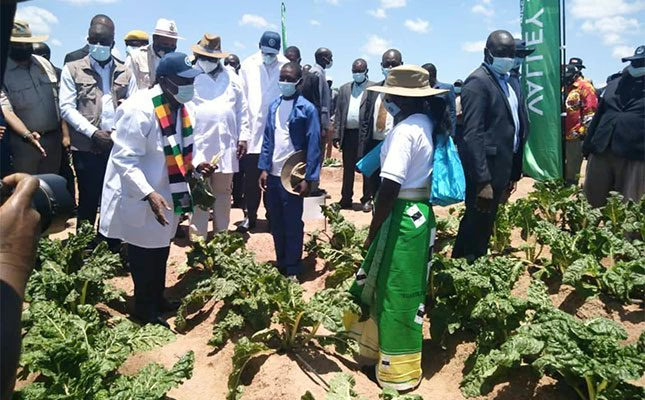
Village business units registered as commercial agricultural ventures are transforming Zimbabwe’s rural landscape, long associated with subsistence farming.
These community-based, commercially run village business units (VBUs) are located in rural areas to generate income and improve livelihoods through agricultural activities such as horticulture and fisheries.
Each centre is equipped with piped water , washing slabs, cattle troughs and two fishponds.
Speaking to Farmer’s Weekly, Tinotenda Mhiko, CEO of the State-run Agricultural and Rural Development Authority (Arda), said each 1ha VBU was solar powered, with horticulture gardens using renewable energy to pump water for crop production.
He added that a “whole-of-government approach”, guided by the Lands, Agriculture, Fisheries, Water and Rural Development ministry, has seen Arda collaborate with other agricultural State entities, including the Zimbabwe National Water Authority and the Department of Irrigation on irrigation projects and the Agricultural Marketing Authority on crop marketing. Arda oversees the agronomy and business management aspects of the value chain.
Mhiko said under the Companies and Other Business Entities Act, VBUs are registered to operate as professional agricultural companies, enabling beneficiaries to access credit for operational and capital expenditure.
“All crop production is supported by a profitable, viable business case and a guaranteed supply market through a contract, ensuring sustainability and long-term success of the units,” he added.
According to Mhiko, they are finalising a few export market agreements for contract farming of chillies, fine green beans and peas at the units.
The government established VBUs under the Rural Development 8.0 programme, with agricultural development serving as the main driver, creating a strategic focus on agribusiness growth in rural areas.
Lands, Agriculture, Fisheries, Water and Rural Development minister Anxious Masuka recently told Parliament that VBUs fall under the Horticulture Enterprise Enhancement Project (HEEP) jointly funded by the government, the International Fund for Agricultural Developmen, and the OPEC Fund for International Development, among others.
“[The HEEP] is focused on horticulture and VBUs in particular, as well as value chain development, business skills and capacitation,” he said.
While HEEP seeks to establish 620 VBUs by 2030, the government’s long-term vision is to have one unit in each of the country’s 35 000 villages.
“The first success story was that of Sekusile-Makorokoro VBU in Mangwe, Matabeleland South, where the Presidential Rural Development Programme was launched by [President Emmerson Dambudzo Mnangagwa] in 2021.
“The business unit has attracted youth participation, some of whom returned from Botswana and South Africa, where they had emigrated to look for jobs but have since realised the potential of growing a successful business through irrigated horticulture, even in dry and arid areas such as theirs,” Mhiko said.
“Rural farmers are now earning an average income of between US$260 and US$312 [around R4 265 to R5 118] per household per cycle, translating to between US$65 and US$78 [R1 066 and R1 280] per household per month, depending on the crop cycle, season, and market conditions.”
He added that the VBU programme is building resilience in rural communities, ensuring food and nutritional security, and creating employment for more than 1,25 million youths and women.
It is also stimulating rural agro-industrialisation to accelerate rural development and support Zimbabwe’s Vision 2030 of becoming an upper-middle-income economy.
(Farmers Weekly)