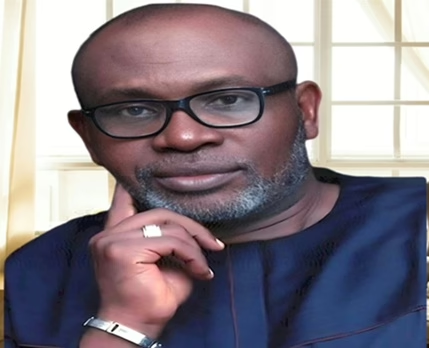
Rekpene Bassey
What happens when a presidential vacation begins to raise questions about the exercise of presidential power? President Bola Ahmed Tinubu left Nigeria on August 30 for what the Presidency described as a three-week working vacation in Europe.
He spent time in London before travelling to Paris, where he held engagements with French President Emmanuel Macron and businessman Vincent Bolloré.
On September 21, the Presidency announced that the stay had been extended by several days.
The latest schedule indicates that Tinubu is expected to return to Lagos on September 29, before the Independence Day celebrations and a subsequent return to Abuja.
The immediate question is not why the President travelled. Presidents travel, and international diplomacy requires it.
The more important question is why an absence initially presented as three weeks was extended, what circumstances necessitated the change and whether Nigerians have been given sufficient information about the constitutional arrangements governing presidential authority during the extended period.
There is also an important distinction between the current episode and the frequently cited 10-day presidential vacation. That earlier announcement concerned Tinubu’s September 2025 trip to France and Britain.
The present journey began in August 2026 and was announced as a three-week annual leave combined with official engagements. Keeping those two episodes separate is essential to understanding the present controversy.
The Presidency has maintained that Tinubu has remained fully engaged with government while abroad, receiving briefings, issuing directives and conducting official meetings.
It has pointed to his diplomatic engagements in France and his intervention in domestic matters, including the response to the deaths of suspected illegal miners in Niger State.
Vice-President Kashim Shettima has also represented the President at official events, including the United Nations General Assembly in New York. There is therefore no evidence that the machinery of government simply stopped functioning.
The constitutional question, however, is more specific. Section 145 of Nigeria’s Constitution provides for a written declaration by the President to the President of the Senate and the Speaker of the House of Representatives when he proceeds on vacation or is otherwise unable to discharge the functions of office.
The provision also addresses the consequences of an absence extending beyond 21 days. The relevant issue, therefore, is not speculation about the President’s health or motives but whether the constitutional procedures governing an extended absence have been properly observed and documented.
That is a question the National Assembly can answer without turning it into a partisan confrontation. The Senate and House can establish what notification was received, the period it covered, whether any extension required additional action and what role the Vice-President was constitutionally exercising. The answers should be matters of record rather than subjects for political interpretation.
The timing makes the issue more sensitive. Nigeria is already inside the operational cycle for the 2027 elections.
INEC has scheduled the presidential and National Assembly elections for January 16, 2027, followed by governorship and State House of Assembly elections on February 6.
The governing APC is preparing for the contest, opposition parties are organising, and the electoral and security institutions are moving into an increasingly consequential phase of preparations.
In such an environment, presidential absence carries a significance beyond geography. Tinubu is simultaneously head of state, head of government and a political actor preparing for another electoral contest.
That does not make his foreign travel improper. It means, however, that the boundaries between presidential duties, government administration and partisan politics must be especially visible.
The same principle applies to the Vice-President and other officials exercising delegated authority. Nigeria has a constitutional system designed to function when the President is unavailable.
The issue is whether citizens can clearly identify who is authorised to make decisions, under what authority and for what period. A functioning state should never require the public to reconstruct its chain of command from press releases or social media.
The President’s description of the trip as a “working vacation” also deserves careful clarification. If official business forms a substantial part of the itinerary, the Presidency should distinguish between private leave and presidential duties conducted abroad.
That distinction would help Nigerians understand why the President’s physical absence has been extended and what government functions continue to require his direct involvement.
There is nothing inherently unusual about a president conducting diplomacy from another country. Tinubu’s meetings with Macron and French business interests fall squarely within presidential responsibilities.
The problem arises only when an extended absence becomes insufficiently explained. Transparency is therefore not an accusation against the Presidency; it is a mechanism for preventing unnecessary speculation.
That distinction is particularly important in the current information environment. When governments leave gaps in information, social media rapidly fills them with competing narratives.
An extended itinerary becomes a rumour about hidden political negotiations; an overseas meeting becomes evidence of an alleged conspiracy; and a constitutional question becomes a partisan accusation. None of these conclusions should be accepted without evidence.
But government cannot solve that problem simply by dismissing questions as political. The more consequential the office, the stronger the case for timely documentation.
The Presidency could substantially reduce uncertainty by publishing the original leave arrangement, the reason for its extension, the relevant constitutional notification, the President’s official engagements and the confirmed timetable for his return to Abuja.
The National Assembly should complement that transparency by treating Section 145 as a constitutional procedure rather than a political weapon. If the required documents are in order, that should be clear.
If there are questions about the duration or status of the President’s absence, they should be resolved through the constitutional institutions established for precisely that purpose.
There is also a national-security dimension. In an election year, clarity over the chain of command is essential. The security agencies must know who has authority to make decisions during a crisis, particularly if the President and Vice-President are simultaneously outside Abuja.
The public does not need access to sensitive operational information, but the constitutional chain of authority should never be ambiguous.
The wider political environment makes this even more important. The President’s extended stay in Europe coincided with the Vice-President’s attendance at the UN General Assembly and the international movement of other senior Nigerian political figures. There is no evidence from those facts alone of unlawful coordination.
But the convergence of senior political activity outside Nigeria inevitably attracts attention in an election season. That makes institutional clarity more valuable, not less.
The Presidency should therefore resist the temptation to treat transparency as a concession to its critics. A government confident in its procedures should be able to explain them.
The objective is not to account for every private movement of the President but to explain those aspects of his absence that have constitutional and public significance.
The opposition, civil society and media also have responsibilities. Questions about presidential authority should be pursued with documents and verifiable evidence rather than assumptions.
An unexplained event deserves investigation; it does not automatically establish misconduct. Responsible scrutiny is strongest when it distinguishes what is known, what is alleged and what remains unknown.
The same discipline should govern discussion of the 2027 election. The President’s foreign travel should not be converted into evidence of electoral manipulation without proof.
At the same time, citizens should not be discouraged from asking whether the institutions managing the election are independent, transparent and properly insulated from political influence. The distinction between legitimate scrutiny and unsupported allegation is vital.
What is ultimately at stake is not the President’s itinerary but institutional confidence. Elections depend on citizens believing that the constitutional rules apply to those who exercise power as well as those who challenge it.
That confidence is built through visible procedures: documented delegations, transparent electoral administration, accountable security institutions and clear constitutional compliance.
Tinubu’s expected return to Lagos on September 29, followed by the Independence Day programme and a subsequent return to Abuja, may close the immediate chapter of his European absence.
It should not close the institutional questions raised by it. The government can still use the episode to clarify the constitutional arrangements under which the country was governed during the extended period.
Nigeria does not need another political argument built around rumours about a presidential vacation. It needs a documented account of how presidential authority was exercised, why the original schedule changed and whether the constitutional requirements governing an extended absence were satisfied.
Those are questions capable of being answered without partisan interpretation.
The larger lesson is straightforward: in a constitutional democracy, power must not only be exercised lawfully; the exercise of that power must be sufficiently transparent for citizens to understand who is responsible for decisions.
As Nigeria moves toward the 2027 elections, that principle becomes more important. The President may return to Abuja, but the country’s institutions must remain visibly anchored there.
The real test, therefore, is not where President Tinubu spends his vacation. It is whether Nigerians can confidently identify who is exercising presidential authority, under what constitutional mandate and within what institutional limits.
That is the standard that should govern this episode—and, more importantly, the political season ahead.
Bassey is the President, African Council on Narcotics and Security Specialist.