Olu Allen
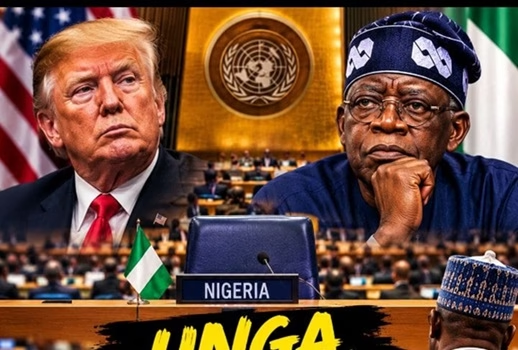
In July, Nigerians were told President Bola Ahmed Tinubu would attend the 81st United Nations General Assembly in New York.
Nigeria’s Permanent Representative to the UN, Ambassador Jimoh Ibrahim, did not present it as a possibility.
He said the President had agreed to attend.
There was even talk of Nigeria securing a prominent position in the General Assembly Hall, close to US President Donald Trump.
Then September arrived.
Tinubu is not going.
Vice President Kashim Shettima will lead Nigeria’s delegation instead.
He is expected to deliver Nigeria’s national statement and participate in high-level and bilateral meetings during the General Debate.
And that is where the interesting question begins.
What changed between July and September?
Tinubu attended the 78th UN General Assembly in 2023.
He did not attend the 79th in 2024.
He did not attend the 80th in 2025.
Shettima represented him on both occasions.
Now, in 2026, Shettima is representing him again.
That makes this the President’s third consecutive absence from the UNGA, although Nigeria itself remains represented at the highest level.
The Presidency has not suggested that Nigeria is withdrawing from the diplomatic engagements surrounding the General Assembly.
Quite the opposite.
Shettima will lead a high-level delegation that includes senior government officials and governors.
He is expected to participate in bilateral meetings and other high-level engagements on issues ranging from development and climate action to international cooperation.
Nigeria’s UN envoy, Jimoh Ibrahim, has also sought to calm concerns.
According to Ibrahim, more than 60 percent of those listed to speak at the current UNGA are being represented by vice presidents or foreign ministers.
He said Nigeria would retain its designated position in the Assembly, including its front-row seat, and that the country would remain fully represented.
He also explained that Tinubu is currently in France on annual leave.
Fair enough.
A president does not have to personally attend every international gathering for his country to be represented.
That part is not controversial.
But there is another issue here.
The communication.
In July, the country was told the President was going.
Not merely that he might go.
Not that arrangements were being considered.
Nigeria’s UN envoy said Tinubu had agreed to attend.
By September, the President’s place in New York had been taken by his deputy.
That is a significant change.
And the public has not been given a detailed explanation of why the plan changed.
That distinction matters.
The question is not whether Vice President Shettima is constitutionally capable of representing Nigeria.
He is.
The question is whether there was a reason the President’s publicly announced attendance was changed – and, if there was, why Nigerians were not told clearly when the change occurred.
Former Vice President Atiku Abubakar has now seized on that gap.
Atiku argues that repeated presidential absence from the UNGA means Nigeria loses some of the diplomatic opportunities that come with having the President personally present at one of the world’s largest gatherings of heads of government.
He has also questioned the earlier announcement concerning Tinubu’s expected proximity to Trump.
But here, facts must remain facts.
Atiku has raised questions about whether Tinubu’s history with US authorities has influenced his decision not to attend.
That is an allegation.
There is no verified evidence that Tinubu is legally barred from entering the United States.
Indeed, Atiku himself acknowledged that he was not claiming that the President was legally prohibited from travelling to America.
So that should not become the story.
The more defensible story is simpler.
A presidential attendance was announced.
Preparations were reportedly made.
The President is no longer attending.
His Vice President is going instead.
And the public explanation that has now been offered is that Tinubu is on annual leave in France.
That may be the complete explanation.
It may also be only part of the explanation.
The public record, at least for now, does not tell us.
And this is where government communication becomes important.
Diplomacy is not only about being physically present.
It is also about perception, access and the ability to explain decisions clearly.
A Vice President can deliver Nigeria’s statement.
He can hold bilateral meetings.
He can negotiate.
He can represent the government.
But there remains a difference between a country being represented and its President personally being present at a gathering where presidents and prime ministers meet, negotiate and build relationships.
That does not automatically make the President’s absence wrong.
It simply makes the reason for a sudden change in an already announced itinerary a legitimate public question.
And there is another detail worth remembering.
The 81st UN General Assembly is not some routine conference happening in the background.
Its high-level General Debate runs from 22 to 28 September, with the session taking place under the theme: “Restoring trust, managing transformation: A United Nations that delivers for all.”
Nigeria will be there.
Shettima will speak.
Nigeria will hold meetings.
The country will retain its diplomatic presence.
So this is not a story about Nigeria disappearing from the UN.
It is a story about presidential presence, changing plans and public explanation.
And perhaps that is the question the Presidency should answer – not because every change of itinerary is suspicious, but because unexplained changes in high-profile matters inevitably create room for speculation.
Governments cannot prevent every rumour.
But they can reduce the space in which rumours grow.
In July, the message was:
Tinubu is going to New York.
In September, the message became:
Shettima is going instead.
We know what happened.
We know who is representing Nigeria.
We know the President is on annual leave in France.
What remains unclear from the public explanations is why the plan changed after the President’s attendance had already been announced.
That is the gap.
And it is a gap worth closing with facts.
Because sometimes, in public affairs, the most important question is not the decision itself.
It is the question the decision leaves behind.
Allen writes on public affairs, governance and the issues shaping Nigeria’s political conversation.