Nigeria is facing a profound national crisis marked by worsening insecurity, economic hardship, shrinking civic space, and declining public trust in governance, the Resource Centre for Human Rights and Civic Education (CHRICED) has warned.
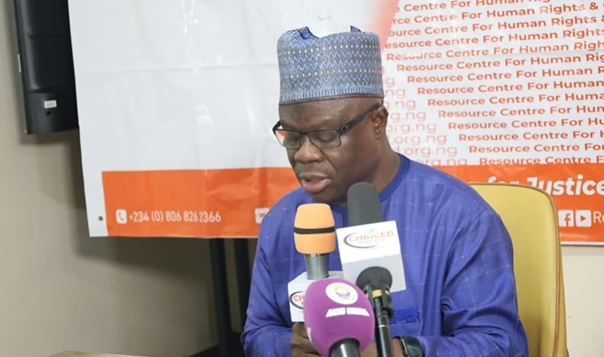
Speaking at a press conference in Abuja on Tuesday, CHRICED’s Executive Director, Ibrahim M. Zikirullahi, painted a grim picture of the state of the nation, describing the country as being at a critical juncture requiring “clarity, courage, and conscience.”
Addressing journalists at the Professor Abubakar Momoh House in Gwarinpa, Comrade Zikirullahi said Nigeria’s democratic foundations were under severe strain, citing insecurity, economic collapse, and governance failures as key drivers of public despair.
CHRICED warned that Nigeria is experiencing a severe security breakdown, with large parts of the country effectively becoming ungoverned spaces.
According to the Comrade Zikirullahi, more than 1,100 people have been abducted since January 2026, while numerous civilians and security personnel have lost their lives in attacks across various regions.
CHRICED highlighted persistent insurgent activities by Boko Haram and Islamic State West Africa Province in the Northeast, alongside escalating banditry in the Northwest and North Central zones.
It also cited recent violence in Plateau State, including the March 29 attack in Angwan Rukuba that reportedly left over 28 people dead, as part of a broader pattern of mass killings and displacement in the Middle Belt.
CHRICED further referenced a reported Nigerian Air Force airstrike on 11 April in Borno State that mistakenly hit a civilian market, allegedly killing between 100 and 200 people, describing the incident as a “catastrophic error” that underscores systemic failures in the country’s security architecture.
It described the killing of Oseni Braimah on April 9 in an ambush during a military base in Benisheikh, Borno State, as a “symbolic rupture” in Nigeria’s defence system.
Zikirullahi said the death of the brigadier general, reportedly in an ambush by insurgents, exposed vulnerabilities in military intelligence, operational planning, and troop morale.
“If a Brigadier can be overrun and killed in a fortified command environment, what hope remains for ordinary citizens?” he asked.
CHRICED criticized what it described as a disconnect between political leadership and citizens, noting that official visits to conflict zones often appear symbolic rather than impactful.
It also raised concerns over the alleged harassment of opposition figures and growing doubts about the independence of the Independent National Electoral Commission (INEC), warning that Nigeria must avoid repeating the political instability that plagued past republics.
It called on the INEC Chairman, Joash Ojo Amupitan, to step aside to preserve public confidence in the electoral process.
Comrade Zikirullahi lamented increasing pressure on civil society organizations and journalists, warning that threats, surveillance, and intimidation were undermining accountability.
“A society that makes truth dangerous risks losing its democratic soul,” he said, stressing the importance of protecting press freedom and dissenting voices.
CHRICED decried what it termed the “normalization of corruption,” alleging that individuals facing serious allegations are being appointed to high public offices, including diplomatic roles.
On the economy, the group highlighted soaring inflation and rising cost of living, noting that petrol prices have climbed to between N1,350 and N1,500 per litre, while cement prices have tripled since 2023.
It warned that youth unemployment—estimated by independent analysts to exceed 50 percent—poses a significant threat to national stability.
“Millions of young Nigerians are trapped in frustration and despair, not due to lack of talent, but systemic failure,” Zikirullahi said.
CHRICED painted a bleak picture of Nigeria’s social sector, citing rising numbers of out-of-school children, deteriorating public education, and a fragile healthcare system marked by high maternal and infant mortality rates.
It also condemned the ongoing forced evictions of indigenous communities in Abuja, describing them as violations of human rights and social justice.
CHRICED outlined a broad set of recommendations, urging the government to undertake comprehensive security reforms, prioritize job creation, and invest in education and healthcare.
It also called on political parties to embrace internal democracy, the judiciary to uphold independence, and citizens to remain actively engaged in democratic processes.
To the international community, the organization appealed for continued support in strengthening Nigeria’s democratic institutions and promoting human rights.
Comrade Zikirullahi described the current period as a defining moment in Nigeria’s history.
“Democracy is not a spectator sport. It demands participation, courage, and sacrifice,” he said, echoing the words of the late Abubakar Momoh.
He reaffirmed CHRICED’s commitment to advocating for a just, inclusive, and democratic Nigeria, urging all stakeholders to act decisively to reverse the country’s downward trajectory.