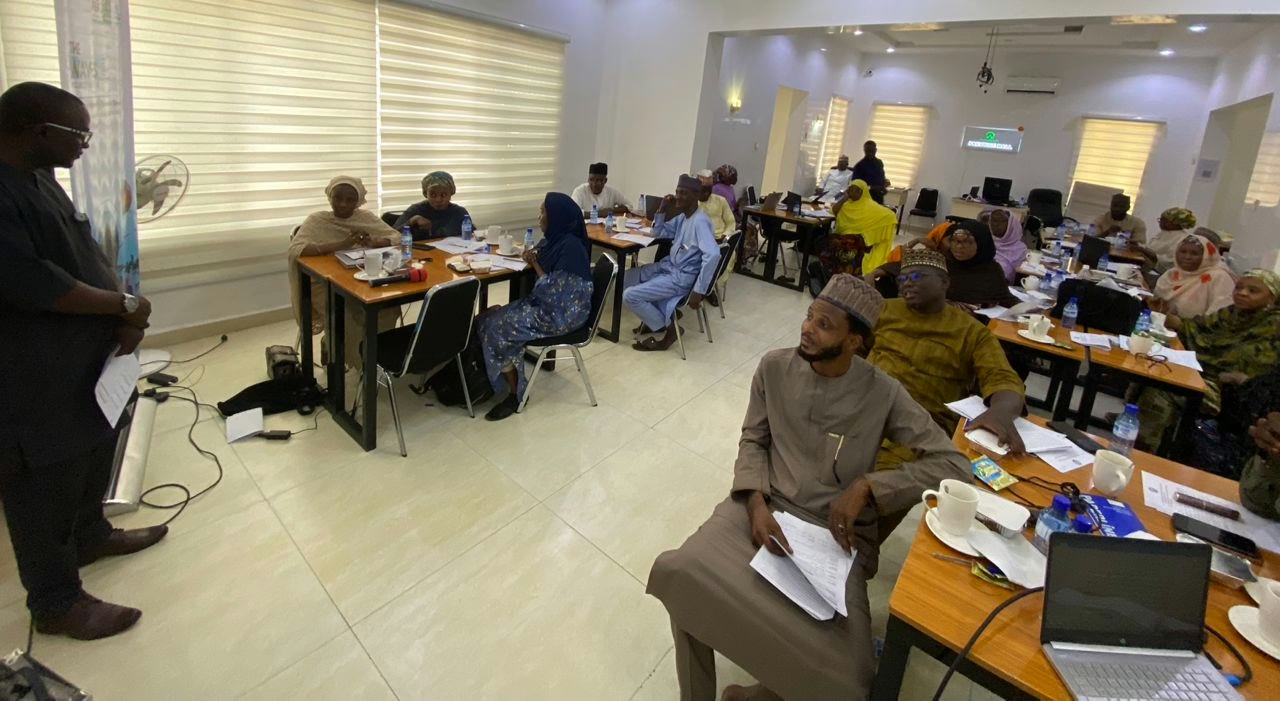
A two-day Training of Trainers (ToT) workshop in Kano State has brought together government officials, civil society organizations, security agencies, and development partners.
This is in an improved push to strengthen how Gender-Based Violence (GBV) is recorded, reported, and addressed.
The training, organized by Bridge Connect Africa under the Women Against Violence Empowered Through Sustainability (WAVES) project with support from the French Embassy in Nigeria, focuses on improving the use of national GBV data systems to drive accountability and policy action.
The two-day workshop which took place at BCAI’s Kano Office on Tuesday and Wednesday is part of a broader effort to close long-standing gaps between GBV incidents and official reporting.
Stakeholders say that while tools like the National GBV Dashboard exist, weak coordination, limited technical capacity, and poor data utilisation continue to undermine response systems.
The sessions are designed not only to train participants on data entry and reporting but also to build a culture of evidence-based decision-making in addressing violence against women and girls.
Opening the workshop, Fatima Musa Aliyu, Chief Operating Officer of Bridge Connect, said the intervention is aimed at transforming how institutions respond to GBV beyond documentation.
“It is a privilege to welcome you to this Training of Trainers for the Kano State Technical Working Group on Gender-Based Violence.
“While we have made progress, there is still a persistent gap between data generation and data use. Tools exist, but inconsistencies in reporting and weak coordination limit their impact,” she said.
Fatima stressed that the training is structured to ensure practical learning and long-term institutional change.
She added: “Over the next two days, we are not just building individual capacity, we are strengthening systems.
“The goal is to ensure GBV data is accurately captured, validated, and used to inform action. Community-level interventions can only be effective when supported by strong institutional frameworks.”
Representing the Kano State government, Acting Permanent Secretary of the Ministry of Women Affairs, Muhammad Sani Ilyasu, described GBV as a deep societal challenge requiring both urgency and precision.
“Gender-based violence is not just a violation of human rights; it is an assault on our shared humanity.
“It undermines the dignity of women, children, and persons with special needs, and erodes the fabric of our communities,” he stated.
He emphasized Kano’s commitment to strengthening legal and institutional responses.
“We have established five dedicated GBV courts to ensure swift justice.
“We are also working to pass the Harmonized Penal Code Bill and have trained and empowered over 400 survivors. But all of these efforts must be supported by reliable data.”
Ilyasu added that Kano is aligning with national systems to ensure better coordination.
Lead facilitator, Sunday Sanusi-Agbabiaka, National GBV Data Manager at the Federal Ministry of Women Affairs, said the rising scale of GBV cases makes data-driven response more urgent than ever.
He noted that “The issue of gender-based violence is taking another dimension in the country.
“People are losing their lives daily, and many cases go unnoticed because they are not reported.”
He explained that the training is designed to improve reporting accuracy and encourage survivors to come forward.
He added: “We are building the capacity of service providers to upload data into the national dashboard so we can see the real trend of GBV cases.”
Sanusi-Agbabiaka also stressed the importance of confidentiality and ethical data handling. “We are introducing principles like informed consent, confidentiality, and the use of unique identifiers to protect survivors,” he said. “This is not just about data; it is about trust.”
Rashida Aminu, Head of the Sexual and Gender-Based Violence Unit at NAPTIP, stated that the biggest challenge remains underreporting.
“Without data, the magnitude of success or failure cannot be measured.
“Kano State currently has very limited data on the national GBV dashboard, and that affects planning and response,” Rashida said.
She called for stronger public awareness to break social silence around abuse.
“We need to break the culture of silence.
“People must understand that rape, domestic violence, and other forms of abuse are crimes. When people report, we can prosecute, and when we prosecute, we deter future offenders,” she stated.