Isiyaku Ahmed
The Kano State Ministry of Women Affairs, Children and Persons with Special Needs, with technical support from the Rule of Law and Anti-Corruption Program (RoLAC II), has disseminated the Hausa translation of the Kano State Disability Law (2022) to stakeholders in the state.
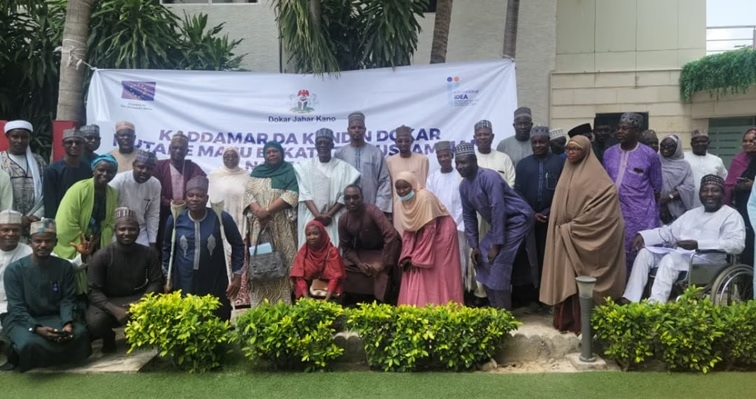
The dissemination took place on Friday at Tahir Guest Palace, Kano, during a stakeholder workshop attended by academics, education specialists, and representatives of tertiary institutions, members of the Association of Sign Language Interpreters, civil society organizations, and the media.
The workshop, supported by the European Union and implemented by the International Institute for Democracy and Electoral Assistance (International IDEA), is aimed at improving awareness of the law and access to justice for persons with disabilities, particularly people with hearing impairment, across Kano State.
In his opening remarks, the Kano State Project Coordinator of RoLAC II, Ibrahim Bello, described the event as a significant milestone in efforts to promote inclusive governance and ensure that persons with disabilities are not left behind in accessing justice and exercising their rights.
He said, “We are gathered here to present the Hausa version of the Kano State Disability Law 2022, produced by the Ministry of Women Affairs with the support of RoLAC.
“We are grateful for the cooperation and support we have received from the Ministry of Women Affairs, Children and Persons with Special Needs.
“Nobody should be left behind.
Since RoLAC commenced its intervention in Kano in 2017, we have been working closely with the state government and relevant ministries to achieve progress in inclusive governance and access to justice.”
Bello also appreciated Governor Abba Kabir Yusuf for supporting initiatives aimed at promoting the rights and welfare of persons with disabilities, stressing that RoLAC II’s interventions were implemented in collaboration with and with the approval of the state government.
He explained that the translation process involved two major components: translating the provisions of the law and providing interpretations to make its contents easier for ordinary citizens to understand.
According to him, experts and relevant stakeholders were consulted during the process to ensure the accuracy and usefulness of the document.
He said Dr Danlami Gwamna was initially engaged to translate the law, after which the draft was subjected to further review and consultation with stakeholders, including the Ministries of Justice and Women Affairs, Children and Persons with Special Needs, as well as representatives of the Joint National Association of Persons with Disabilities (JONAPWD).
Bello acknowledged that although the document had undergone extensive consultation, a minor error had been identified in one section, which he said would be corrected promptly before wider distribution.
He added that copies of the final document would be made available to relevant stakeholders, including lecturers and institutions involved in the education and training of persons with disabilities.
In his goodwill message, the Secretary of JONAPWD in Kano State, Adamu Ibrahim Maikoriya, expressed appreciation to RoLAC II, the Ministry of Women Affairs and other stakeholders for producing the Hausa version of the law.
He said the disability community in Kano had welcomed the initiative because it would make the provisions of the law more accessible, particularly to persons with disabilities living in rural communities.
“On behalf of my fellow persons with disabilities and the leadership of JONAPWD in Kano, we are grateful to RoLAC, the Women Affairs, Children and Persons with Special Needs, the Ministry of Justice and everyone who contributed to the production of this translated version,” Maikoriya said.
He also commended the retired director of the Women Affairs, Children and Persons with Special Needs Ministry who, according to him, pioneered the initiative, describing the translation as a document produced “with us, for us and for our common good.”
Maikoriya, however, appealed for the document to be reproduced in sufficient quantities and distributed to communities across the state’s 44 local government areas and wards.
Representing the Commissioner for Women Affairs, Children and Persons with Special Needs, Hajiya Amina Abdullahi, the Director of Administration and General Services, Muhammed Sambo Aliyu, commended RoLAC II for its technical support towards the dissemination of the translated law.
He said the intervention would contribute significantly to improving access to justice and strengthening the protection of the rights of persons with disabilities in Kano State.
The commissioner subsequently performed the formal dissemination ceremony and presented copies of the translated Disability Law 2022 to representatives of three associations of persons with disabilities.
Participants at the workshop also commended the initiative, describing the translation as an important step towards making the disability law understandable and accessible to a wider section of the population.
Some participants who spoke to Stallion Times noted that presenting the law in Hausa would particularly benefit persons with disabilities and their families in communities where English-language legal documents remain difficult to access and understand.
Also, representatives of disability organizations said increased awareness of the law would enable persons with disabilities to better understand their rights and the obligations of government and other institutions towards them.
The stakeholders expressed optimism that wider distribution and effective public awareness of the Hausa version would help bridge information gaps, strengthen inclusion, and enable more persons with disabilities to understand and seek enforcement of their rights under the law.