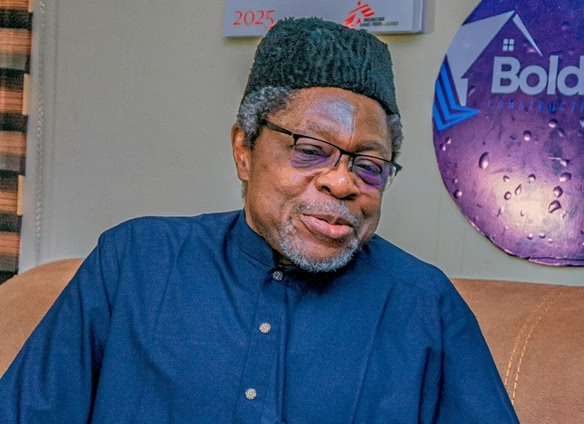
Hassan Gimba
Last Sunday, at a special prayer session organised in his honour by members of his family in Lagos, President Bola Ahmed Tinubu shocked – some would say regaled – the nation when he disclosed: “On the Wednesday of last week, I was shaving, and the water went off.
In the Villa, you won’t know punishment dey dia too” (there is punishment there, too, in Nigerian Pidgin). He emphasised: “In the Villa o!”
However, the President, who is seeking a second term, quickly added a caveat: “The water went off. So, we will correct all this. No light, no water, no electricity, no development. We have just started. We can do it, and we will do it for Nigeria,” he said.
But apparently, nothing works now; even the President had to lament: “No light, no water, no electricity, no development”!
During the colonial period, Nigeria had a 10-year development plan. It ran from 1946 to 1956 and was christened the Ten-Year Plan of Development and Welfare for Nigeria.
After independence, we shifted to five-year development plans. The last one, the Fourth National Development Plan, fashioned by the Shehu Shagari administration, ran from 1981 to 1985.
The purpose of five-year and 10-year development plans is to provide structured, time-bound roadmaps that align resources, policies, and projects toward long-term economic growth, social welfare, and structural transformation.
They also establish clear national or regional goals, priorities and target outcomes within a defined period.
But we no longer have such plans, having opted instead for highfalutin programmes such as Vision 2010, Vision 20:2020 and Nigeria Agenda 2050.
Yet, high-income and advanced economies continue to use multi-year plans to guide capital infrastructure development, sustainability initiatives and regional alignment.
Ireland, for instance, operates a rolling 10-year capital investment strategy known as the National Development Plan. Updated in July 2025, it is scheduled to run from 2026 to 2035, with €275.4 billion earmarked for investment.
Belgium operates a continuous cycle of five-year Federal Plans for Sustainable Development under federal law, aligning public policies with long-term sustainability goals.
Other developed economies with various five-year or 10-year development plans include Norway, South Korea, Canada, Hong Kong and China, which is embarking on its 15th Five-Year Plan for 2026–2030.
I recall that, in the 1970s, the Water Board made public announcements to notify residents of repairs and maintenance work so they would know when water supply to their taps would be interrupted. And when it would resume. Those were the days when we hardly knew anything about boreholes.
Even electricity supply was not simply cut off without notice. The Electricity Corporation of Nigeria (ECN), not to be confused with the Energy Commission of Nigeria, operated from around 1950/1951 until its merger with the Niger Dams Authority (NDA) in 1972 to form the National Electric Power Authority (NEPA). Before disconnecting supply, the ECN informed consumers. Sometimes, it gave warning signals.
First, the lights blinked, indicating that supply was about to be interrupted. Then, the power went off briefly before being restored for a minute or so, giving people time to fetch candles and lamps. The third interruption was final.
But now that nothing works, even the Villa is not spared the shenanigans of the Water Board and NEPA. Perhaps that explains why the Villa has turned to solar power.
As we have said, nothing seems to be working. Otherwise, how on earth could people enter a Government House, where the state’s Chief Security Officer resides, and kidnap his wife?
Even wanwantu, our answer to America’s nainwanwan, no longer seems to work. If it does, how come Dauda Adamu Kahutu, popularly known as Rarara, was beaten black and blue at the Central Mosque in Abuja two Fridays ago?
Rarara is no small fry. Anyone whom a President stands up to shake hands with is no ordinary folk. Besides, in September last year, the Emir of Daura, Alhaji Umar Faruk Umar, conferred on him the traditional title of Sarkin Wakar Kasar Hausa (King of Songs of Hausaland).
Incidentally, the nothing-is-working syndrome appears to have affected the Emir of Daura himself.
Last week, his protocol officers and guards reportedly disappeared from the scene, leaving him at the mercy of a big-busted, spyglass-wearing European woman.
It is astonishing that palace guards, whose duty is to protect the traditional institution and its dignity, even at the cost of their lives, could leave the Emir unattended in the company of a woman in an environment where, it would seem, the only other presence was the devil.
Now, embarrassing conduct has led to the suspension of the 60th Emir of Daura, exactly 60 years – almost to the date – after his predecessor, the late Emir, Alhaji Muhammadu Bashar, was suspended in 1966.
Palace guards can do anything to ensure the institution suffers no shame or embarrassment.
There is a story about palace guards in one of the Hausa emirates who beat up their Emir for sneaking out at night.
The story goes that the Emir, then young and randy, regularly sneaked out alone at night, wearing jeans and a T-shirt or baggy trousers with a matching shirt tucked in, to “enjoy” himself away from the strict routines of the palace.
The guards were unhappy because they believed he was desecrating the ancestral stool.
They reportedly conspired to end the practice. On the Emir’s return in the early hours of one night, the guards pounced on the unsuspecting, jeans-clad ruler and began beating him with their horsewhips.
Although he shouted that he was the Emir, they retorted: “Karya kake, Sarki baya shigan nan, kuma baya fita da dare” (You are lying. The Emir does not dress like this, and he never goes out at night).
According to the story, he never went out again. That sort of going out.
But because nothing works anymore, the Emir of Daura was left at the mercy of a manipulative enchantress!
But come to think of it, that video is incomplete. I want to believe that the Polish so-called tourist, Mirka Czee, who uses the Instagram handle @beduinqa and accused the Emir of touching her breasts without her consent during a visit to his palace, cut off a very important part of the recording.
How come the video ended when the Emir looked at her and echoed her “no, no, no” while leading her, presumably, to a more secluded inner chamber?
Remember, he held her hand and said, “Let me show you something”, before the hug, the kiss and the caressing touch and squeeze.
Why did the recording stop just where the world could see and hear her protesting, without showing us what she was allegedly shown – presumably, with her consent?
Lest I Forget
We are an open book to these white people who seem to know our country better than we know it ourselves.
She toured Nigeria for 30 days and recorded a great deal. And all “guided” by Nigerians. Many NGOs use Nigerians to gather information that even our governments don’t have.
Surely, we will examine that.
Gimba, ANIPR, is the Publisher and CEO of Neptune