Sani Kabir Hamza
There are political moments when wisdom must prevail over personal differences, when collective interests must take precedence over individual ambitions, and when the future of a people must matter more than the ego of their political leaders.
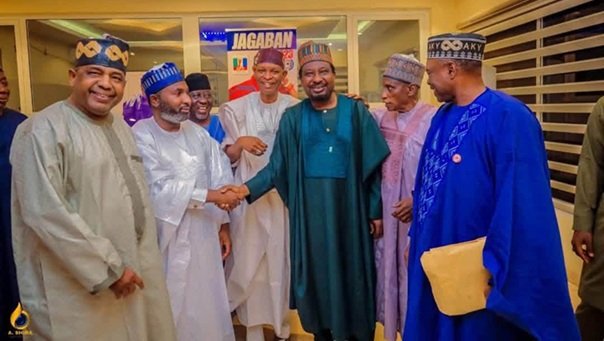
The reconciliation between the Deputy Senate President, Senator Barau I. Jibrin, and the Chairman of the House Committee on Appropriations, Hon. Abubakar Kabir Bichi, is one such moment.
This reconciliation should be seen beyond the relationship between two individuals. It presents an opportunity for Kano North to consolidate its political influence, strengthen its voice at the national level and improve its capacity to attract development and opportunities.
Consider the positions occupied by these two political figures. Barau is the Deputy Senate President, while Abba Bichi chairs one of the most influential committees in the House of Representatives, the Committee on Appropriations.
These are important national positions. When two individuals from the same senatorial district occupy such strategic positions, the potential benefits of cooperation cannot be ignored.
One represents Kano North in the Senate and occupies the second-highest presiding office in that chamber. The other represents Bichi Federal Constituency and plays a significant role in the National Assembly’s budgetary process.
Imagine what constructive cooperation, consultation and mutual understanding between these two offices could mean for Kano North.
It could strengthen advocacy for federal projects, improve attention to constituency needs, facilitate development initiatives and give the people a more coordinated voice in national affairs.
Of course, holding influential positions does not automatically translate into development. What matters is how effectively those positions are used, how institutions perform their responsibilities and how the people benefit from the opportunities available.
THE REAL CHALLENGE: THE POLITICS OF DETRACTION
Unfortunately, political reconciliation sometimes creates discomfort among those whose political relevance or calculations depend on continued disagreement between influential leaders.
This is where the conduct of political actors such as Umar Haruna Doguwa, Ali Baba Agama Lafiya, Aruwa and others deserves public scrutiny.
The question is not whether these individuals have the democratic right to hold different political opinions. They certainly do. The question is whether their political engagements contribute to reconciliation or perpetuate the divisions that the two leaders have made efforts to overcome.
It is also worth examining the geographical and political interests involved. These personalities are not representatives of Kano North in the National Assembly. Yet their political activities and interventions can influence the atmosphere surrounding the relationship between two prominent Kano North leaders.
This is not an argument that people from outside Kano North should have no voice in Kano politics. Kano belongs to everybody, and every citizen has a legitimate stake in its political development.
However, there is a difference between constructive participation and allowing factional interests to undermine cooperation that could benefit an entire senatorial district.
Political disagreements should not become permanent business for those who thrive on division.
BARAU AND ABBA BICHI MUST LOOK BEYOND THEIR DIFFERENCES
Both leaders should understand that reconciliation is not a declaration that one has defeated the other. Neither is it an admission of political weakness.
It is an acknowledgement that their individual political interests can coexist with a larger collective interest.
They must also recognise that not everyone applauding their reconciliation necessarily wants to see it succeed, just as not everyone who previously disagreed with either of them is automatically an enemy of peace.
The most important thing is to judge people by their conduct, not their public declarations.
Both leaders should maintain direct communication, resolve misunderstandings privately, respect one another’s political constituencies and avoid allowing third parties to become permanent interpreters of their relationship.
They should also discourage their supporters from turning every political disagreement into an opportunity for insults, character attacks and public humiliation.
A reconciliation that exists only in photographs and press statements is not enough. Its real value will be demonstrated through sustained cooperation, mutual respect and measurable benefits to the people.
THE BENEFITS MUST GO BEYOND POLITICAL POSITIONS
Kano North needs more than political titles. Its people need roads, education, healthcare, employment opportunities, industrial development, agricultural support and meaningful federal presence.
The positions occupied by Barau and Abba Bichi offer opportunities to pursue these interests through their respective legislative responsibilities.
The Senate and House of Representatives are different institutions, but they are part of the same National Assembly. Their members can work together without surrendering their independence or political identities.
There should be regular consultation on projects, legislative priorities, constituency interventions and matters affecting Kano North.
The people should ultimately be able to assess the value of their representation through results, not political propaganda.
A WORD TO THE POLITICAL CLASS
Kano politics has suffered enough from personality-driven rivalries and factional struggles. Political alliances should not be treated as permanent personal property, and political disagreements should not be allowed to destroy opportunities for cooperation.
The reconciliation facilitated by Governor Abba Kabir Yusuf in October, and the renewed commitment reported by the APC reconciliation committee today, November 25, 2026, provide an opportunity to move beyond public exchanges and establish a more sustainable working relationship.
The real test is what happens after the meetings.
Can the two leaders sustain communication? Can their supporters respect the understanding reached? Can other political stakeholders accommodate the reconciliation rather than continually reopening old wounds?
These are the questions that matter.
Kano North is bigger than Barau, bigger than Abba Bichi and certainly bigger than the ambitions of any political intermediary.
Neither leader should allow personal ego, political suspicion or the influence of third parties to destroy an opportunity for cooperation.
They do not have to become political twins. They do not have to agree on every issue. They only need to recognise that they can disagree on certain matters while working together on issues that benefit their people.
The ultimate measure of political leadership is not how many political opponents one defeats, but how many opportunities one creates for the people one represents.
Let reconciliation produce results. Let competition remain democratic. And let the interest of Kano North remain above personal ego.