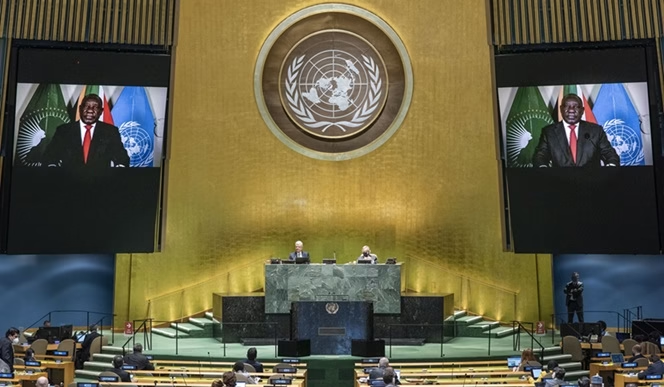
African leaders attending the 2026 United Nations (UN) General Assembly have renewed calls for reform of the UN Security Council to give the continent permanent representation in the powerful decision-making body.
Several African heads of state who addressed the General Assembly since its opening on Tuesday criticised the continent’s lack of permanent seats, arguing that Africa is directly affected by major global security crises despite having no permanent voice in the council.
The conflicts between Russia and Ukraine, Israel and Hamas, as well as the recent U.S.-Iran war, have featured prominently at this year’s gathering.
The 15-member Security Council currently has five permanent members — the United States, Russia, France, the United Kingdom and China — all of which possess veto power. The remaining 10 members are elected by the General Assembly for two-year terms, with Africa currently occupying three of the non-permanent seats.
Calls for Reform Intensify
African leaders said the ongoing global conflicts have made Security Council reform more urgent, warning that the continent’s exclusion undermines the credibility of the UN’s commitment to multilateralism and equality among nations.
Kenyan President William Ruto told delegates that while all nations are sovereign and equal under the UN Charter, five countries retain permanent powers on issues of war and peace that are unavailable to the rest of the membership.
Ethiopian President Taye Atske Selassie also questioned the continued exclusion of Africa, pointing to the continent’s population of about 1.6 billion people and its large representation among UN member states.
Liberian President Joseph Nyuma Boakai described the situation as a historical injustice that was no longer sustainable, arguing that correcting the imbalance was necessary to restore trust, credibility and legitimacy in the United Nations.
In 2024, the United States under former President Joe Biden expressed support for creating two additional permanent Security Council seats for African countries.
The African Union has long advocated for at least two permanent seats for the continent, a position contained in its 2005 consensus on UN reform.
Africa Seeks Greater Voice on AI
The demand for greater representation also extended to emerging global issues, particularly artificial intelligence, as African leaders called for developing countries to have a meaningful role in shaping rules governing the technology.
Botswana President Duma Boko said African countries should participate in discussions on AI and other technologies, as well as decisions concerning critical minerals, rare earth elements and energy resources that support technological development.
He said developing countries should have a meaningful voice in establishing standards and safeguards for emerging technologies to ensure they expand opportunities, support decent work and strengthen public services while protecting human rights and security.
Namibia’s President Netumbo Nandi-Ndaitwah said Africa had been negotiating for reform for too long and urged the international community to recognise the need for change.
Somali President Hassan Sheikh Mohamud similarly argued that reform should not be viewed as an attack on the United Nations, but as a necessary step to strengthen the organisation’s legitimacy, renew confidence in its institutions and enable it to respond effectively to contemporary global challenges.
(PBS)