Olu Allen
There is an old political lesson Nigerian godfathers never seem to learn:
The person you spend years building may eventually become the person you spend the rest of your political life fighting.
I thought the rumours about Abba Kabir Yusuf and Rabiu Musa Kwankwaso were exaggerated.
For years, the relationship looked almost unbreakable. Abba was not just Kwankwaso’s political protégé. He had served him as Personal Assistant, Principal Private Secretary and Commissioner.
He was the candidate of the Kwankwasiyya movement in 2019 and 2023. Their relationship extended beyond politics into family.
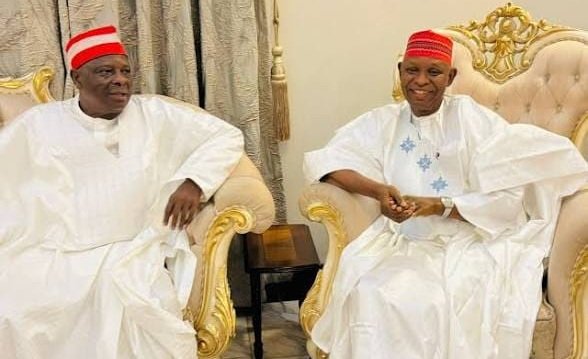
The red cap was more than an item of clothing. It represented a movement, a political identity and a structure built around one man’s influence.
Then came January 2026.
Abba left the NNPP and joined the APC.
He did not move alone. Members of the Kano State political establishment followed him, including all 44 elected local government chairmen. Kwankwaso called January 23 a World Day of Betrayal.
Many thought that was the end of the political romance.
But November 27 brought another chapter.
Kwankwaso publicly accused his former political protégé of attempting to use the EFCC to damage his reputation and political standing.
He alleged that Abba had personally petitioned the commission and subsequently used a civil society organisation to mount pressure through protests.
The Kano State Government rejected the accusation, insisting that Abba had no involvement in Kwankwaso’s dealings with the EFCC. The organisation behind the petition has also presented its action as an anti-corruption initiative.
So, let us be clear: these are allegations, not established facts. Whether Abba was involved is a matter that requires evidence.
But the political rupture is no longer a rumour.
Two men whose political relationship helped shape Kano’s recent political history are now publicly on opposite sides.
And this is where the story becomes bigger than Kano.
It is a familiar Nigerian political tragedy.
The Godfather build the godson. The godson inherits the power. Then the godfather discovers that his creation has become his rival
The first warning: Awolow and Akintola
Nigeria has seen this movie before.
In the First Republic, Chief Obafemi Awolowo was the dominant leader of the Action Group. Samuel Ladoke Akintola succeeded him as Premier of the Western Region.
But the relationship between the two men deteriorated over political strategy, leadership and the direction of the party.
Akintola favoured a different political alignment, including closer cooperation with the Northern People’s Congress. Awolowo and his supporters opposed the move.
The disagreement escalated into a major political crisis.
Akintola formed the United Peoples Party and returned to power through an alliance with the ruling federal political establishment.
The Western Region descended into political violence, followed by a state of emergency in 1962.
Awolowo was later convicted of treasonable felony in 1963 and imprisoned.
We must be careful not to reduce that entire national crisis to a simple story of one man betraying another. There were ideological disagreements, factional struggles and wider federal political calculations.
But the lesson remains relevant: when political loyalty becomes more important than institutions, a disagreement between political leaders can become a crisis for an entire society.
The fourth republic: Godfatherism becomes and industry
Since 1999, Nigeria has produced several versions of the same political arrangement.
A powerful political financier identifies a candidate, provides the machinery, mobilises resources and helps secure electoral victory.
The candidate becomes governor.
But the godfather expects more than gratitude.
He expects influence over appointments, contracts, political decisions and access to public resources.
The problem begins when the governor discovers that the office he occupies carries constitutional powers of its own.
Suddenly, the man who helped him become governor wants to determine how he governs.
And the man who was once grateful begins to resist.
Look at Anambra.
In 2003, Chris Uba played a major role in the emergence of Chris Ngige as governor. Their relationship collapsed when Ngige resisted Uba’s demands for control and political influence.
The conflict became notorious when Ngige was abducted by police officers and pressured to resign.
The episode exposed the frightening consequences of treating an elected governorship as the property of a political financier.
That was not democracy. That was political ownership.
Look at Lagos.
The political relationship between Bola Tinubu and Akinwunmi Ambode became a subject of intense public discussion when Ambode failed to secure the APC’s ticket for a second term in 2019.
Whatever interpretation one gives that episode, it demonstrated how powerful political structures and party gatekeepers can shape the political future of an incumbent governor.
Look at Kano itself.
Kwankwaso helped Ganduje become governor in 2015. Their relationship later collapsed spectacularly. Ganduje insisted on exercising his own authority, while Kwankwaso became one of his strongest political opponents.
Ganduje completed two terms.
Kwankwaso survived the political setback and rebuilt his influence.
And now, the man who helped build Abba’s political career is confronting another rupture.
The names change. The states change. The political colours change.
But the underlying struggle remains remarkably familiar.
Why does the godson always want to break free?
There is a fundamental contradiction in godfatherism.
The godfather wants to produce a governor who is powerful enough to win elections but not powerful enough to become independent.
He wants a leader who can govern the state but must first consult him before making important decisions.
He wants the respect of a mentor but often demands the obedience of an employer.
But the Constitution does not recognise political godfathers.
It recognises elected governors.
Once a governor takes the oath of office, he assumes constitutional responsibilities.
He controls an executive administration, appoints officials within the law, presents budgets and makes decisions for which he must ultimately answer to the people.
The godfather may have funded the campaign. He may have mobilised the supporters.
He may have provided the political structure.
But he did not win the constitutional mandate.
And this is where the relationship becomes complicated.
The godfather believes the governor owes him political obedience.
The governor believes the godfather must respect his authority.
Both may claim loyalty to the same political movement, but they are fighting over who actually controls it.
The godson wants a successor. The godson wants to become the principal
Sometimes, the godson does not merely want freedom from the godfather.
He wants to remove the godfather’s influence completely.
That is when political disagreement becomes political warfare.
Kwankwaso and Abba: The family connection did not save the polotical relationship
What makes the Kano situation particularly interesting is the length and depth of the relationship.
Kwankwaso described it as a 43-year relationship built on trust.
Abba served under him in several capacities. He became the preferred candidate of the movement and eventually governor.
The relationship was political, personal and familial.
Yet, none of those connections prevented the eventual separation.
This should tell us something about the nature of political loyalty.
A political alliance can survive opposition, elections, disagreements and even temporary setbacks.
But when two powerful individuals begin to disagree over who controls the machinery of power, personal relationships can quickly become casualties.
Kwankwaso’s accusation against Abba is serious. Abba’s government has denied involvement. The EFCC must examine any petition it receives on its merits, without becoming an instrument of political revenge.
If Kwankwaso has questions to answer, he should answer them.
If Abba is accused of abusing public institutions for political purposes, evidence should establish that too.
Neither a former godfather nor a sitting governor should enjoy immunity from accountability.
That is the point politicians often forget.
Public Institutions Are Not Family Property
The real victims are the people
Here is the part that should concern us most.
While political godfathers and godsons fight over influence, the ordinary people who voted for them are often left watching from the sidelines.
Where is the debate about Kano’s schools?
Where is the sustained conversation about employment, healthcare, water supply, security and the condition of public infrastructure?
How much political energy is being spent on governance, and how much is being consumed by the struggle over who controls the party?
The people did not elect a governor to settle scores with his former mentor.
Neither did they elect a former governor to spend his political life fighting the man he helped install.
They expect leadership.
And this is why godfatherism is dangerous.
It shifts political accountability away from the electorate and places it in the hands of private power brokers.
The governor begins to answer to the godfather instead of the people.
The godfather begins to behave as though the state belongs to him because he helped produce the governor.
And the citizens become spectators in a political arrangement they never agreed to.
The lesson Nigerian godfathers never learn
Every godfather believes his own godson will be different.
More loyal. More grateful. More obedient.
But power changes relationships.
The man who once needed your endorsement eventually acquires his own political structure.
The man who once waited for your instructions begins receiving instructions from others.
The man who once needed your name to win an election may eventually discover that your name has become a political burden.
This is not necessarily because every godson is wicked or every godfather is manipulative.
Sometimes the godfather genuinely refuses to let go.
Sometimes the godson becomes arrogant after acquiring power.
Sometimes both are simply fighting over political control.
But the system itself is defective because it creates political debts that are never clearly defined and expectations that have no constitutional foundation.
A democracy cannot be built around the private ownership of elected officials.
A governor is not an employee of his political benefactor.
A political mentor is not the owner of a state.
And a candidate’s gratitude must never become a substitute for democratic accountability.
The Godfather May Help You Win The Election, But The People Must Remain The Owners of The Mandate
The last word
Kwankwaso survived his political war with Ganduje.
Now he is locked in another bitter confrontation with Abba, the man he helped build, the man he trusted and the man who eventually became governor.
Whether the latest EFCC allegations are true or not, the political rupture is a reminder of how fragile these relationships can be.
Perhaps the real tragedy is not that a godson eventually outgrows his godfather.
It is that Nigerian politics repeatedly produces godfathers who believe they can own elected officials and godsons who sometimes believe that acquiring office means they owe nobody an explanation.
Both are wrong.
The governor must answer to the Constitution and the people.
The former governor must answer for his own public record.
The EFCC must answer to the law, not political instructions.
And the electorate must stop rewarding politicians merely for defeating their former political masters.
Because when the next election comes, Nigerians should not be asked to choose between a godfather and his godson.
They should be asked to choose who has the better record, the better ideas and the capacity to govern.
The boy made may eventually bury your political influence. But the people should never be the ones left to bury the consequences
So, here is tonight’s question:
Is Nigerian godfatherism producing political leaders, or merely producing powerful godsons who eventually become the next generation of godfathers?
Allen writes on public affairs and promotes good governance.