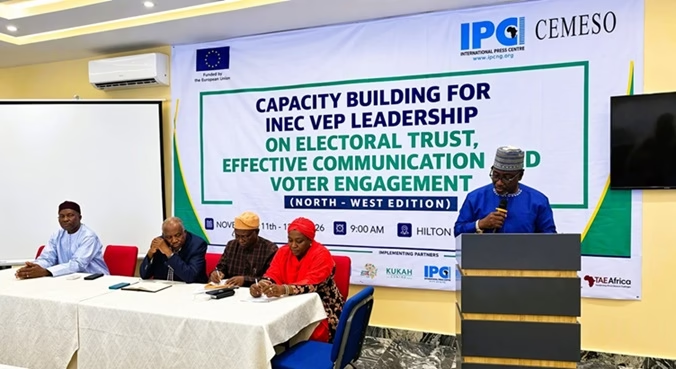
The International Press Centre (IPC) has urged officials of the Independent National Electoral Commission (INEC) to strengthen their communication, legal knowledge, and fact-checking capacity to protect public trust in the electoral process ahead of the 2027 general elections.
The IPC warned that inaccurate information, misinformation and disinformation, particularly from officials responsible for voter education and publicity, could undermine public confidence in the commission.
The Executive Director of IPC, Lanre Arogundade, gave the charge on Wednesday at a two-day capacity-building workshop for INEC’s Voter Education and Publicity (VEP) and gender officials in Kano.
The workshop, organized by IPC and the Centre for Media and Society (CEMESO), is part of Component 4: Support to Media of the European Union Support to Democratic Governance in Nigeria (EU-SDGN) program.
Arogundade said the engagement was designed to assess INEC’s preparedness and strengthen the capacity of its officials to deliver effective public communication through improved knowledge of electoral laws, crisis communication, proactive verification and fact-checking.
He noted that with the 2027 general elections approaching and political campaigns intensifying, public scrutiny of INEC was increasing amid widespread uncertainties, controversies, false narratives and competing claims.
According to him, VEP and gender officials occupy a strategic position in the information chain between INEC and the public, making their responsibilities critical to ensuring effective, efficient and inclusive voter education.
He expressed confidence in their ability to contribute to credible elections, citing previous engagements with INEC officials in Anambra, Ondo, Ekiti and Osun, where off-cycle elections were conducted within the past two years.
Arogundade said the contributions of VEP officials to those elections included active participation in media and stakeholder engagements, capacity-building programs on information management and the establishment of fact-checking units through an IPC-led initiative.
However, he cautioned that the challenges ahead of the 2027 elections would require greater preparedness, particularly as electoral processes increasingly face legal disputes, court actions and misleading public narratives.
He stressed that public trust must be built long before Election Day through consistent, accurate and transparent communication.
The IPC executive director also raised concerns about the growing threat of artificial intelligence-generated content and foreign information manipulation, noting that technological advances had made it possible to clone voices and falsify election result sheets within seconds.
He made reference to the national summit on Artificial Intelligence (AI), Foreign Information Manipulation and Interference (FIMI) and Electoral Information Integrity held in Abuja on November 2 and 3, which identified states facing varying levels of electoral information risks.
According to the threat assessment presented at the summit, Kano, Kaduna, Zamfara, Borno, Plateau and Benue were classified as very high-risk states, while Katsina, Sokoto, Kebbi, Yobe and Adamawa were among states rated high-risk.
Jigawa and some other states were classified as having elevated risks.
Arogundade urged INEC officials to avoid vague or inaccurate responses to public questions, particularly those concerning the Electoral Act and voting procedures, warning that such mistakes could damage the commission’s credibility.
He emphasised that every public interaction by an INEC official could either strengthen or weaken institutional trust.
He also stressed the importance of local knowledge in designing voter education messages, noting that information needs, media access and public concerns differ across states and communities.
He said the training would feature practical simulations, including hostile press questions, viral rumours and election-day disputes, to prepare participants to respond accurately and professionally under pressure.
The sessions are being facilitated by Dr. Monday Ashibogwu, Managing Editor of Quick News, and Dr. Mohammed Amali, Senior Research Fellow in Bills and Legislative Drafting at the National Institute for Legislative and Democratic Studies.
Arogundade urged participants to take advantage of the facilitators’ expertise and develop plans to transfer the knowledge acquired to their colleagues across the commission.
He appreciated the Chairman of the Independent Voter Education Committee (IVEC), National Commissioner Muhammed Haruna, and INEC Director of Voter Education and Publicity, Mrs Victoria Etta-Messi, for their support in making the initiative possible after nearly two years of engagement.
He also acknowledged the European Union for providing funding support for the program.
“Trust under pressure is built by those who are prepared, and you are the people who will carry it into 2027,” he said.