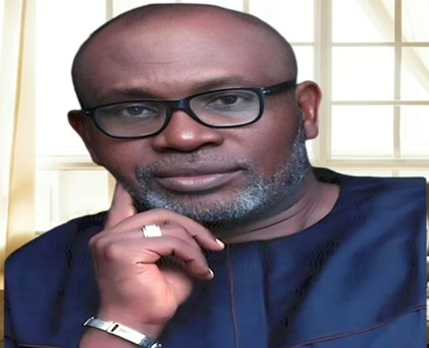
Rekpene Bassey
Every nation is ultimately betrayed twice. First by those who exploit its weaknesses. Then by the institutions that failed to recognize those weaknesses before they were exploited.
The first is criminality. The second is institutional failure. History teaches that the latter is always the most dangerous.
More than two thousand years ago, the Roman satirist Juvenal posed a question that has outlived empires, monarchies and republics.
It remains perhaps the most enduring question in the philosophy of governance: Quis custodiet ipsos custodes – Who guards the guardians?
Every civilization has attempted an answer. Kings trusted loyal courtiers. Empires relied on military power.
Democracies established constitutions, intelligence agencies, anti-corruption commissions, auditors, inspectors-general and parliamentary oversight committees.
Still every generation eventually rediscovers the same uncomfortable truth: institutions created to guard society must themselves be guarded against complacency, error and failure.
Nigeria finds itself confronting that timeless dilemma presently. The Independent Corrupt Practices and Other Related Offences Commission (ICPC) has announced interim findings alleging that the so-called Presidential Foreign Intervention Promotion Council (PFIPC) had no legal foundation, that appointment documents associated with it were forged, and that additional fictitious agencies were allegedly created to support its operations.
The Commission has also stated that its investigation is continuing and that criminal proceedings are being prepared against those it believes were involved.
If those allegations are ultimately established in court, the episode will rank among the most extraordinary cases of institutional deception in Nigeria’s democratic history.
However, even before the courts pronounce judgment, one uncomfortable truth already confronts the nation.
The most important question is not who allegedly created the deception. The most important question is why the deception was not uncovered and interrupted much earlier by ICPC, the Economic and Financial Crimes Commission (EFCC), the Department of State Services (DSS) or the Nigeria Police Force (NPF).
That distinction changes everything.
Public attention naturally gravitates towards personalities. Newspapers identify suspects. Television debates discuss culpability.
Politicians demand punishment. Citizens ask who should be arrested, prosecuted or dismissed.
Those questions matter. But they are not the questions that determine whether a republic becomes stronger after a crisis.
History remembers scandals differently. It rarely remembers only the individuals involved.
Instead, history asks what the scandal revealed about the institutions that allowed it to happen.
That is why Watergate is remembered not merely for Richard Nixon but for what it revealed about executive power.
The Enron collapse is remembered not simply because corporate executives committed fraud but because it exposed deep weaknesses in corporate governance, auditing and financial regulation.
The attacks of September 11 are studied not only because terrorists succeeded but because the world’s most sophisticated intelligence community failed to connect information that already existed.
Serious nations therefore examine crises differently. They investigate individuals. But they reform institutions.
Nigeria must do the same. The PFIPC affair, as publicly described by investigators, should not merely become another criminal prosecution.
It should become an institutional audit of the Nigerian State itself. For beneath every successful deception lies an unsuccessful system of detection. That is the real story.
Thomas Hobbes argued that civilization exists because individuals surrender certain freedoms to a sovereign authority capable of maintaining order.
The State, in Hobbes’ conception, becomes the ultimate source of legitimate authority.
More than two centuries later, the German sociologist Max Weber refined that idea, describing the State as the institution possessing the monopoly of legitimate authority.
Their language differed. But their conclusion did not.
Government possesses one privilege that no private citizen, corporation or organisation enjoys.
Only government can legitimately create government. Only government can lawfully establish public institutions.
Only the government can constitutionally appoint public officials.
Everything else derives from that singular source of legitimacy. This is why the allegations surrounding the PFIPC matter far beyond questions of criminal liability.
If an organisation could allegedly present itself as an institution of government without legal authority, then the issue confronting Nigeria extends beyond corruption. It touches the authenticity of the State itself.
Government must always know itself!
That statement sounds obvious until one reflects upon its implications.
A modern nation state should instantly know which agencies legally exist. It should immediately authenticate appointments.
It should verify institutional mandates without ambiguity. It should distinguish genuine authority from fabricated authority without hesitation.
When that certainty weakens, opportunities emerge. And where opportunities emerge, deception follows.
Fraud, contrary to popular belief, rarely begins with forged documents. It begins much earlier.
It begins when verification becomes less rigorous. When assumptions replace confirmation. And when one institution assumes another has already undertaken the necessary scrutiny.
The fraud is therefore never the beginning of the story. It is merely the moment when institutional weakness becomes visible.
That is why the title of this article is The Failure Before the Fraud.
The fraud, if ultimately proven, belongs to criminal law. The failure belongs to the political class, technocrats and public administration.
And institutional failures are invariably more consequential than individual crimes because they remain long after individuals have departed.
Political philosopher Hannah Arendt once observed that power ultimately rests not upon force but upon legitimacy.
Governments endure because citizens collectively accept that public institutions exercise lawful authority.
Trust therefore becomes the invisible currency of every constitutional democracy.
Investors trust regulatory agencies. Foreign governments trust diplomatic institutions. Businesses trust licensing authorities.
Citizens trust official documents. Public servants trust the legitimacy of communications received from other public institutions.
Every one of those relationships depends upon confidence that the State knows itself. Once uncertainty enters that equation, institutional confidence begins to erode.
That erosion may not be immediately visible. But like rust beneath paint, it spreads quietly until one day the structure itself begins to weaken.
This is precisely why mature democracies respond differently to institutional scandals. They do not merely prosecute offenders.
They interrogate systems. They ask not only, “Who committed the offence?” but, “What weakness made the offence possible?”
That second question is invariably the more valuable one. The American response to the intelligence failures preceding the attacks of September 11 illustrates the point.
Subsequent investigations concluded that information relevant to the attacks had existed within different institutions. The problem was not necessarily the total absence of intelligence.
The problem was that institutions possessing fragments of information failed to integrate those fragments into coherent understanding.
The failure lay not merely in collection. It lay in coordination. It lay in verification and in institutional imagination.
The 9/11 Commission would later describe it as “a failure of imagination.”
That phrase deserves careful reflection. Institutions rarely collapse because they know too little.
More often, they collapse because they fail to recognise the significance of what they already know.
Nigeria should approach the PFIPC affair with similar intellectual honesty. The challenge is not merely to determine what investigators have uncovered.
The challenge is to ask what institutional lessons remain to be learned.
(The naration continues…)
Bassey is the President of the African Council on Narcotics and a Security Specialist.