Ahmed Yahaya Joe
“The lion does not concern himself with the opinion of the sheep.” – Tywin Lannister, Game of Thrones (S1 E7)
While it is conventional wisdom that newspapers provide the rough draft of history, books, on the other hand, actually determine the ultimate course of history. Perhaps why Churchill maintains, “History would be kind to me because I intend on writing it.”
Therefore against the backdrop of the many books written by or about the members of Nigeria’s retired generals, we “bloody civilians” ought to bow our heads in shame for not bringing forth alternative narratives on the cyclic phenomenon of military intervention between our First and Third Republics.
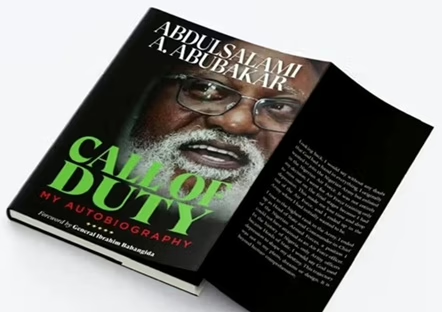
From Babangida’s “My Journey in Service” to Gowon’s recent “My Life of Duty & Allegiance” and Abubakar’s forthcoming “Call of Duty: My Autobiography” is “From Soldier to Statesman: The Legacy of Muhammadu Buhari” by Charles Omole.
This high falutin literary precedent was first set in 1979 with “Danjuma: The Making of a General” by Lindsay Barrett on Nigeria’s army chief from 1975 to the beginning of the Second Republic.
Closely following in his erstwhile principal’s “My Command” by Olusegun Obasanjo in 1980 with later the same year “The Nigerian Revolution and the Biafran War” by Alexander Madiebo, Biafra’s army chief and Sandhurst course mate to Gowon.
By 1981, Ben Gbulie and Adewale Ademoyega had presented to the reading public “Nigeria’s Five Majors” and “Why We Struck” respectively.
The rest is still living history till 13 June 2026, when General Abdulsalami Alhaji Abubakar, on the day of his 84th birthday, will present his own version of events for public scrutiny.
How did the ageing members of the retired generals’ billionaire club reinvent themselves as the so-called “protectors of the national interest” rather than remaining as defenders against external aggression?
“With no external enemies to fight, military heroism tended to be sought in the political arena rather than in the battlefield.” – p.4 Soldiers of Fortune (2013) by Max Siollun
Chidi Amuta adds in his preface to Olusegun Adeniyi’s Against the Run of Play (2017); “Nigeria’s (civilian) politicians have the appetite of elephants but the memory of mice. Political events themselves are suffused in hearsay and myths.
Our politicians hardly keep diaries, let alone wrote memoirs. They play politics as a game, albeit an unserious one disconnected from any commitment to national history and goals.”
Arguably, if the 15 January 1966 putschists had been duly charged and seen to be diligently prosecuted for their heinous crimes, “Paiko’s wedding” of July 29 later that same year would not have taken place at all.
While that may sound like stretching speculation too far: Was the Nigerian Civil War avoidable?
No. This is because the casus belli was crude oil; “War is a racket. It has always been. It is possibly the oldest, easily the most profitable, surely the most vicious. It is the only one in which the profits are reckoned in dollars and the losses in lives.”
– US Marines Major General Smedley D. Butler (1881-1940)
As former President Obasanjo puts it; “If Nigeria had been left alone by other countries and their nationals, especially the developed countries, the Nigerian crisis might not have developed into a civil war.
Without the promise and assurance of moral and material support and open recognition, Ojukwu might not have taken the final plunge of declaring the Eastern Region an independent state of Biafra.”
– p.208 My Command (2015 reprint)
From the First Republic in 1965 to date under the Tinubu dispensation, there has been a total of 30 indigenous army chiefs.
21 that have held that office from the North with only 9 of southern extraction in order of seniority: Ironsi, Ejoor, Akinrinade, Ogomudia, Azazi, Ihejirika, Minimah, Lagbaja, Oluyede.
The future President Buhari, in his own words on 20 March 2002, offers some context on this lopsidedness;
“The leadership of the North paid close attention to shifting trends abroad and in particular to the situation in Iraq where an ancient monarchy had been displaced by young officers in July 1958.
The Emir of Kano (Sanusi I) told one of us (Shehu) that if soldiers could overthrow a line of kings descended directly from the Prophet, it could happen anywhere. So, we should go and join the army….
Shehu travelled to Lagos with his elder brother Yusuf, still confident of a move to King’s College (for his HSC). They were told by their father (Tafida of Katsina, Musa Yar’adua) to be ready the next morning to meet the defence minister.
Ushered into his office, Ribadu asked Shehu, ‘What are you planning to do with your life?’
He replied that he had come to Lagos to study. ‘You must join the army,’ he said. ‘I will speak to Tafida.’ The meeting marked the end of Shehu’s legal ambitions.” – pp. 18-25 Shehu Musa Yar’adua: A Life of Service (2004) by Jacqueline Farris & Mohammed Bomoi
Meanwhile; “Yorubas of the Western Region, for example, still looked down on a career in the military. By 1966, out of 10,500 soldiers, Yorubas numbered about 700 instead of a projected 2205 based on quota.
In the Midwest Region, interest was particularly high in the Anioma areas.
In the Eastern Region, recruitment from the Calabar-Ogoja-Rivers provinces, which had been a source of many soldiers during WWII, declined as economic opportunities there increased.
On the other hand, interest in the core Igbo areas increased.” – History of Civil-Military Relations (Part II) by Nowa Omoigui
For goodness sake, who would want to read the recollections or even reminiscences of the FCT minister under the current dispensation, even for free? Thanks, but no thanks.
Kudos, IBB, for providing a soft copy link of your memoirs.
Perhaps his lifelong friend and Minna hilltop neighbour, General Abdulsalami Alhaji Abubakar, might similarly oblige a generality of Nigerians, particularly those of us who can’t afford the N100,000 price tag on a hardcover copy of Gowon’s book.
Lest we forget while in exile on the island of Saint Helena after his fall from power, Napoleon Bonaparte, who attained the rank of Major General at the age of 26 later becoming emperor of France, 1804-1814 declared;
“Mais qu’est alors cette vérité historique, la plupart du temps? Une fable convenue, ainsi qu’on l’a dit fort ingénument.”
(“But what is historical truth, most of the time? An agreed-upon fable.”)