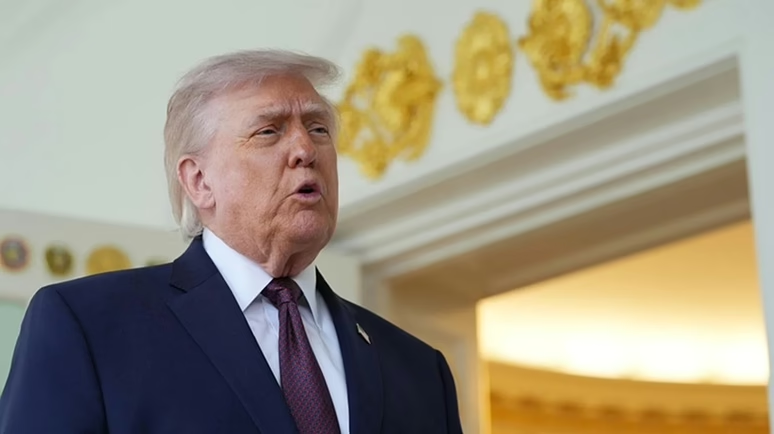
US President Donald Trump warned Iran it would face “a much higher level and intensity” of strikes if it failed to agree to a peace deal that the two sides are reportedly closing in on.
Media, including Axios and Reuters, reported on May 6 that Tehran and Washington were close to an agreement on a one-page memorandum to end the war in the Gulf.
The agreement would include Iran committing to a moratorium on nuclear enrichment, the United States agreeing to lift sanctions, Axios reported.
Also, billions of dollars in frozen Iranian funds would be released, and both sides would lift restrictions around ships sailing through the Strait of Hormuz.
Trump appeared to confirm a deal was nearing in a post on social media, though he gave no details.
“Assuming Iran agrees to give what has been agreed to, which is, perhaps, a big assumption, the already legendary Epic Fury will be at an end, and the highly effective Blockade will allow the Hormuz Strait to be OPEN TO ALL, including Iran,” he wrote.
“If they don’t agree, the bombing starts, and it will be, sadly, at a much higher level and intensity than it was before.”
In comments later to the broadcaster PBS, Trump said he was optimistic about striking a deal, which he said could include Iran exporting its highly enriched uranium to the United States.
“I think it’s got a very good chance of ending,” he said, referring to the 9-week-old war, “and if it doesn’t end, we have to go back to bombing the hell out of them.”
Among the key reasons cited by the Trump administration for going to war is Iran’s nuclear ambitions.
Washington wants Tehran to give up its uranium, including its highly enriched uranium, which can be used for building a weapon.
Tehran insists its nuclear programs are strictly for civilian purposes.
Trump’s comments came hours after he announced that the operation called Project Freedom to guide ships through the Strait of Hormuz will be “paused for a short period of time” after making “Great Progress….toward a Complete and Final Agreement with Representatives of Iran.”
The United States sought to restore commercial traffic through the crucial waterway after it was effectively closed by Iran, leaving thousands of ships stranded for weeks and impacting the global economy.
The move was taken in response to the US and Israeli military campaign, which was launched on February 28.
Fears have grown that a halt in hostilities announced nearly a month ago had unraveled after the United Arab Emirates — a key US ally in the Gulf region — reported incoming volleys of Iranian missiles and drone attacks were reported on at least one ship in the Persian Gulf.
Beijing on May 6 reiterated its call for a “comprehensive cease-fire” in the conflict and for a return to normal passage through the Strait of Hormuz as Iranian Foreign Minister Abbas Araqchi kicked off his first visit to China since the conflict erupted.
Foreign Minister Wang Yi said after a meeting with Araqchi in the Chinese capital that China will work “harder” to help bring an end to the fighting and play a “greater role in restoring peace and tranquility to the Middle East.”
“China believes that a complete cessation of hostilities is imperative, restarting the conflict is unacceptable and persisting in negotiations is particularly important,” Wang said, according to a statement from his ministry after the talks, which come one week before Trump is scheduled to meet his Chinese counterpart Xi Jinping.
China relies heavily on Middle Eastern oil exported and shipped via the Strait of Hormuz, and Chinese officials have been quietly involved in trying to help broker a settlement and get the ship traffic moving again.
(RFE/RL)