Stephen Enoch
Across Nigeria, the seeming collapse of public education has quietly reshaped how families pursue learning, pushing millions toward private schools as a form of rescue.
But that rescue is coming at a steep price. What was once seen as a pathway to better education is now raising concerns about affordability, transparency, and fairness.
According to parents who spoke to Stallion Times in Kano, they regard this system as one in which fees rise sharply, sometimes without clear justification, and additional charges are introduced with little consultation.
The Sudden Fee Increase
When Engr. Rabiu Haruna received a N700,000 school fee teller for his son’s second term at Intercontinental School in Kano; he thought it was an error.
Only months earlier, he had paid about N520,000 for the first term, a payment that already covered uniforms, books, and other compulsory items.
“To my surprise, for the second term to see a teller containing N700,000 is outrageous,” Haruna said.
He told Stallion Times that the increase pushed him into financial distress and forced him to reconsider whether quality education in Kano has become a privilege reserved for the wealthy.
Compulsory Feeding, Questionable Charges
According to Haruna, school authorities justified part of the increase with the introduction of Science, Technology, Engineering, and Mathematics (STEM) classes and feeding arrangements.
But he questioned why parents were compelled to pay for services they were neither consulted about nor allowed to opt out of.
“The authorities said STEM was introduced and feeding was compulsory,” he explained.
Haruna also revealed that not every child is allowed to carry food from home.

The policy, he argued, effectively forces parents to purchase meals directly from the school regardless of their financial situation or the child’s preference.
“If my child doesn’t want that meal, what does that mean? He will be forced to eat that because he cannot stay the whole day without food.
“Denying them food from home does not eliminate the possibility of carrying substances because they still come with school bags,” he complained.
When this parent demanded a detailed breakdown of the N700,000 fee, Haruna claimed school administrators struggled to justify the figures.
According to him, N25,000 was allocated to STEM classes and N80,000 to feeding, while the remaining amount was largely categorized as tuition.
“JS1 tuition alone reaching almost N600,000? There is no electronic laboratory or special facility in the school,” he said.
Education Becoming an Industry
For Haruna, the issue extends beyond a single school bill. He believes private education in Kano is gradually shifting from a social service to a profit-driven enterprise.
“I’m taking my children there because of discipline and quality education, not because I want to compete with wealthy families,” he stated.
He alleged that some schools deliberately target elite families and then raise fees beyond the reach of middle-income earners.
The pressure intensifies during graduation ceremonies and extracurricular activities.
Haruna recalled paying N300,000 for his daughter’s SS3 graduation ceremony in 2025, an amount he described as excessive for what he called “a show of class identity.”
“If you don’t pay, your child begins to feel inferior among classmates,” he pointed out.
Beyond the financial burden, Haruna accused authorities of failing to adequately regulate private schools.
He argued that government agencies responsible for education oversight have allowed schools to operate with minimal scrutiny, especially regarding fee structures and learning materials.
“The government is there to regulate every industry and protect the interests of the people,” he said.
“If You Cannot Afford It, Remove Your Child.”
For years, Ahmad Mohammed Sarari, a parent, believed education was the one inheritance he could confidently give his children.
Though he described himself as “not from a rich family,” he sacrificed heavily to keep his children in some of Kano’s most prestigious private schools, convinced quality education would secure their future.
Sarari recalled how what began as steady annual fee adjustments suddenly turned into what he described as “astronomical increases” by private schools in the state.
“For the last three or four years, I noticed increases of 50 percent, 75 percent, even almost 100 percent,” he said.
According to him, many middle-class parents could no longer cope with the rising charges, yet school authorities allegedly dismissed their complaints.
“The response was always: ‘If you cannot afford it, remove your child.’ There was no respect for parents,” he said.
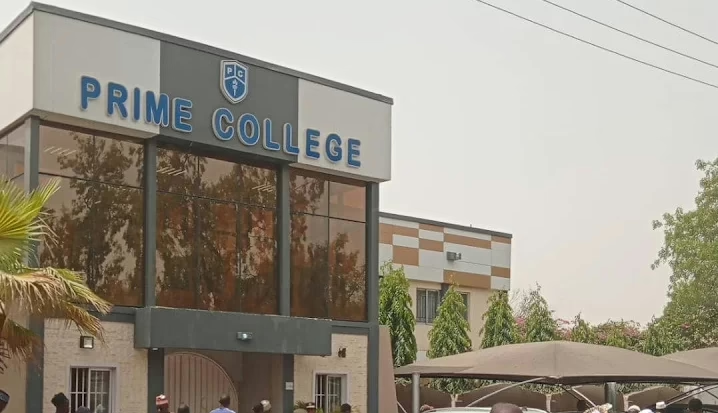
Sarari’s account reflects growing frustration among parents in Kano, where some elite private schools, like Prime College, where his children used to attend, now charge between N2 million and N3 million annually.
Investigations revealed that, in addition to tuition fees, some schools impose additional charges for prayer activities, cultural events, graduation ceremonies, and special programs.

PTA Stifled
Sarari alleged that Parent-Teacher Associations (PTAs), which ordinarily serve as accountability channels between schools and parents, have become ineffective in some institutions.
“They don’t allow the PTA to function properly. For years, there has not been meaningful engagement,” he claimed.
The situation eventually pushed him to withdraw one of his children from Prime College after years of patronage.
Behind the frustration lies a deeper concern. A widening educational divide between wealthy families and ordinary Nigerians.
Sarari fears the trend is gradually turning quality education into an exclusive privilege for elites, while public schools continue to deteriorate.
He accused regulatory authorities of failing to properly monitor private schools, alleging that weak oversight has enabled unchecked fee hikes and exploitative practices.
“The government has a responsibility to regulate schools and protect citizens.
“Education should not become an industry only for the rich,” Sarari pointed out.
Other Hidden Costs
For Engr. Abdulmutallib Mohammed, enrolling his children in one of Kano’s elite private schools, was never about prestige.
It was about values, discipline, and quality education.
The father of four said he deliberately chose Intercontinental School because of its strong blend of conventional and Islamic education, despite the school’s reputation as one of the most expensive in Kano.
“To be fair to them, they provide quality education,” he admitted.
According to him, what is becoming very frustrating is not just the school fees, but the hidden costs attached to everything.
Like many middle-class parents in Kano, Abu said he accepted the high tuition because he believed it would secure a better future for his children.
But over time, he began noticing what he described as “systematic exploitation” through compulsory purchases and repetitive charges imposed on parents.
“One issue particularly angered me, and it was the compulsory purchase of new textbooks every academic session, even when older siblings already had the same materials and could use them.
“I have four children in the school, following one another.
“Why must I buy books again for a child entering JS2 when another child has already used those same books and moved to JS3?” Mohammed questioned.
According to him, the school allegedly structured its policies in ways that leave parents with no alternatives.
“They make it compulsory.
“Whether you have one child or ten children, everybody must buy the books again,” he said.
For Mohammed, the problem is not entirely about paying for quality education.
Instead, he believes some schools are exploiting parents through policies that appear designed to maximize profit.
He said, “The books are even more annoying than the uniforms.
“Uniforms, maybe you can understand because children grow. But books? Why can’t another child use them?”
He also questioned the lack of detailed explanations from school management whenever parents demand accountability over rising charges.
“When you ask them to explain why the fees keep increasing, they don’t really give clear answers,” he added.

From Parent to Proprietor
For Shua’ibu Umar, the decision to establish a school was not driven by ambition but by frustration, financial strain, and a system he believes left parents with little protection.
Umar recounts how his experience with a private school in Kano became increasingly difficult as fees rose steadily each academic session.
With five children enrolled at the same school, the burden quickly compounded.
“Almost every new session, the school fees kept increasing. Sometimes by 10 to 20 percent. This pattern is unsustainable for me,” he said,
He explained that this situation was worsened by what he perceived as limited justification for the increments.
“The explanation was always inflation.
“Despite rising fees, teachers’ salaries appeared largely unchanged from what I observed.
“Faced with mounting costs and uncertainty, I began exploring alternatives.
“Together with a neighbor facing similar challenges, we made the bold decision to establish a school that would be more affordable and responsive to parents’ realities.
“We wanted to create a school that would give relief not just for others, but for ourselves too,” he explained.
He noted that the school started modestly, charging as low as N20,000 per term, an intentional effort to make education accessible.
According to him, he also faced challenges in running the school, but despite these, Umar insisted that regulating school fees remains critical.
“Without proper regulation, schools will continue to charge arbitrarily,” he warned.
Recent data from the United Nations Children’s Fund (UNICEF) indicate that Kano is among the states with the highest numbers of out-of-school children in Nigeria.
This gap has increased reliance on private schools, often with little regulation on fees.
The World Bank also notes that households in Nigeria bear a significant share of education costs, with rising “learning poverty” and inequality in access to quality education.
In 2025, the Kano government announced the closure of six private schools for alleged regulatory breaches, including arbitrary fee hikes and failure to provide parents with approved book lists.
Despite this, parents still complain about arbitrary fee increases and systematic extortion.
Arbitrary Fee Hikes Violate Kano Private School Regulations — K-SAFE
Dr. Auwal Halilu, Co-Chair of The Kano State Accountability Forum on Education (K-SAFE), has raised concerns over what he described as arbitrary and unlawful increases in private school fees across Kano State, warning that the trend is negatively affecting both parents and students.
Speaking to Stallion Times, Halilu said existing laws guiding private school operations in Kano already provide clear procedures for reviewing school fees, including consultations with parents and timelines for adjustments.
“There is a law guiding private school administration in Kano State under the Private and Voluntary Schools Board.
“The regulation states that school fees should not be increased frequently, and there must be an agreement between the school management and the PTA before any increase,” he explained.
He revealed that many private schools now allegedly bypass these procedures and impose sudden fee hikes without proper consultation with parents.
According to him, once they fail to follow the legal process, many parents see it as extortion.
Dr. Halilu noted that the rising cost of education is forcing some parents to withdraw their children from high-fee schools. In contrast, others struggle with repeated embarrassment when their children sent home for unpaid fees.
“That constant sending of children out of school affects their psychology and concentration.
“Some children begin to see their parents as failures because they cannot pay on time,” he noted.
While acknowledging that private schools also face economic pressures due to inflation and operational costs, Dr. Halilu argued that arbitrary increases without transparency only deepen distrust between schools and parents.
“The schools also have challenges maintaining standards because costs are rising everywhere, but both sides must work within the law,” the K-Safe Co-chair stated.
He called on the Kano State Government, private school owners, and civil society groups to enforce existing regulations and ensure accountability in the education sector.
“Everyone must play according to the rules. The government, school owners, and civil society must work together if we truly want quality education for the children of Kano State,” he noted.
Allegations of Extortion Meet Silence, Denial
Stallion Times visited Prime International School in Kano following allegations by parents of systematic extortion and other questionable charges, but the school management declined to comment. The principal refused to respond to inquiries or address the claims.
At Intercontinental College, however, the principal, Mr. Stephen Edede, denied any wrongdoing, insisting the school’s fees reflect the quality of education provided.
He said the institution operates a high-tech system that combines Nigerian and British curricula, integrating STEM and artificial intelligence-driven learning tools.
“We maintain high standards in everything we do,” he said, adding that teachers earn up to N500,000 and undergo regular training and retraining.
According to him, the school is also an accredited Scholastic Aptitude Test (SAT) and American College Testing (ACT) centre, a status held by only a few institutions in Northern Nigeria.
Edede maintained that the school’s consistent academic performance justifies its cost, noting that its students regularly outperform peers across Kano.
No School Has the Right to an Arbitrary Fee Increase – Board
The Executive Secretary of the Private and Voluntary Institutions Board, Abubakar Umar, in an interview with this reporter, said that no private school in the state is allowed to arbitrarily increase fees without consulting the PTA and the Board.
Responding to claims that some private schools pay the government to look the other way at alleged extortion, he refuted them.
According to him, “the private schools are mandated to pay the government 10% per tuition fee, but none of the schools in Kano are paying up to even 5%.

“It is lawful for increases in fees to be made, but the PTA and the Board must come to a consensus and agree before any change is made.
“Any school increasing fees without following this process is doing so unlawfully.
“For parents who have complaints of an arbitrary increase in fees or any alleged extortion, they should formally write to the board, and we will take up the matter,” Umar clarified.
This report was produced with support from Civic Media Lab