Rekpene Bassey
A Nigerian courtroom produced a mix only the internet age could decipher back in early April 2026. Consequently, one activist threatened to send another activist to prison. Not a minister, not a police officer, but a fellow activist, or dissident as some may term him (or them generally).
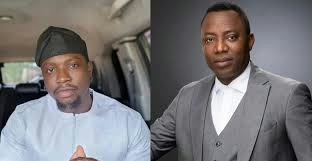
“Sowore, I swear to God, if dem born you well… use my picture on a billboard… I will send you to prison,” VeryDarkMan, or VDM, whose real name is Martin Vincent Otse, warned Omoyele Sowore on Instagram.
The target: a man who once led #RevolutionNow protests from the Department of State Services’ detention cell and has spent more than 15 years making enemies of the state.
The trigger: one Linus Ifejirika, a cryptocurrency businessman known as Blord. Charged with impersonating VDM, using his image on billboards and fake event tickets without consent, Blord was remanded at Kuje Prison on April 1, 2026.
Sowore stepped in, directing his lawyer Marshal Abubakar to withdraw from VDM’s legal team and pledging to secure Blord’s release. VDM responded with fury, accusing Sowore of betrayal: “Sowore just disappointed me… VDM I know, don’t fight half way.”
This is no longer a personality clash. It is a war between frontliners in Nigerian activism, and it exposes four structural fractures that make “speaking truth to power” in Nigeria look, from the outside, like speaking loudest to each other.
From comrades to combatants. The privatization of Public interests: Sowore and VDM were once aligned. Both built brands on confrontation. Sowore with Sahara Reporters and presidential bids; VDM with viral videos policing fraud, fake products, and elite hypocrisy.
Both faced arrest: Sowore by DSS in 2019, VDM by EFCC five years ago, a couple of years later, prompting a #FreeVDM campaign that Sowore himself joined.
However, by April 2026, their Venn diagram collapsed. “The worst thing…Sowore and VDM use to be best of friends, what change?”one commenter asked. The answer: the cause became the commodity.
Blord’s case crystallized it. To VDM, it was identity theft and “criminal conspiracy, impersonation, and unauthorised use.” To Sowore, it was state overreach: “sending Blord to prison over… an innovative strategy… should not be seen as a victory.” He framed it as “weaponisation of the legal system against citizens.”
When activists disagree on whether a jail term protects a person or punishes dissent, the moral center has fractured. The public square becomes a marketplace where influence is litigated. “Im convinced that there is absolutely no one verydark man can’t go against. And the fact that they are both self claimed activists,” quipped another commentator.
Lawfare is activism when the court replaces the street. And the second fracture! The movement migrated from protest to prosecution.
VDM’s arsenal is petitions, defamation suits, and N1 billion claims. He is also a defendant: Femi and Folarin Falana sued him for N500 million each over a video alleging they collected N10 million from Bobrisky to pervert justice. That case was adjourned to January 2025, with the court ordering VDM to take down the video.
Sowore’s response to Blord’s detention invoked Section 36 of the 1999 Constitution: “everyone is innocent until proven guilty.” A lawyer breaking down the feud said Sowore “is fighting for the law and fairness.”
So the irony: the man who once dismissed Nigerian courts as compromised now files bail applications; the man who built a career on viral call-outs now demands due process for the person who allegedly stole his likeness. Activism has been judicialized.
The risk: when every activist has a lawyer on retainer and a defamation suit pending, the state no longer needs to silence you. Your peers will keep you in court.
The audience verdict is influenced, without institutions. Hence the third fracture is accountability without structure. It is not likely that Sowore or VDM lead an NGO with a board, a manifesto, or dues-paying members. Their legitimacy is algorithmic: followers, engagement, the “Ratels” who marched for #FreeVDM.
That makes their different wars personal, performative, and volatile. When Sahara Reporters alleged VDM held a “secret night meeting” with IGP Olatunji Rilwan Disu to plot against Sowore, VDM gave them “1 hour to prove this to Nigerians or shut down your pages.”
The replies were pure crowd verdict: “Nobody trusts Sahara before na cruise dem dey do”; “VDM has long deviated… Shakara & Ego don take over!” Street vibes.
Without parties or unions, there’s no disciplinary committee. There is only the timeline. And the timeline rewards escalation. “This whole saga is now getting more interesting. Who do you think will win this new battle between VDM & SOWORE.” War becomes content. Nuance becomes a rating risk.
But of course there is the state’s quiet dividend: Divide et impera, digital edition. And now the fourth and most consequential fracture: the Nigerian state wins when its critics devour each other.
Sowore criticized police for opposing Blord’s bail, saying it “shows little change under the new Inspector-General Tunji Disu.” Days later, Sahara Reporters published that VDM met Disu secretly. True or not, the effect is identical: activists accuse each other of being state-adjacent while the state prosecutes both.
Meanwhile, the issues that birthed both men – police brutality, cybercrime arrests, impunity persist. VDM’s January 2025 video said he’d campaign for Seyi Tinubu for governor because “Seyi Tinubu is a bridge to achieving something I believe will make Nigeria work.”
Sowore’s politics are diametrically opposed. Their base is now forced to choose: anti-establishment purity or pragmatic access. That choice, not the government, fractures the movement.
“This kind of situation is avoidable, they just need to handle things more maturely and talk it out,” declared a fan. But maturity doesn’t trend. War does.
The cost of the feud sucks. The Blord bail hearing was delayed because the arrest was “timed to coincide with the Easter holidays.” Judges were on vacation. In that vacuum, two of Nigeria’s loudest voices spent 13 days litigating each other on Instagram instead of litigating the system that designed the vacuum.
That is the tragedy. Sowore is correct: celebrating pretrial detention normalizes a weaponized legal system. VDM is also correct: impersonation and forgery are crimes, and victims deserve redress.
Both positions can coexist. But in 2026’s attention economy, they cannot. The algorithm demands a villain and a hero, not two flawed protagonists.
A Unequivocal is closing. Equivocation means being deliberately vague to avoid commitment. Its opposite is being unequivocal: categorical, explicit, unambiguous.
So let this be unequivocal: Nigerian activism is not dying from state repression. It is bleeding from friendly fire. When the man who campaigned for your freedom from EFCC custody becomes the man you threaten with Kuje Prison, the state doesn’t need to ban protests. The protest has become the punishment.
The war between Sowore and Very Dark Man is not about Blord. It is about what happens when dissent becomes a brand, when followers replace constituents, and when the courtroom replaces consensus. It is about what happens when activists forget that the point of speaking truth to power is not to become the power that others must speak truth to.
Until that is understood, the only side winning is the one both men claim to fight. And it isn’t watching their Instagram Lives. It is watching them.
Bassey is the President of the African Council on Narcotics and a Security Specialist.