Olu Allen
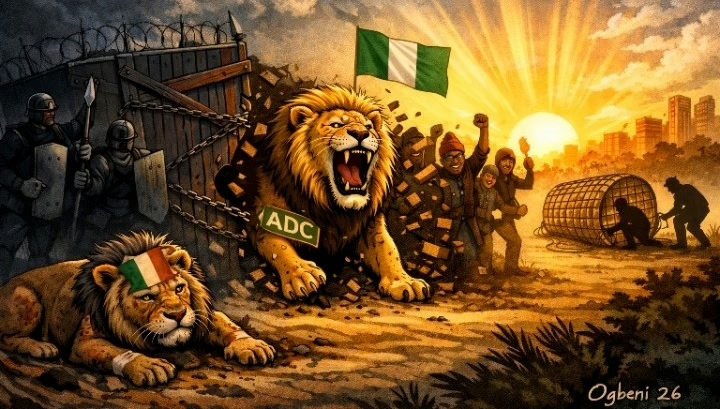
In the natural order of power, there is a curious law: when a lion who rules the pride has exhausted his strength, every effort to bar the entrance of the new lion only serves to hasten his emergence.
The system, the apparatus, the entire machinery of suppression, all of it, unwittingly, becomes the midwife of the change it seeks to abort.
The African Democratic Congress (ADC) national convention of 14 April 2026 is a textbook demonstration of this immutable truth. Against a coordinated assault of state power, the opposition did not merely survive; it was forged. Yet the critical analyst must also ask: what if the hunters have learned to trap lions before dawn?
The Anatomy of Suppression
The drama that unfolded in Abuja laid bare the desperation of a ruling class terrified of competition. After being denied access to Eagle Square and the Moshood Abiola National Stadium, national symbols that should be open to all, the party secured the privately owned Rainbow Event Centre, paid all fees, and signed a binding contract. Then the machinery of coercion began to grind.
First, the party alleged that the Federal Capital Development Authority (FCDA) and the Minister of the FCT, Nyesom Wike, threatened the venue owner with licence revocation.
When that pressure failed, the landlord, emboldened by the government, cut off power. In any functioning democracy, this would be a scandal. In Nigeria, it was merely Tuesday.
But the ADC had Dino Melaye, a figure whose political dexterity is matched only by his polarizing baggage. His team arranged industrial generators.
The convention went on. Yet the shrewd observer notes: making Melaye the organizational lynchpin also hands the APC a ready-made target for character-driven counter-narratives.
History’s Unwritten Law-and Its Exceptions
What the actors in this sordid play failed to understand is that political change is not a product of permits or power supply; it is a product of organized time.
Every great movement, from the fall of authoritarian regimes to the birth of new orders—follows a pattern.
The Arab Spring seemed to prove this: dictators believed they could suppress dissent with brute force. But when the time came, the people’s will swept through the region.
Then came the counter-revolution, Egypt’s generals, Libya’s fragmentation, Syria’s abyss. The lesson is not that change is inevitable; it is that the window of opportunity is real but finite.
Closer to home, the annulment of June 12, 1993, deepened pro-democracy resolve, and democratic rule emerged in 1999, but only after a military dictator’s death and elite bargaining.
The ADC’s convention is the latest chapter. Whether it becomes a turning point or a footnote depends on factors the convention alone cannot control.
Signs That the Gestation Period Is Ending
The signs are unmistakable for those with eyes to see. The ADC convention was preceded by a massive protest at INEC headquarters, where Atiku Abubakar, Peter Obi, and Rabiu Kwankwaso rallied against the commission’s derecognition of the David Mark-led leadership.
This was not a fringe gathering; it was a convergence of forces that, if united, could reshape Nigeria’s landscape.
The convention attracted over 3,000 delegates, ratified constitutional reforms, dissolved the old NWC, and installed a caretaker leadership. These are not the actions of a dying party.
More importantly, the ruling All Progressives Congress (APC) is bleeding internally. In Adamawa State, a governorship aspirant resigned citing “injustice and imposition.”
Across the country, APC economic policies have pushed poverty rates to 63 percent; 93 percent of Nigerians believe the country is heading in the wrong direction.
Fuel prices have surged nearly 500 percent; 82 percent report going without enough food. This is the soil in which change grows. But soil alone does not plant seeds. The missing link is ballot access—and the state still controls the ballot.
Structural Constraints the Optimist Must Acknowledge
No honest forecast ignores the regime’s counter-learning. The APC has watched this playbook before. Expect: accelerated co-option of opposition figures with ministerial appointments, judicial maneuvers to disqualify candidates, selective arrests of financiers, and the quiet funding of splinter factions to divide the ADC.
The Independent National Electoral Commission (INEC) has already demonstrated whose side it occupies. In a tight race, the party that controls accreditation, results collation, and tribunal appointments does not need to win the popular vote, it needs only to manage the margin of litigation.
The Most Possible Happening, and the Shadow Case
The ADC convention was a dress rehearsal. The real event will be the 2027 general elections. The most likely outcome is a seismic shift in Nigeria’s political alignment, with the ADC emerging as a central pillar of a coalition challenging APC hegemony.
The generator politics of the Rainbow Event Centre will, in this scenario, become a beacon for millions.
But the critical analyst must also entertain the shadow case. What if the ADC fragments under the weight of its own ambition? What if the APC simply postpones the election or orchestrates an “interim government” under the guise of national security?
What if the opposition unites only to discover that unity without local government penetration and polling unit agents is a castle built on sand? These are not doomsaying; they are the constraints that have broken every opposition wave since 1999.
The Wildcard
No forecast is complete without the variable no one controls. An elite rupture, a cabal within the APC breaking ranks, could accelerate the transition.
An economic collapse beyond current misery could make the regime’s survival secondary to basic order. Conversely, a nationalist rallying event (a security crisis, a foreign policy victory) could reset the clock.
The lion does not hunt alone; the savannah has weather.
Conclusion
The lion’s hour is approaching. And when it comes, no amount of power cuts or licence threats will stop it, provided the opposition solves the organizational puzzle the state has spent decades perfecting.
The dawn is not guaranteed. But for the first time in a generation, it is plausible. That, in Nigerian politics, is already a revolution.
Allen writes on public affairs and promote good governance.