Olu Allen
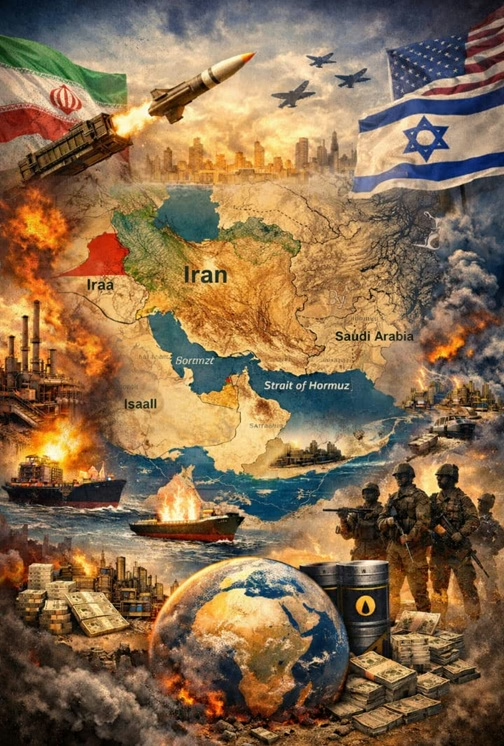
Most people watching the war in the Middle East think they understand it.
Missiles are flying.
Ships are burning.
News anchors are shouting.
But they are watching the wrong scoreboard.
The real battle is not between Iran, Israel, and the United States.
The real battle is about power, production, oil, and time.
And the deeper you look, the stranger the war becomes.
This War Is Not About Territory
Unlike the great wars of the past, nobody is trying to capture Tehran or Tel Aviv.
Instead, the war is fought through systems:
- missile factories
- shipping lanes
- cyber networks
- energy markets
When the Strait of Hormuz was disrupted, global oil prices surged and shipping traffic collapsed. Nearly 20% of the world’s oil flows through that narrow waterway.
A few explosions in the Gulf can shake the entire world economy.
That is not just war.
That is economic leverage.
Iran’s Real Weapon Is Disruption
Iran knows it cannot defeat the United States in a conventional war.
But it does not need to.
All it needs to do is create instability.
A few drone attacks.
A few damaged tankers.
Suddenly oil prices spike and global markets panic.
This is classic asymmetric warfare. A weaker power cannot overpower its opponent, so it disturbs the entire system.
America Is Fighting a Different War
While Iran plays the disruption game, the United States plays a different one.
Industrial war.
Instead of chasing every missile or drone, the strategy focuses on destroying the factories and infrastructure that produce them.
History teaches us something important. In World War II, Germany built superior tanks. But America built far more tanks. The production line defeated engineering brilliance.
The same principle may decide this conflict.
Israel’s Role: Survival
For Israel, this war is existential.
Iran’s network of allies across the region creates a ring of pressure, including Hezbollah, Hamas, and proxies in Syria.
From Israel’s perspective, weakening Iran’s military capability today prevents a far more dangerous confrontation tomorrow.
The Arabs: Nervous Spectators
Meanwhile, the Gulf states, particularly Saudi Arabia and the United Arab Emirates, are watching with deep anxiety.
They fear two things:
Iranian expansion.
A full regional war that destroys their economies.
For them, stability is everything. Because if the Gulf burns, the global energy system burns with it.
A New Cold War Is Emerging
Step back far enough and something else becomes visible.
The Middle East may be entering its own Cold War phase.
Not a single decisive conflict. But decades of:
- proxy wars
- cyber attacks
- sanctions
- intelligence operations
- occasional missile exchanges
Just like the long rivalry between the United States and the Soviet Union.
The difference is that today the battlefield includes oil markets and global supply chains.
The Most Dangerous Illusion
The biggest mistake people make about war is believing victory will be clear.
Modern wars rarely end with surrender.
They end with adjusted equilibrium.
Iran will claim resistance.
America will claim deterrence.
Israel will claim security.
And the region will move into the next chapter of its long strategic struggle.
The Final Question
The real question is not who wins this war.
The real question is: What kind of Middle East will emerge after it?
A stable region integrated into the global economy?
Or a permanent geopolitical fault line where the world’s energy, politics, and power constantly collide?
Because if history is any guide…
This war may not be the end of something.
It may be the beginning of a new era.
Allen writes from Kano, he writes on public affairs and promote good governance.