Isiyaku Ahmed
The Rule of Law and Anti-Corruption Program (ROLAC II) funded by the European Union and implemented by the International Institute for Democracy and Electoral Assistance (IDEA), on Monday, conducted a capacity-building workshop for Civil Society Organizations (CSOs) and media practitioners on effective reporting and monitoring of Kano State’s budget implementation using the simplified Public Financial Management Laws (PFMLs).
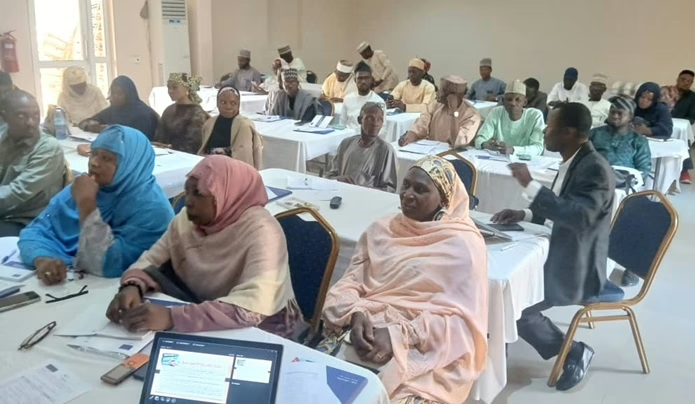
The two-day training, held at Bon Hotel, Kano, brought together over 30 participants, including journalists from print, broadcast, and online platforms, and representatives of leading CSOs working on governance, transparency, accountability, and public finance reform across the state.
In his welcome remarks, Ismail Bello, ROLAC II State Associate Program Officer, emphasized that the training aligns with ROLAC II’s mandate to strengthen transparency and accountability within Nigeria’s public finance space.
He highlighted some of ROLAC’s ongoing interventions in Kano State, including technical support for the domestication and simplification of public financial management laws, strengthening justice sector institutions, the domestication of the Violence Against Persons Prohibition (VAPP) Law 2015, and enhancing citizen participation in governance.
According to him, ROLAC II aims to deepen reforms that make governance more transparent and responsive.
“This training is a continuation of our work in Kano to empower CSOs and the media with the tools they need to monitor government spending and improve public trust,” he said.
Delivering the main presentation, the Executive Director of the Financial Inclusion and Development Advocacy Centre (FIDAC), Dr. Abdulssalam Kani, explained that the training was designed to enhance participants’ ability to track budget execution, procurement processes, auditing practices, and debt management using the legal frameworks provided in the PFMLs.
He walked participants through key components of the PFMLs, including the Budget Law 2021, Procurement Law 2020, Audit Law 2021, and Public Debt Management Framework, highlighting specific sections that empower the media and civil society to demand transparency, access procurement documents, and monitor contract execution.
He noted citizen oversight remains weak due to a limited understanding of public finance laws.
Dr. Kani stressed that strengthening transparency in budget implementation is essential, as studies show that Nigeria loses an estimated 20–30% of its public spending annually to inefficiencies, lack of oversight, and corruption.
Empowering civil society and the media, he said, is crucial for bridging this accountability gap.
He outlined four key objectives of the training to include improving understanding of the simplified PFMLs among CSOs, community-based organizations (CBOs), and media practitioners, build capacity to track and monitor budget implementation using legal tools and frameworks.
Strengthen collaboration between civil society, the media, and state oversight institutions to promote fiscal transparency, promote informed civic engagement, and enhance citizens’ participation in budget and financial oversight processes in Kano State.
Dr. Kani presented the simplified PFMLs, highlighting sections that empower citizens to request budget information, monitor procurement, and report violations of due process.
He also emphasized the critical role of journalists in providing accurate, data-driven reporting to improve public awareness of how state resources are managed.
Participants engaged in interactive sessions on budget analysis, data extraction, procurement monitoring, and how to use platforms such as the Open Nigeria States, which publishes approved budgets and quarterly budget performance reports.
Many attendees described the training as timely, especially given the increasing demand for fiscal transparency and accountability in the state.
ROLAC II expressed optimism that with enhanced capacity, CSOs and journalists will contribute more effectively to promoting good governance and ensuring that public resources are used for the benefit of citizens.