Isiyaku Ahmed
The Managing Director (MD) and Chief Executive Officer of the Northwest Development Commission (NWDC), Professor Shehu Abdullahi Ma’aji, has called on Civil Society Organizations (CSOs) to partner with the commission to promote transparency, accountability and sustainable development across the Northwest region.
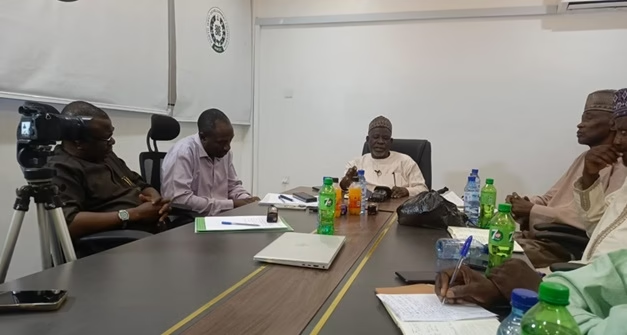
He made the call on Sunday while receiving representatives of CSOs in Kano State during a courtesy visit and interactive session with the commission at its headquarters.
Prof. Ma’aji said CSOs have a critical role to play in ensuring that public institutions remain accountable and that development interventions address the needs and aspirations of people at the grassroots.
The NWDC MD described CSOs as important partners in the commission’s efforts to improve the socioeconomic conditions of the region.
“We are going to work together as partners and collaborators in the progress of humanity,” he said, urging the CSOs to provide constructive criticism whenever the commission deviated from its mandate.
Prof. Ma’aji said he welcomed the engagement because he needed people who could independently assess the commission’s activities, identify shortcomings, and encourage it to remain on the right path.
He stressed that the commission required the support of civil society groups to serve as the eyes and ears of the public, particularly in monitoring projects and promoting transparency in the use of public resources.
According to him, the commission occupies a position of significant responsibility, given the expectations of the Federal Government and the hopes of millions of residents across the region.
He said the commission must live up to those expectations by delivering meaningful interventions that improve living conditions and create opportunities for the population.
Commission’s establishment
Prof. Ma’aji said the NWDC was established through legislation signed into law on 24 July 2024, following advocacy that began in 2019.
He explained that the commission’s governing leadership was inaugurated on 11 February 2025, while operational activities gathered momentum in 2026.
The commission covers Kano, Jigawa, Kaduna, Katsina, Kebbi, Sokoto and Zamfara states, comprising 186 local government areas.
He described the region as having a large population and significant development needs, particularly among young people, making coordinated interventions necessary to address insecurity, unemployment and gaps in public services.
Prof. Ma’aji further highlighted the importance of his professional background in technical and vocational education, saying his experience in teaching, research, consultancy and institutional development had prepared him for the responsibility of leading the commission.
He said his return to Kano was an opportunity to contribute directly to the development of his home region after several years of working in academic institutions and other professional capacities.
The NWDC boss reiterated his readiness to work with CSOs and other stakeholders, stressing that constructive engagement, public scrutiny and collaboration would be essential to achieving the commission’s objectives.
Seven priority areas
Explaining the commission’s mandate, Prof. Ma’aji said the NWDC was established to drive socioeconomic development across the seven states of the Northwest through interventions in seven major sectors.
These include security, education and health, agriculture, industry and energy, infrastructure, the environment, and youth and women’s development.
He said the commission would support efforts to address insecurity, noting that lasting development in other sectors would remain difficult without an improvement in the region’s security situation.
On education and health, he said the commission would seek to address critical gaps, while its agricultural interventions would cover livestock production, irrigation and other aspects of farming.
He also identified industrial development and energy supply as important priorities, particularly efforts to rehabilitate collapsed industries and improve access to reliable energy.
On infrastructure, the NWDC Boss said the commission could support the development and rehabilitation of roads, bridges, culverts and other transport infrastructure needed to improve connectivity and economic activities.
He added that environmental interventions would address challenges such as mining-related concerns, ecological problems and deforestation.
“The commission would also prioritize young people and women to transform their growing population into productive assets through opportunities that promote participation in economic and social development,” he added.
Prof. Ma’aji also said the seven priority areas offered opportunities for CSOs to contribute their expertise, monitor interventions and help ensure that projects reflected the needs of local communities.
NWDC not in competition with states
Prof. Ma’aji clarified that the NWDC was established as an intervention agency to complement the efforts of state and local governments rather than compete with them.
He explained that the commission would focus on addressing existing development gaps in its areas of responsibility.
The NWDC MD said the commission would also explore alternative funding sources instead of relying entirely on government allocations.
He said the NWDC had the mandate, subject to the necessary approvals, to seek development financing from institutions such as the African Development Bank, Islamic Development Bank and World Bank.
Prof. Ma’aji also said the commission could explore broader regional economic initiatives, including establishing a regional bank, airline, and railway, as part of efforts to accelerate development.
Earlier, Akibu Hamisu, convener of the meeting, described the engagement as an important opportunity for CSOs and media partners to establish a working relationship with the commission.
He said the meeting was convened to identify areas of collaboration and explore how CSOs could support the implementation of the NWDC’s mandate and specific development objectives across the Northwest.
He described the engagement as the first of its kind, noting that it demonstrated the commission’s willingness to involve CSOs and media partners in its activities.
According to him, the partnership would provide an avenue for CSOs to contribute to the commission’s development agenda while strengthening accountability in the implementation of projects and interventions across the seven states.
Hamisu said CSOs are ready to work with the commission to promote public awareness of its programs, communicate development opportunities to communities and support efforts to ensure that interventions reached their intended beneficiaries.
He emphasized the importance of sustained engagement between the commission and non-state actors, noting that effective collaboration could help bridge the gap between policymakers and communities while ensuring that local concerns informed development priorities.