Muhammad Kabir
The National President of the Nigeria Union of Journalists (NUJ), Alhassan Yahya Abdullahi, has called for stronger institutional measures to protect journalists working in security-challenged areas of the North-West, declaring that no story is worth the life of a journalist.
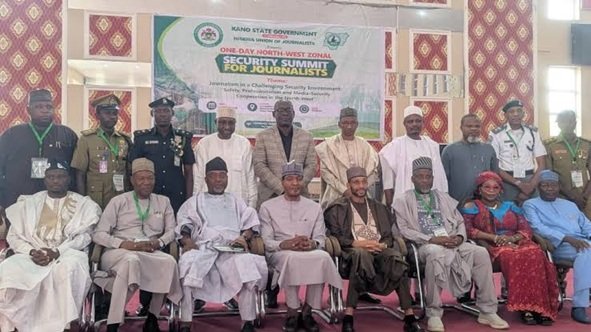
He made the call on Monday while delivering his welcome address at the One-Day North-West Zonal Security Summit for Journalists held at the Coronation Hall, Government House, Kano.
The summit, themed “Journalism in a Challenging Security Environment: Safety, Professionalism and Media-Security Cooperation in the North-West,” brought together journalists, security agencies, government officials, media executives, development partners and other stakeholders to deliberate on the safety of media professionals in the region.
The NUJ President expressed concern over increasing security threats, including banditry, terrorism, kidnapping and communal conflicts, which he said had made routine news gathering increasingly dangerous for journalists.
He noted that journalists covering volatile communities frequently faced intimidation, abduction and violent attacks, with some losing their lives while carrying out their professional responsibilities.
Describing the situation as unacceptable, Abdullahi said the union could no longer remain passive while its members continued to face avoidable dangers.
He called for practical safety measures to address both physical threats confronting journalists in the field and emerging digital security risks, including cyberattacks, surveillance and artificial intelligence-driven disinformation.
The NUJ President also advocated stronger cooperation between media organisations and security agencies, stressing that journalists should not be treated as enemies of the state or adversaries of security institutions.
According to him, journalists and security agencies have distinct but complementary responsibilities in promoting public safety, peace and democratic governance.
He called for a framework of mutual trust and understanding that would enable journalists to discharge their constitutional responsibilities without intimidation while respecting the operational confidentiality of security agencies.
Abdullahi further announced that the summit featured three keynote speakers: retired Brigadier General Sani Kukasheka Usman, Professor Umaru Pate and retired Major General Chris Olukolade.
He said Usman was expected to address threats, risk assessment and protection strategies for journalists in the North-West, while Pate would examine ethical responsibilities and the balance between public interest and national security.
Olukolade, he added, would discuss strategies for building effective and sustainable partnerships between the media and security institutions.
The summit also featured two panel sessions focusing on trust and communication gaps during security emergencies, newsroom safety policies, field realities and deployment protocols.
The NUJ President stressed that journalists must prioritize their safety, noting that professional courage should be accompanied by adequate preparation, caution and responsible reporting.
He said the success of the summit should not be measured by speeches and photographs but by concrete commitments capable of bringing lasting improvements to journalists’ working conditions.
Among the measures proposed were the establishment of a permanent rapid-response communication channel between the NUJ and security agencies, mandatory newsroom safety policies, expanded hostile-environment and digital security training, and prompt, transparent investigations into attacks against media professionals.
He also urged journalists to uphold the highest standards of accuracy, fairness and professional ethics, warning against sensationalism and the publication of unverified information.
Abdullahi called on participants to contribute practical recommendations that would strengthen journalists’ safety, improve media-security relations and promote lasting peace across the North-West.
Also speaking, the Kaduna State Commissioner for Information, Ahmad Maiyaki, urged media organizations to strengthen their financial independence, warning that economic vulnerability could undermine their ability to hold political authorities accountable.
Maiyaki argued that media organizations that constantly depend on politicians and government officials for financial assistance to organize conferences and other activities risk losing their independence.
He said politicians often viewed financially vulnerable journalists as tools that could be deployed to advance personal and political interests, urging media practitioners to develop sustainable funding mechanisms.
In his remarks, the Kano State Commissioner for Information, Sunusi Bature Dawakin Tofa, said the state government had prioritized the welfare and safety of journalists and media organisations.
He disclosed that the government had spent more than N200 million on journalists’ welfare, including sponsorship of workshops, conferences and other professional activities.
Bature cited the ongoing National Association of Women Journalists (NAWOJ) conference in Kano as one of the activities supported by the state government.