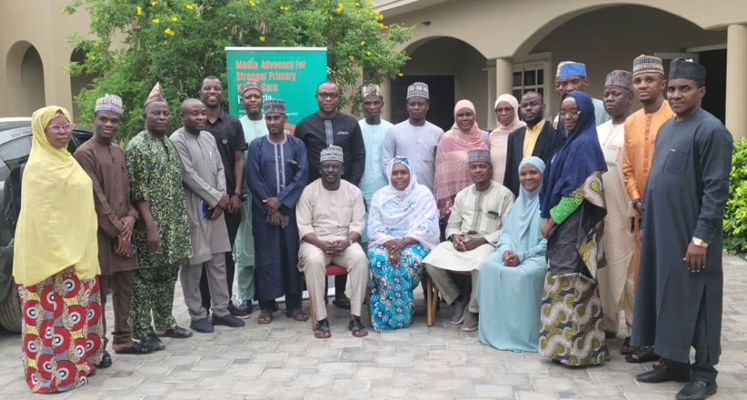
The International Society of Media in Public Health (ISMPH) has urged journalists to embrace evidence-based reporting as a vital tool for promoting accountability, transparency, and improved service delivery in Nigeria’s primary healthcare system.
The call was made on Wednesday at the opening of a two-day Media Engagement and Capacity-Building Workshop for members of the Kano Health Journalists Network (KAHJON) in Kano.
The workshop, organised by ISMPH in collaboration with the Kano State Ministry of Health and supported by the EngenderHealth Consortium Partnership, is designed to strengthen journalists’ capacity to report on Primary Health Care (PHC) Accountability Scorecards using findings from the Integrated Supportive Supervision (ISS) and the PHC Facility Assessment Tool (PHC-FAT).
Delivering the welcome address on behalf of ISMPH Executive Director, Chief (Mrs.) Moji Makanjuola, the organisation’s Programmes and Monitoring, Evaluation, Accountability and Learning (MEAL) Manager, Philip Muoneke, said the workshop builds on the recent State Roundtable Dialogue on health accountability held in Kano.
According to her, the dialogue underscored the need for journalists to develop the skills required to interpret, contextualise, and communicate health data in ways that inform the public, promote transparency, and support evidence-based decision-making.
Chief Makanjuola said participants would be exposed to practical sessions on PHC Accountability Scorecards, Integrated Supportive Supervision findings, PHC Facility Assessment Tool reports, and health financing data to enable them to produce balanced, data-driven, and solutions-focused reports.
She stressed that the role of journalists extends beyond reporting events, noting that the media plays a critical role in shaping public discourse, amplifying community voices, bridging the gap between government and citizens, and strengthening accountability through accurate and verified information.
Chief Makanjuola reaffirmed ISMPH’s commitment to partnering with government institutions, media organisations, civil society groups, and development partners to strengthen health journalism and improve accountability across Nigeria’s health sector.
The ISMPH Boss also commended the Kano State Government, the Kano State Ministry of Health, and the EngenderHealth Consortium Partnership for supporting initiatives aimed at improving evidence-based health reporting.
“The knowledge and skills gained during this workshop should translate into stories that not only inform the public but also inspire positive action, promote accountability, and strengthen confidence in the primary healthcare system,” he said.
Speaking at the event, Chairperson of the Kano Health Journalists Network (KAHJON), Hauwa Suleiman Zahradeen, represented by the Network’s Vice Chairman, Mustapha Hodi Adamu, described the workshop as a timely intervention that would enhance journalists’ ability to analyse and interpret health sector data.
She explained that the training was conceived following an earlier session on the ISS Data Scorecard, which exposed gaps in journalists’ capacity to translate complex health data into compelling, evidence-based stories.
According to her, the workshop will equip participants with practical skills in data analysis, story development, and evidence-based reporting to improve public understanding of health sector performance and support stronger accountability mechanisms.
She urged participants to take full advantage of the training, noting that the knowledge acquired would contribute to more impactful journalism and a stronger health system in Kano State.
In his goodwill message, the Kano State Lead of the Legislative Initiative for Sustainable Development (LISDEL), Dr. Muhammad Inuwa Shuaib, described the workshop as an opportunity for journalists to deepen their understanding of health data generation, analysis, and interpretation.
He said the training would strengthen accurate reporting on critical health programmes, including the Integrated Supportive Supervision (ISS), Routine Monitoring and Accountability for Results (RAMCA), Vulnerable and Hard-to-Reach Communities (VHC), and other health interventions across the state.
Dr. Shuaib encouraged journalists to familiarise themselves with technical health indicators and available data resources to enable them to produce reports that inform citizens, support advocacy efforts, and contribute to evidence-based policymaking.
Also speaking, the Policy Coordinator of the Centre for Communication and Social Impact (CCSI), Atiku Mohammed Yola, underscored the importance of scientific evidence in journalism.
He said journalists who rely on verified and scientifically generated data produce more credible, ethical, and professional reports while safeguarding themselves against misinformation and unfounded criticism.
Yola urged media practitioners to remain objective and impartial, stressing that factual, evidence-driven reporting is essential for promoting transparency, strengthening governance, and improving health outcomes.
The workshop brought together officials of the Kano State Ministry of Health, the Kano State Primary Health Care Management Board (PHCMB), the Kano State Contributory Healthcare Management Agency (KSCHMA), development partners, resource persons, and health journalists to enhance media capacity for data-driven health reporting and improve public communication on healthcare issues in Kano State.
– Isiyaku Ahmed