Olu Allen
So, the President has found time for an interview.
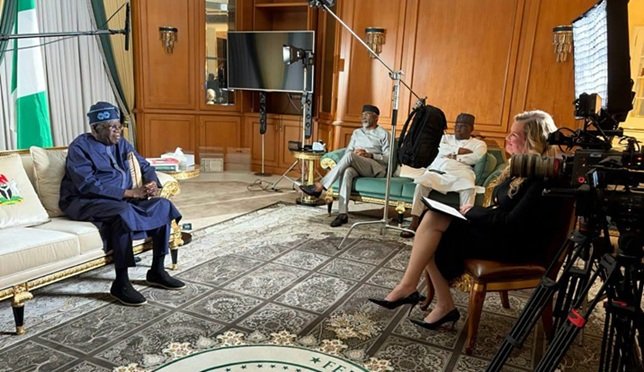
The cameras were ready. The photographs were released. The conversation was recorded. And Nigerians were given the familiar teaser: Coming soon!
President Bola Ahmed Tinubu has granted an exclusive interview to Diana London, an American political strategist, lobbyist and media personality.
Interesting. Very interesting.
But before we start celebrating another presidential media appearance, perhaps Nigerians should ask a few questions.
Who exactly is Diana London, and why does her connection to the Nigerian government matter?
According to US government lobbying disclosures, London is associated with DCI Group, a Washington-based lobbying firm engaged by the Nigerian government to help communicate its position on the protection of Christian communities and security cooperation with the United States.
The contract was reportedly worth $4.5 million for its initial six months.
TheCable also reported that DCI disclosed payments of $450,000 to London’s company.
Now, let us put these facts together.
The Nigerian government engages an American lobbying firm for millions of dollars to shape and communicate its international narrative. A media personality associated with that lobbying engagement subsequently conducts a recorded interview with the Nigerian President.
And we are supposed to treat this as just another ordinary presidential interview?
Really?
Let me be clear: Diana London has every right to interview President Tinubu. There is nothing inherently wrong with an American journalist or media personality speaking with a Nigerian President.
But the circumstances surrounding this engagement raise legitimate questions about independence, editorial distance and transparency.
Who is interviewing whom, and who controls the narrative?
What questions were asked?
Who selected the questions?
Was the interview independently arranged?
Will the complete conversation be released?
Will Nigerians have access to the unedited recording?
These are not unreasonable questions. They are the minimum questions a country spending millions on international strategic communications should be prepared to answer.
But here is where the real political irony begins.
Tinubu can face an American interviewer, why not Nigerian journalists?
Nigeria is not short of journalists.
We have experienced broadcasters, investigative reporters and political interviewers who understand the Nigerian condition and know exactly where the government has fallen short.
Why not sit with Rufai Oseni?
Why not face Seun Okinbaloye?
Why not grant an extended interview to Nigerian journalists who can interrogate his administration’s economic policies, insecurity, rising cost of living, unemployment, taxation, foreign borrowing and the daily struggles of ordinary Nigerians?
Why should Nigerians depend on a foreign political strategist to ask their President questions about the country they live in?
What exactly is preventing the President from having a serious, unscripted conversation with Nigerian journalists?
And there is another layer of irony.
Tinubu has long been associated with major Nigerian media platforms, including TVC and The Nation. Yet this particular engagement has been presented through an American media personality rather than as an opportunity for Nigerian journalists to lead a rigorous presidential interview.
A President should not need a foreign platform to communicate with his own citizens.
A President who wants to be heard must also be prepared to be question
Let us get something straight.
An interview is not a presidential advertisement.
It is not a campaign trailer.
It is not a public-relations exercise designed to produce attractive photographs and carefully packaged sound bites.
It is an opportunity for citizens to hear directly from the person entrusted with governing them.
Nigerians want to know why the cost of living remains a burden for millions of households.
They want answers on insecurity and the persistent attacks on communities.
They want to understand the direction of the economy, the consequences of government policies and what practical relief is coming.
They want to know what the administration has achieved, what has failed and what it intends to do differently.
These are not hostile questions. They are democratic questions.
And the President should be able to answer them.
I am not suggesting that Tinubu should grant interviews only to journalists who oppose his administration. Far from it.
He should face credible journalists regardless of their political leanings, provided they are prepared to ask difficult questions and demand meaningful answers.
That is what accountability looks like.
And Nigerian media organisations must also examine their own responsibilities.
Journalists are not decorations in a democracy. They are not supposed to become publicity officers whenever political power offers them access.
The responsibility of the media is not to make government comfortable. It is to make power accountable.
My question tonight:
If President Tinubu can sit down for a recorded conversation with an American political strategist and lobbyist, why has he not made himself equally available for a serious, unscripted interview with Nigerian journalists?
Is this about international image management?
Is it about controlling the government’s narrative before an American audience?
Or is there an increasing discomfort with the kind of domestic scrutiny that comes with facing journalists who understand the realities Nigerians experience every day?
And when this interview is finally released, will Nigerians hear a President answering difficult questions, or simply a government presenting its preferred narrative?
Because, Mr President, international image management may help sell Nigeria abroad.
But it cannot replace accountability at home.
You cannot spend millions telling the world your side of the story while leaving Nigerians struggling to get straight answers from their own President.
Nigeria deserves answers. Not just photographs.
Allen writes on public affairs and promotes good governance.