Olu Allen
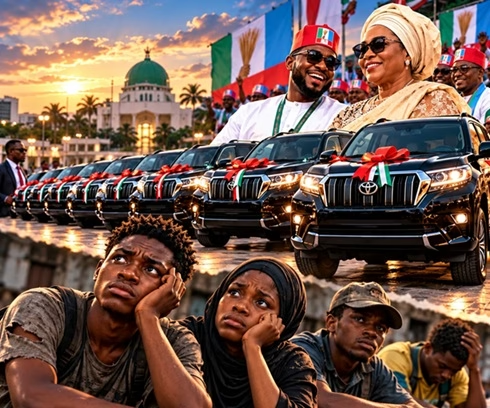
Seven luxury SUVs. One ruling party. Millions of young Nigerians struggling to get ahead.
Sometimes, a political decision says more than a thousand campaign promises. And sometimes, seven vehicles are enough to start a national conversation about priorities, privilege and the future of a generation.
On Sunday, 25 October 2026, APC National Youth Leader Dayo Israel posted a video showing seven brand-new 2026 Toyota Land Cruiser Prado SUVs intended for selected party youth leaders to support election mobilisation ahead of the 2027 general elections.
He thanked First Lady Oluremi Tinubu for her support. Although the post was subsequently deleted, the First Lady confirmed that she had donated vehicles to the party’s youth wing.
Premium Times reported the confirmation, while BusinessDay reported that a new 2026 Toyota Prado could cost between N120 million and N160 million, depending on specification and dealer.
At those estimated prices, seven vehicles could be worth between N840 million and N1.12 billion.
That is a market estimate, not a confirmed invoice for the vehicles.
Let us be fair. Political parties need resources to organise campaigns, coordinate their structures and reach voters.
Vehicles can serve legitimate organisational purposes. There is also no established evidence in the reporting cited here that public funds paid for these SUVs.
But fairness should not become an excuse to avoid scrutiny.
The real issue is not just the cost. It is the message.
Across Nigeria, young people are searching for jobs, struggling with transport costs, paying rent and trying to build businesses in an economy that makes financial security increasingly difficult for many households.
Graduates are looking for opportunities. Young entrepreneurs are struggling to raise capital. Workers are trying to stretch their incomes to meet rising expenses.
For many, the dream is not a luxury SUV; it is a stable income, a decent home and the opportunity to build a future without being overwhelmed by daily survival.
Now consider the political symbolism of seven luxury vehicles potentially worth close to N1 billion being allocated to selected youth leaders ahead of an election.
What does this say to the young Nigerian who has submitted dozens of job applications without success?
What does it say to the entrepreneur who cannot secure a modest business loan? What does it say to the graduate whose qualifications have yet to translate into meaningful employment?
These questions do not automatically make the donation improper. They do, however, raise a legitimate question about the priorities political leaders choose to display.
A political party is entitled to invest in its campaign machinery. But when the beneficiaries are youth leaders and the stated purpose is mobilisation, Nigerians are entitled to ask what this investment is expected to achieve.
If the vehicles were privately donated, the source and terms of the donation should be clear. If party resources were used, the expenditure should be explained.
Transparency is not an accusation. It is the foundation of public trust.
And then there is the question of leadership.
The vehicle controversy emerged amid confusion over the leadership of the APC’s Youth Mobilisation Directorate for the 2027 presidential campaign.
The published campaign council structure named Youth Development Minister Ayodele Olawande as director and Dayo Israel as deputy director. Israel subsequently disputed how the change in leadership had been communicated.
PUNCH reported on the controversy surrounding the appointments.
The leadership dispute does not establish that the vehicle donation was connected to an internal political struggle. It would be irresponsible to claim otherwise without evidence.
Yet the timing makes clarity even more important. When a party is preparing for a national election, its organisational structure, resource allocation and responsibilities should be sufficiently clear to inspire confidence.
Who is responsible for what? Who determines the beneficiaries of campaign resources? What objectives must those resources deliver?
These are not trivial administrative questions. They go to the heart of how political organisations operate and how they account for decisions made in pursuit of power.
Four questions the APC should answer.
First, who funded the seven vehicles, and what was their actual purchase price?
Second, who selected the beneficiaries, what criteria guided the selection, and what responsibilities come with the vehicles?
Third, what measurable results does the party expect from this investment in youth mobilisation?
Fourth, what safeguards will ensure that the vehicles are used for their stated purpose, and how will the party assess their effectiveness?
There is nothing unreasonable about asking these questions. They do not presume wrongdoing; they demand clarity.
Indeed, answering them would give the APC an opportunity to explain the rationale behind the donation rather than allow speculation to fill the information gap.
And this standard should apply to every political party. Accountability cannot depend on which party is in power or whose supporters are involved.
Young Nigerians deserve more than mobilization.
This is where the conversation must go beyond seven vehicles.
Young Nigerians are not merely a voting bloc to be assembled when elections approach.
They are citizens whose aspirations extend well beyond campaign rallies, political appointments and party structures.
They want employment opportunities that reward their qualifications.
They want an education that prepares them for work. They want access to affordable healthcare, support for entrepreneurship and an economy in which hard work offers a realistic prospect of progress.
Political mobilisation may help a party organise its supporters. It does not, by itself, amount to youth development.
There is a difference between mobilising young people to help a party acquire power and creating conditions that enable young people to build meaningful lives.
The two objectives are not necessarily incompatible. A political party can organise an effective campaign while pursuing policies that expand opportunity. But the public has every right to ask how its political investments connect to the needs of the citizens being mobilised.
If the APC considers these vehicles an investment in youth engagement, it should explain the expected outcomes and demonstrate the results.
If they are intended to strengthen grassroots organisation, the party should be able to show how that objective is being achieved.
The burden is not to prove that expensive vehicles are inherently wrong. It is to explain why this particular expenditure is justified, how it will be managed and what it will accomplish.
That is the difference between accepting a political explanation and holding political leaders accountable.
The question.
If a political party can deploy resources potentially worth nearly N1 billion towards the mobilisation of selected youth leaders, what comparable commitment should young Nigerians expect towards the jobs, skills, healthcare and economic opportunities they desperately need?
This is not an argument that the money spent on the vehicles would automatically have solved Nigeria’s unemployment crisis or transformed the healthcare system. Such claims would be simplistic.
It is an argument about what political leaders choose to prioritise, what they are prepared to explain and what citizens should demand in return for their trust.
Seven Prados cannot solve the challenges confronting millions of young Nigerians. Neither can campaign slogans, grand promises or carefully choreographed displays of political generosity.
As the 2027 elections approach, the APC, and every other party seeking the support of Nigerian voters, must understand that young people are not simply instruments of electoral mobilisation.
They are citizens with expectations, legitimate demands and a stake in the country’s future.
The real test of political leadership is not how effectively it mobilises young people to win power. It is what it does with that power to improve their lives.
The question is not whether the APC can acquire seven luxury SUVs. The question is what this expenditure tells Nigerians about its priorities, and whether those priorities reflect the future young Nigerians deserve.
Allen writes on public affairs and advocates for good governance.