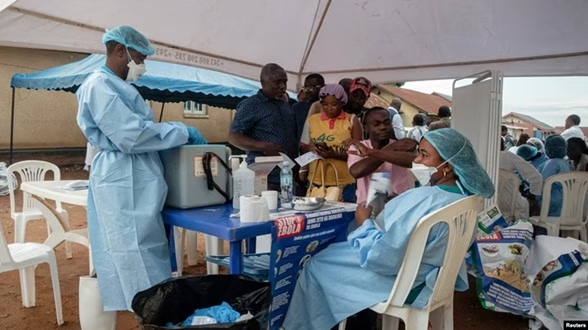
The United States is deeply concerned by the impacts of the ongoing Ebola outbreak in the Democratic Republic of the Congo, said Ambassador Jeffrey Bartos U.S. Representative for U.N. Management and Reform at a recent United Nations Security Council briefing.
The illness has spread in the region with more than 9,000 confirmed cases and more than 4,000 deaths.
The outbreak has been difficult to contain due, in part, to ongoing fighting between the DRC government and rebel forces, which has created a devastating humanitarian crisis.
“Safe, unhindered access for health responders and the protection of medical personnel and facilities are critical to saving lives,” said Ambassador Bartos, who called on all parties to adhere to obligations under the Washington Accords for Peace and Prosperity and the Doha protocols.
“We urge the parties to uphold the ceasefire, halt harmful drone strikes, and refrain from inflammatory rhetoric. All Security Council members should reinforce these expectations and maintain pressure for implementation.”
“We thank all of the humanitarian, security, and peacekeeping personnel risking their lives to help address this crisis,” said Ambassador Bartos.
This outbreak “poses unique challenges,” noted a recent State Department statement. It outlined not only conflict in the region, but the nature of the new Bundibugyo strain itself.
“Global actors must scale up response activities across outbreak zones and strengthen preparedness in high-risk areas, including contact tracing, protecting frontline responders, expanding bed capacity, deploying new diagnostics, and investing in vaccine development,” the statement said.
For its part, the U.S. Department of State announced an additional $267 million in direct life-saving health and humanitarian assistance for the response to the Ebola outbreak on the sidelines of the UN General Assembly last month.
“With this new life-saving global health assistance, the United States will directly scale up support to combat the outbreak through new Ebola treatment units, additional safe and dignified burial teams, mass procurements of personal protective equipment, expanded surveillance, critical health commodities, and contact tracing through trusted implementers,” said a separate statement.
The funds are in addition to $887 million already provided, $780 million of which was in direct health and humanitarian assistance.
These funds are also in addition to $350 million in critical humanitarian assistance provided to the DRC, Uganda, and South Sudan, as part of a $1.8 billion commitment in assistance to the UN Office for the Coordination of Humanitarian Affairs, last spring.
The U.S. also recently convened a G20 Foreign Ministerial to reaffirm its commitment to accelerating collective action against the Ebola.
At the event, the G20 and other major donors announced more than $470 million in new commitments, surpassing $2 billion in total global pledges since the outbreak began in May 2026.
The conference brought together many donors from outside the G20 who were also invited to the event.
“This disease can be defeated, as shown by the successful end of Uganda’s outbreak in August,” noted a statement.
The U.S. and its partners in the international community are committed to making that defeat a reality.
(VOA News)