Isiyaku Ahmed
On Thursday, the Kano State Ministry of Women Affairs, Children and Persons with Special Needs, with technical support from the Rule of Law and Anti-Corruption Program (RoLAC II), trained sign-language interpreters at a workshop on the use of the newly developed legal terminology under the Kano State Administration of Criminal Justice Law (ACJL) 2019.
The workshop brought together academics, education specialists, representatives of tertiary institutions, members of the Association of Sign Language Interpreters, civil society organizations and journalists.
The initiative, supported by the European Union and implemented by the International Institute for Democracy and Electoral Assistance (International IDEA), aims at improving access to justice for persons with hearing impairment in Kano State and Nigeria.
The developed legal signs are intended to provide accurate, consistent, and understandable signs for technical legal concepts used in criminal justice proceedings, rather than create a separate language for the law.
Speaking at the event, the Kano State Project Coordinator of RoLAC II, Ibrahim Bello, described the initiative as a significant milestone in efforts to ensure that persons with hearing impairment are not excluded from the criminal justice system because of communication barriers.
He said the project was designed to enable persons with hearing impairment to better understand and participate in criminal justice processes under the ACJL.
Bello explained that the first phase involved identifying and extracting commonly used legal terms contained in the law.
According to him, Professor Kyauta Ibrahim and another consultant, Aisha John, were engaged for the exercise and identified more than 400 legal terminologies.
“During the first phase of RoLAC, we extracted these terminologies. Prof. Kyauta and another consultant, Aisha Jahun Esq., helped us to extract these commonly used terminologies found in the Administration of Criminal Justice Law,” Bello said.
He said the current second phase, the RoLAC II programme focused on converting the identified legal terms into appropriate sign-language versions that interpreters could use during legal and court proceedings.
The Kano State RoLAC II Coordinator said Prof. Ibrahim was again engaged to lead the development of the sign-language versions.
He disclosed that the exercise took about several weeks, resulting in the development of sign-language versions for slightly more than 200 of the identified terms.
“Because of the constraints we faced, we were only able to develop sign-language versions for over 200 terminologies. That alone took several weeks of work,” he said.
Bello said RoLAC II intended to build on the work in subsequent phases, including the development of the remaining legal terminologies.
Bello commended Prof. Ibrahim and other experts involved in the project, stressing that their contributions were critical to the success of the initiative.
He also disclosed that the developed terminology underwent a critical validation exercise about two weeks before the training workshop.
The Kano State RoLAC II Coordinator said the validation process was necessary to ensure the accuracy, relevance, and practical usefulness of the terminologies before their adoption for wider use.
Watch Video
Representing the Commissioner for Women Affairs, Child and Persons with Special Needs, Hajiya Amina Abdullahi, the Deputy Director, Directorate of People with Disabilities, Tahir Shehu, described the workshop as timely and commended RoLAC for its support.
The Commissioner noted that the intervention will go a long way to improve access to justice in the state.
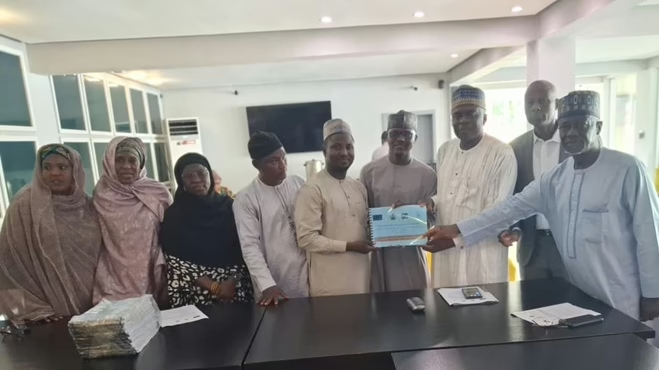
She then performed the dissemination ceremony and handed the developed sign language version of the glossary of legal terminologies to Sagir Salisu Muazu, the Chairman, Association of Sign Language Interpreters of Nigeria (ASLIN), Kano branch.
How the Legal Signs Were Developed
Professor Kyauta Ibrahim, a consultant on the Administration of Criminal Justice Law (ACJL) Sign Language Initiative, has explained how specialized sign-language terminology for legal proceedings was developed to improve access to justice for persons with hearing impairment.
Prof. Ibrahim said the initiative began around 2019, when experts and representatives from the Correctional Service, Ministry of Justice and other relevant institutions were brought together to identify legal terms commonly used in the criminal justice system.
He said consultants subsequently identified terms, after which sign-language interpreters were invited and trained on their use.
“We identified and compiled commonly used legal terms and terminologies that would be relevant to their work,” Ibrahim explained.
“After the terms were developed, sign-language interpreters were invited and trained on how to use them,” he added.
According to him, another exercise was conducted in 2021 to review the earlier work and strengthen the use of the legal terminology.
Prof. Ibrahim said the involvement of experts from different sectors of the justice system was necessary to ensure that the signs accurately reflected the language and concepts used in criminal proceedings.
He explained that the initiative was also driven by the communication barriers faced by persons with hearing impairment in accessing essential services, particularly within the justice system.
The Consultant said the ultimate objective was to equip interpreters with specialised legal vocabulary to enable them to accurately interpret court proceedings involving persons with hearing impairment.
To illustrate the importance of the initiative, Ibrahim recounted the case of a person with hearing impairment who, according to him, spent about five years within the criminal justice system amid serious communication difficulties.
He recalled that while working at a special education school, the school principal invited him to assist with the case after the individual was arrested in connection with a murder case.
According to Prof. Ibrahim, the man was initially taken to a police station in Tudun Wada Local Government Area before being transferred to the State Police Command in Bompai, Kano.
He said the police officer handling the case later contacted him to provide sign-language interpretation, adding that the man was eventually found innocent after about five years of legal proceedings.
Prof. Ibrahim said several officers who handled the case had difficulty communicating with the man because of his hearing impairment and the lack of adequate sign-language interpretation.
He said the experience demonstrated the need for interpreters who possess not only general sign-language skills but also specialized knowledge of legal terminologies.
“The main reason why this workshop was organized was to equip interpreters with modern legal terminologies so that they could be able to interpret court proceedings that involve persons with hearing impairment,” he said.
Prof. Ibrahim said the initiative would help bridge the communication gap between persons with hearing impairment and the justice system by enabling Deaf persons to understand legal proceedings, communicate with authorities, and participate meaningfully in cases affecting their rights and liberty.
He also called for continuous training and periodic review of the terminologies to ensure that interpreters remain equipped to respond to evolving legal language and court procedures.