Alimi O. Adamu, Esq.
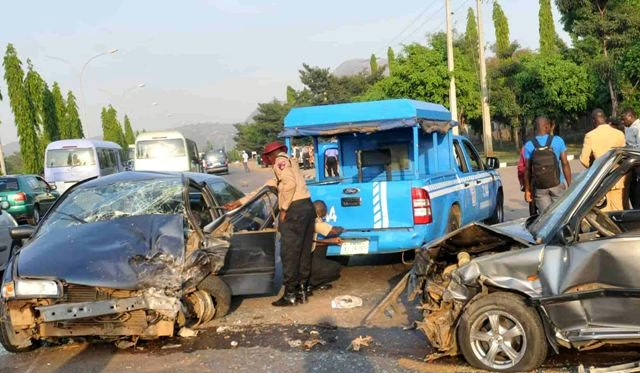
Road traffic crash (RTC) is a tax on the economy. Studies have shown that there is a direct linkage between the crashes and the worsening poverty rates in low-and middle-income countries, caused by diversion of scarce resources from the productive sectors to care for crash aftereffects.
To mitigate the debilitating impact of RTCs, there is a need to evaluate the socio-economic consequences, consider the costs and benefits of alternative measures, and develop strategies for reducing the frequency.
Reducing crash rates in Nigeria comes with enormous challenges. These include paucity of country-specific data for measuring the burden, under or insufficient crash reporting, and lack of system-wide studies and indices for valuating the costs in monetary terms.
On the costs-valuation challenge, Nigeria relies on generic reports by multi-national organisations and a mixed patch of weak, outdated, and recycled statistics, and ends up with mere guesstimation.
The capacity gap deprives her of the tools for assessing the true socio-economic impact of RTCs.
This analysis is not meant to fill the capacity gap but to contribute to the discourse on the costs of RTCs to Nigeria and highlight issues to guide policymakers in formulating effective remediative measures.
RTC is a leading cause of death worldwide; it claims more than 1.19 million lives annually. This figure represents 3,300 road deaths per day, or two lives lost every minute.
In addition to the death count, another 50 million people suffer crash- related injuries every year.
RTCs affect a peoples’ economic well-being. The aftermaths include common costs like medical expenses, property damage, loss of productive capacity, and administrative expenses.
Generally, these impacts are financially quantifiable and are borne by the victims, their families, and society.
In addition to the economic repercussions, RTC survivors could face social afflictions like pain and suffering, emotional distress, societal scorn, loss of self- esteem and/or loss of marital conjugation.
Although the social impact is not monetarily quantifiable, it may nonetheless negatively alter the quality of life of the survivors and their loved ones and impose a burden on society.
Majority of RTCs occur in low-and-middle income countries. With roughly 60% of the world’s motor vehicles, these countries suffer 92% of global fatalities, and the most disproportionately affected are the poor, children, and young adults aged between 5 and 29 years.
RTC is the fourth leading cause of death in people aged 5-44 in Africa. Over 75% of the casualties are in the young and economically productive age groups of 16-65, with the most vulnerable road users being pedestrians, vehicle passengers and low- motorised vehicle operators like motorcyclists and cyclists.
These victims constitute 65% of the fatalities and bear the heaviest burden of the carnage.
Globally, the socio-economic cost of RTCs is estimated at US$518 billion or 3% of annual GDP.
For Africa, the loss is between 1% and 5% of GDP, and for Nigeria, it is estimated variably as N80 billion and N800 billion.
Nigeria’s estimated loss of N80 billion and N800 billion is not supportable by contemporary factors. One reason for the skepticism is that the N80 billion projection, for instance, has been floated since about 2010.
It fails to account for inflation or the 2024 rebasing of the economy to accurately reflect current realities and adjust to structural changes.
Another reason that the figures are untenable is the increasing RTCs in the country. Nigeria is witnessing an upsurge in crash rates.
The rate rose to 10,446 in 2025 from 9,570 in 2024, for a year-over-year increase of 9.2%. These worsening statistics should dictate commensurate new analyses and conclusions.
Furthermore, an independent study shows that the Federal Capital Territory (FCT) alone lost N534.9b (approx. $1.2billion) to RTCs in 2022. Although the FCT is a hot zone of crashes, which explains the high-cost finding, it is nonetheless a microcosm of the Nigerian road crash realities.
If the result of the study were extrapolated and prior assumptions supplemented with current country-wide or sector-specific data, the outcome would be significantly higher than N80 billion and N800 billion.
Most importantly, the N80 billion and N800 billion bills is not defensible by the country’s RTC Cost: GDP ratio. Nigeria recorded $285 billion GDP (equivalent to N122.81 trillion) in 2025.
That is a 3.87% year-over-year real growth from 2024. It is estimated that she loses 3% of her annual GDP to RTCs. 3% loss on N122.81 trillion is N3.68 trillion.
In other words, the projected loss to traffic crashes in 2025 would be N3.68 trillion, a figure that is consistent with the findings of the independent FCT study.
Not to be overlooked is that with the loss of 3% on 3.87% GDP growth from 2024, the net or disposable growth for 2025 is 0.87%. This ties in with the linkage between RTCs and worsening poverty rates in low-and middle-income countries.
GDP loss to RTC does not necessarily result in economic shrinkage. Despite the negative connotation, road crashes are likely to generate activities and translate to gains in the healthcare, auto repair, and other sectors, and increase growth in those areas of the economy.
However, the derivative employment generation is at an opportunity cost to the country because it competes for resources with other activities where the resources could otherwise be more productively utilised.
To understand the social-economic consequences of RTCs, it is necessary to identify the invisible waste or non-value-adding activities that consume resources and drive the costs.
Results have shown that RTCs trigger more injuries than deaths, and RTC-related injuries exert more burden on the economy than fatalities.
In addition to common costs, there are other economic burdens of RTC fatalities. These are usually of a one-off nature, like interment expenses and discretionary burial rites.
On the other hand, injuries would have more lasting impacts like diminished productive capacity, rehabilitation, long-term care, assistive living and reduction in the quality of life and life expectancy.
Despite the prevalence and more serious impacts of RTC injuries, analyses and reports tend to focus more on fatality rates. Meanwhile, the plight of injured survivors is exacerbated by a lot of factors.
Nigeria’s healthcare delivery system is substandard, and the facilities are ill- equipped. The sick and the injured are forced to patronise unorthodox practitioners in search of speculative cures.
This complicates or worsens their health condition and imposes additional economic burden on them.
The injured may also have to employ private caregivers and divert resources of able-bodied family members who could, if otherwise productively employed, contribute more meaningfully to the economy.
Nigeria lacks established social programmes for RTC survivors. The only programme with seemingness of social welfare, the National Social Insurance Trust Fund, is a contributory scheme that compensates for work-related accidents and injuries. It does not cover RTC injuries per se.
The society has low tolerance for the physically disabled and treats their infirmity as if it were contagious and an object of derision.
Any injuries, including from RTCs, could qualify the survivors as subhuman and create a fit problem for them. This is worsened by the influx of disabled and destitute persons into Nigerian cities from neighbouring countries, which creates competition for government resources that might otherwise be available to RTC survivors.
Some of the destitutes have so constituted themselves into nuisance that many Nigerians have become inert to the plight of the disabled and the less privileged. This creates difficulties in reintegrating injured crash survivors into the society’s psyche.
The law prohibiting discrimination against persons with disabilities requires that Nigerian roads and other public facilities be accessibility-friendly to fully integrate and enable affected persons to resume their normal life as much as possible and contribute meaningfully to the society.
Designated to go into full effect five years after the passage, now more than seven years after the commencement date, it is no more efficacious than before its passage and is more observed in the breach.
Less commonly discussed is the gender bias or residual socio-economic effect of RTCs against the females. Most of the reported RTC survivors are men, but women bear much of the burden and spend more time on nursing and homecare for the injured loved ones.
This puts a lot of strain on the females and limits their opportunity for personal advancement and economic productivity.
The cumulative socio-economic loss by RTC survivors includes diminished social status, and loss of jobs and ability to be gainfully employed at a higher rate than the non-disabled.
As a result, they live with a sense of diminished self-worth and withdraw from social activities. The cost implication of this is deeper than it may appear.
Nigeria’s economy is driven by subsistence farming and small-scale businesses.
A disabled person’s loss of job, or inability to return to work or to be gainfully employed, translates into loss of patronage for the local economy, thereby reducing the country’s GDP.
If the RTC survivor were the breadwinner, this would affect the family’s finances, and standard of living, and life expectations.
With a rate of 21.4 per 100,000 population, Nigeria has one of the highest rates of road traffic deaths in Africa. Despite the alarming statistics, the government’s response to RTCs is tepid compared to its reaction to other calamities with less socio-economic and numerical impacts on the society.
When COVID-19 pandemic ravaged Nigeria beginning from 2020, the government recognised the virus as an existential threat to the country and instituted extraordinary measures to suppress the spread.
It declared a state of national emergency, put the country on lockdown, suspended non-essential activities, closed the borders, and restricted inter-state travels.
The architecture for combating the pandemic was built from scratch. Most importantly, to contain the virus, the government mobilised and spent limitless resources, human and financial, including extra-budgetary spending and external borrowings.
The same urgency is being mobilized to combat terrorism, another crisis afflicting the country. In this case, the government adopted a multi-pronged approach, reengineered military capabilities, and partnered with foreign governments and local vigilantes in the battle.
It spends billions of Naira annually, including, again, extra-budgetary funding, to acquire weapons and deployed every policy and political suasion possible in the process.
While not minimising the devastating consequences of the pandemic and banditry, the reality is that more people die every year on Nigerian roads than lose their lives to these causes.
Comparing road traffic crash to the twin scourges of COVID-19 and terrorism may seem pedantic, but statistics do not lie. Between February 27, 2020, when COVID-19 was first detected in Nigeria, and the end of October 2023, the country lost 3,155 to the pandemic.
The number of people killed in terrorist attacks is difficult to track, but it is reported that between 2023 and 2024, 950 people were killed nationwide. The figures compare to 6456 deaths and 38,930 injuries from 13,656 RTCs in 2022.
RTC statistics should prompt the government into recognising it as a pandemic at par with COVID-19 and terrorism and mustering the same resources and political will for addressing the crashes as with the other crises. Instead, road safety management has become a mere budgetary item without any renewed vigour in battling it.
Nigerian road users, on their own, have a role to play in mitigating the debilitating socio-economic consequences of RTCs. The people lack a culture of insuring against catastrophic events like personal injury and disability that could cushion their plight.
Rather, they wrap themselves in divine insurance with no palliative value, the “I reject it syndrome”, a belief that wishes or prays away risks of adversities.
In the event of injuries, they are left without medical or financial recourse.
Similarly, Nigerians fail to appreciate the usefulness of the vehicle insurance system. Many view the auto insurance environment as another revenue toll on motorists.
Motorists take out auto insurance policies not to indemnify against loss, but supposedly to comply with the law and obtain proof of compliance to exhibit to road traffic law enforcement officers.
In the event of collision, they resort to fist cuffs rather than claim for indemnity.
Alarmingly, road users, including motorists, are not aware that they are party to auto insurance contracts or of their benefits thereunder and rarely claim for indemnity under the policies.
There is a general belief in the country that the insurance practice and claim processes are elitist, burdensome, and rigged against the common man.
This perception feeds the narrative that the industry is a behemoth that could get away with wrongful claims denial at will. As a result, the beneficiaries, including insured road users, fail to exploit possible indemnity on the occurrence of insured risk.
The beneficiaries of road-user ignorance and apathy are the insurance companies. There is no incentive for them to educate the public on the efficacy of the policies, the claims process, or entitlements.
They capitalise instead on public ignorance and mindset to reap hefty rewards because non-claimed benefits end up as hefty balance sheet items for them.
Nigerian Insurance Industry Reform Act, 2025 updated the Road Accident Victims Compensation Fund to recompense victims of uninsured RTCs and healthcare providers for up to N2,000,000.00 for costs and expenses incurred in respect of death or bodily injury.
The fund is funded by 0.5% of the underwriting profit on motor insurance business. The fund is currently underutilised because road users do not appear to be aware of the benefits under the scheme, and even though putative beneficiaries, they continue to bear the burden of their uninsured loss.
There is a need for education on injury and disability insurance generally, and road- user rights and entitlement to insurance benefits.
The insurance industry can be part of the solution to the low information regime by educating the public on the benefits of insurance.
The educating can be funded wholly or partially by clawing back and returning part of the funding mechanisms for the Victims Compensation Fund to the insurance companies with a mandate to apply the savings to the education.
The suggestion that insurance companies be responsible for educating the public is only reasonable because it would engender competing approaches and forestall the money being compromised by committees of bureaucrats.
With the ever-increasing RTCs, Nigeria should be concerned about their debilitating effect on the economy as measured against the GDP.
Measuring in this context presupposes a common matrix for comparing the two indicants, that is, the RTC and the GDP. But GDP is denominated in monetary values, and RTC statistical indices are reported in numerical terms.
This necessitates that RTC costs be expressed in monetary terms to enable comparison. Doing so requires protocols for monetising RTC drivers, which protocol or wherewithal Nigeria presently lacks.
Granted, studies have been conducted to measure the financial burden of RTCs in monetary terms, but the sample size is grossly inadequate, and the mechanism
adopted, the willingness-to-pay method, is adjudged improper for a low-and middle-income-country like Nigeria.
Assigning monetary value to the social and economic impact of RTCs would reinforce in graphic detail how much waste the carnage inflicts on the country and the potential cost-savings of better driving behaviours.
For the government, it should demonstrate the potential returns, investing in safer roads could accrue to the nation and provide incentives to seriously combat RTCs by prioritising resources and investing adequately in safer roads management in line with its national and international commitments.
There is a need, therefore, for systems-wide studies and indices for determining the monetary costs of RTCs to the Nigerian economy.
Failing to do so, the situation would continue to spiral recurrently on a worsening trajectory.
Adamu is a Legal Practitioner and Convener of Safer Roads Action Network. He is an Attorney, licensed to practice law in Nigeria and the State of California, United States of America, among others. He can be reached on: +234-703-374-8551 – WhatsApp only.