Uzair Adam
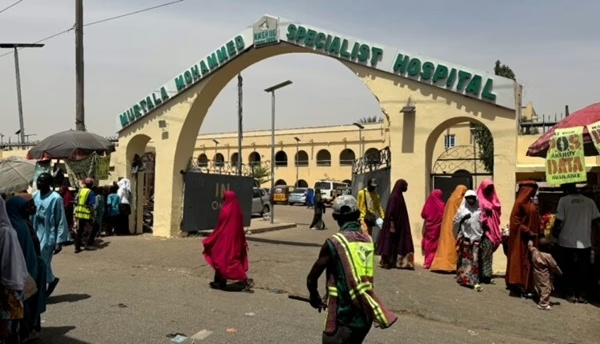
The cries of women in labour echo through the maternity wards of Murtala Muhammad Specialist Hospital and Gwagwarwa Primary Healthcare Center, Nasarawa local government area in Kano, as anxious relatives pace the corridors, waiting for doctors and nurses to attend to their loved ones.
For many families, however, the urgency of childbirth is quickly overshadowed by another pressure, an alleged demand for money or unnecessary delivery materials by some health workers in the two hospitals.
SolaceBase reports that the situation further worsens the emotional and financial strain relatives already face in those critical moments. For families overwhelmed by the fear of losing both mother and child, refusing such demands is hardly an option.
In the tense atmosphere of the labour ward, many feel compelled to comply by paying unofficial delivery fees or rushing to procure materials that are supposed to be provided free under the state’s maternal healthcare policy, just to ensure their wives or relatives receive attention.
However, the Kano State government introduced a program to reduce maternal and child mortality and ease the financial burden on vulnerable families.
The policy provides free antenatal services, childbirth, including both vaginal delivery and Caesarean section, postnatal care, as well as treatment for children under five.
However, an investigation by SolaceBase has found that despite the policy, some health workers in these facilities allegedly demand unofficial payments or require relatives to provide delivery materials before attending to women in labour.
The practice often places families in a difficult position, either to comply immediately or risk delays in care.
How patients are extorted to pay delivery fees
At Gwagwarwa Primary Healthcare Centre, relatives of women in labour appear visibly distressed as they are asked to pay delivery fees, often before care is provided.
Findings by SolaceBase show that the amount demanded is not fixed. Instead, it appears to vary depending on the patient’s condition and, in some cases, on what health workers assume the family can afford.

Several relatives said failure to make the payment can lead to delays in attending to patients. In some cases, women are allegedly not allowed to leave the facility after delivery until the money is paid.
The payments are typically made in cash within the labour ward, with no receipts issued and no clear explanation of what the money is meant to cover.
Mariya Hashim, who brought her daughter for delivery, said she was asked to pay ₦6,500, even though she was aware that delivery services are officially free.
“I brought my daughter here because we were told delivery is free. But they asked me to pay ₦6,500. They didn’t explain what it was for, and nothing was bought from the pharmacy,” she said.
She added that some families were asked to pay more.“It depends on how they see you. Some people paid higher. If you refuse, they may delay attending to you. And even after delivery, you must pay before they allow you to go,” she said.
Another relative, Aisha Usman, who brought her sister, said she had a similar experience, adding that, “They told us to pay in cash at the labour ward, saying delivery is free, is not what we saw here.”
She described the moment as overwhelming, saying she could not question the demand. “When my sister was taken inside, a health worker called me and asked for N6,500.
“I didn’t even have the strength to ask why. At that moment, all I was thinking about was her safety,” she added.
Several relatives told SolaceBase they felt compelled to comply because of the life-threatening situation, leaving them with little room to question the legitimacy of the payments.
Mothers and babies withheld overpayment
There are also serious allegations that some women and their newborns are not allowed to leave the facility until delivery payments are made at Gwagwarwa PHC.
Ummi Adam, who visited the hospital for a check-up, recounted an incident she witnessed where a woman and her baby were held back after delivery.
According to her, the woman’s husband was asked to pay about N12,000 before they could be discharged. He reportedly told health workers he could not afford the amount, insisting that delivery services were meant to be free.
With no immediate solution, he later returned with N8,000, which he said he borrowed. Despite this, the family was still not allowed to leave.
“He even brought a tricycle to take them home, but they refused to release his wife and the baby. He looked completely helpless,” Ummi said.
Another relative, Maryam Auwal, said she faced a similar situation after making a payment. She said that after paying N7,000, she was asked to pay an additional N100 before she was allowed access to her patient.
“That N100 I begged them to remove caused tension. They said they couldn’t risk it because the person in charge would hold them responsible,” she said.
Hafsat Shu’aibu said such incidents are not isolated, alleging that it is not uncommon for mothers and newborns to be held back until payments are completed.
Collusion to sell drugs, materials
At Murtala Muhammad Specialist Hospital, a different pattern emerged during the investigation, with several patients` relatives alleging that health workers direct them to purchase drugs and delivery materials from a specific private shop outside the facility.
Despite the presence of a functional pharmacy within the hospital, relatives said they were instructed to obtain items from a shop located directly opposite the hospital’s main gate.
SolaceBase finds that this practice is not isolated, as multiple sources have described similar experiences, raising suspicions of collusion between some health workers and the shop operators.
Sadiya Ahmad, one of the relatives at the facility, said she was not only directed to the shop but was also accompanied there by a nurse after she indicated she was unfamiliar with the location.
“The way it is done, you may not even question it. They didn’t ask me to pay anything in the labour room, but told me to go to that shop and buy everything, even though we were told these things should be free.”
She questioned why patients were not referred to the hospital pharmacy or allowed to make purchases elsewhere. “If it is really about getting the materials, why not send us to the hospital pharmacy, or allow us to buy from any shop outside? Why that particular place?” she asked.
Other patients who spoke to this reporter raised similar concerns, suggesting a pattern indicative of a coordinated system rather than isolated decisions by individual staff.
‘We are compelled to buy from the shop’
Our reporter has uncovered that many pregnant women who sought care at Murtala Muhammad Specialist Hospital were not given a choice in where to purchase delivery materials, as they were repeatedly directed to a particular shop outside the facility.
Several patients said they had indicated a willingness to buy the items either from the hospital pharmacy or from nearby shops, but were still told to go to the same location.
Items listed for purchase included gloves, cotton wool, syringes, drips, razor blades, and other delivery materials, many of which are expected to be provided under the free maternal healthcare policy.
One woman, who asked not to be named, said she was taken to the shop by a nurse and instructed to hand over her money, adding that, “I gave the nurse my money, and she handed it to the shop owner, who then gave her the items on my list. I spent about N6,500.”
Another relative waiting outside the labour ward, Sadiya Musa (not her real name), described a similar experience. “We were told to give our money to a nurse, who took us to the shop. She handed the money to the owner, and we were given the items,” she said.
She alleged that the arrangement suggests a relationship between the shop and some hospital staff, adding that, “The way everything is coordinated, it doesn’t look like a normal business. It seems like the shop belongs to them or someone close to them,” she added.
She said she spent over N50,000 in total, including delivery materials and other items she was asked to provide at the labour ward.
Across multiple accounts, patients described a system where they had little control over how or where they obtained required items, reinforcing concerns about possible exploitation within the process.
‘A calculated system exploiting vulnerable families’
Some relatives believe the pattern of demands and referrals is not accidental, but a deliberate system that takes advantage of families at their most vulnerable moments.
Isma’il Muhammad, who brought his wife for delivery at Murtala Muhammad Specialist Hospital, described the experience as deeply troubling.

He said the timing of the demands, often when patients require urgent attention, makes it difficult for families to question or resist.
“You come here hoping for help, but you are faced with these demands when you are not in the right state of mind,” he said.
According to him, most relatives are too emotionally distressed to challenge the situation, as their primary concern is the safety of the woman in labour.
“At that moment, your focus is on saving your wife and the baby. You don’t have the strength to start asking questions,” he added.
He also questioned why patients are being asked to buy delivery materials despite government claims that such services are free. “If the government is providing these things, why are we still being asked to buy them outside?” he asked.
He said the experience left him disappointed, adding that many families would likely challenge the process if they were not under such pressure.
Insiders confirm practice
A health worker at Murtala Muhammad Specialist Hospital, who spoke to SolaceBase on condition of anonymity, confirmed that patients are often asked to provide delivery materials, including disinfectants and detergents, during childbirth.
The source said the items are collected to maintain cleanliness in the labour ward. “We ask them to bring these things so we can keep the environment clean and reduce odour,” the source said.
However, findings from SolaceBase indicate that such materials are already supplied to the facility regularly.
Documents and information obtained from the hospital’s administrative unit indicate that disinfectants and other consumables are periodically provided to support operations in the labor ward.
When confronted with this, the labour ward supervisor (matron) maintained that materials brought by patients are preferred. “What patients bring is often better than what is supplied,” the source added.
The matron, however, did not explain what happens to the items provided by the hospital, raising further questions about how supplies are managed within the facility.
Despite warnings, illegal charges persist
The practice of charging patients for services meant to be free, as well as the alleged diversion of medical supplies, has remained a persistent problem in Kano’s public health facilities despite repeated government warnings.
In 2023, the Kano State government issued a stern warning to health workers against diverting or selling drugs and consumables meant for free distribution.
The Commissioner for Health, Dr Abubakar Labaran Yusuf, said the government had uncovered cases where therapeutic foods and medical supplies were being diverted, sometimes with the involvement of insiders, and sold in markets and private pharmacies.
“We discovered that some of these items are being stolen and taken to markets,” he said, warning that anyone found culpable would face arrest and prosecution.
He added that security agencies had been directed to monitor the situation and take action against offenders. The government also announced measures to curb the practice, including tighter monitoring of medical supplies across state facilities.
The government blames hospital authorities
When contacted, the Kano State Commissioner for Health, Dr Abubakar Labaran Yusuf, blamed hospital authorities for the alleged practices, describing them as a setback to government efforts.
He said the state provides medical supplies to hospitals monthly and allows them to request additional materials as needed.
“From the government’s side, we are making all the necessary provisions to ensure this programme succeeds. What is happening is wrong, and it is being driven by some selfish individuals.”
The commissioner maintained that there was no justification for asking patients to pay or provide materials, stressing that hospitals are expected to operate within the framework of the free maternal healthcare policy.
“We have made it clear that if supplies run out, facilities can request more. So there is no reason for patients to be asked to provide these items,” he added.
He described the situation as a form of sabotage, noting that such actions undermine the government’s efforts to reduce the financial burden on citizens.
Health board outlines policy, silent on allegations
The Director-General of the Kano State Primary Healthcare Management Board, Prof. Salisu Ibrahim, said the government is expanding maternal healthcare services across state facilities.

He noted that the policy aims to provide free maternal services, including childbirth, across public health institutions.
He also said that monitoring mechanisms are in place to ensure compliance, including oversight by record officers and coordinators, as well as periodic supervisory visits. “Any staff found culpable will be dealt with in accordance with the law,” he said.
However, he did not directly respond to questions about the alleged demands for payment and materials at Gwagwarwa Primary Healthcare Center.
Similarly, the Kano State Hospitals Management Board declined to comment on allegations involving Murtala Muhammad Specialist Hospital, stating that the Commissioner for Health had already addressed the issue.
This report was produced with support from Civic Media Lab