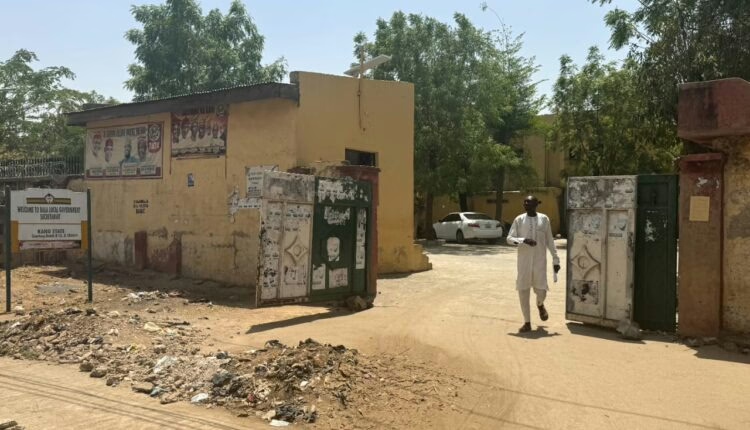
Obtaining an indigene certificate in Kano State is supposed to involve a strict verification process designed to confirm a person’s local origin. But in Dala Local Government Area, the process has quietly been turned into a lucrative bribery scheme, allowing applicants to obtain the document within minutes without undergoing the required checks.
An investigation by SolaceBase uncovered how intermediaries operating around the local government secretariat collect unofficial payments ranging from N2,000 to N10,000 and facilitate the issuance of indigene certificates for applicants, bypassing the official procedures meant to verify their background.
During an undercover visit to the secretariat, this reporter obtained the certificate through an intermediary after paying N8,000, without presenting the mandatory endorsement form or undergoing any verification by traditional or government authorities.
The investigation found that the illegal practice enables individuals who are not from Dala, and in some cases not even from Kano State or Nigeria to obtain the certificate, a document required for government employment, scholarship opportunities, school admissions under state quotas, and political appointments.
The ease with which the certificate can be obtained raises serious concerns about corruption within the local government system and exposes potential security risks, as the document could be used by criminals or non-residents to gain access to opportunities meant for genuine indigenes.
The Official Process
Under the official procedure in Kano State, an applicant seeking an indigene certificate must undergo a verification process to confirm their true origin within the local government area.
The process begins with obtaining an application form, which must be endorsed by several authorities, including the ward councillor, the ward head, the district head, and officials from the immigration office, before it is finally approved by the chairman of the local government.
After completing the form and securing the required endorsements, the applicant is expected to pay the official fee of ₦1,000 at the designated bank for the local government.
The bank receipt, together with the completed form, must then be submitted to the indigene certificate unit at the local government secretariat for processing and issuance of the document.
These steps are intended to ensure that only genuine indigenes receive the certificate, as the officials and traditional leaders signing the form are expected to confirm the applicant’s membership in the community.
In theory, the process provides an important safeguard against impersonation and protects opportunities meant for residents of the local government area.
However, this investigation found that the official process is frequently ignored in Dala Local Government Area, allowing individuals to obtain the certificate without completing the required verification procedures.
How the Process Is Bypassed
This investigation reveals that applicants often avoid the formal procedure at the Dala Local Government Secretariat by dealing with intermediaries operating around the premises.

These intermediaries approach individuals seeking the certificate and offer to facilitate the process for unofficial fees.
Applicants who agree to pay these amounts can receive the certificate without presenting the endorsement form or obtaining approval from the ward councillor, ward head, district head, immigration office, or the chairman of the local government.
The investigation found that once payment is made, the intermediaries take the applicant’s passport photographs and personal details, then return shortly afterwards with a completed indigene certificate bearing the local government’s official stamp.
This practice effectively turns the certificate into a purchasable document, undermining the verification system designed to confirm a person’s local origin.
As a result, individuals who are not from Dala Local Government Area or even from Kano State can obtain the certificate and use it to access opportunities reserved for genuine indigenes.
Inside the Indigene Certificate Office
Information gathered during this investigation indicates that the indigene certificate unit at the Dala Local Government Area secretariat is overseen by Mallam Yahaya Jibril Musa, who is responsible for processing and issuing the documents to applicants.
According to multiple sources familiar with the office’s operations, the unit has allegedly evolved into an informal network in which intermediaries assist applicants in obtaining certificates in exchange for money.

These intermediaries are often seen around the secretariat premises, approaching individuals who inquire about the indigene certificate and offering to facilitate the process.
Sources alleged that the intermediaries collect payments from applicants before liaising with officials inside the office to process the certificates quickly.
Some of the intermediaries are believed to have connections with political figures and staff within the secretariat, enabling them to operate openly within the premises.
As a result, what should ordinarily be a routine administrative service has allegedly become a lucrative enterprise driven by unofficial payments.
Inside the Secretariat: How the Certificate Was Obtained
During an undercover visit by SolaceBase to the Dala Local Government Council Secretariat, this reporter observed several individuals loitering on the premises shortly after their arrival, inquiring about the process for obtaining an indigene certificate.
Moments after asking about the location of the indigene office, the reporter was approached by a man who introduced himself as Bello Musa.
Musa said he could facilitate the issuance of the certificate and asked whether it was needed immediately or could wait until the next day.
According to him, obtaining the certificate instantly would cost N5,000, while processing it the following day would cost N3,000.
When the reporter indicated that the certificate was needed immediately, Musa requested payment and asked for two passport photographs.
The reporter then asked whether the certificate could still be issued without completing the official form containing endorsements from the ward councillor, ward head, district head, immigration office, and the local government chairman.
Musa dismissed the concern, assuring the reporter that the certificate would be ready once payment was made.
“Don’t worry. Once you make the payment, you will receive your certificate. Which area in Dala do you want to claim?” he asked.
After the reporter mentioned Gwammaja, Musa collected the passport photographs and entered the indigene office, instructing the reporter and the individual whose photographs were submitted to wait outside the building.

A few minutes later, he returned with the indigene certificate bearing the submitted name and photograph, stamped with the official seal of the local government vice chairman. He then asked the reporter to step outside the secretariat to collect the document.
After handing over the certificate, Musa demanded an additional N3,000 as a facilitation fee, claiming that the initial N5,000 had already been given to “Mallam Yahaya” inside the office. The reporter subsequently transferred the additional payment, completing the transaction.

Certificate Issued to Non-Indigene
The certificate obtained during the undercover operation was issued in the name of Saminu Yakubu, who is not an indigene of Kano State.
Yakubu, who cooperated with this investigation, is from Sabon Birni Local Government Area of Sokoto State and had spent less than six months in Kano at the time the certificate was obtained. Despite this, the document identified him as an indigene of Dala Local Government Area.

“I cannot imagine that I now have an indigene certificate from Dala. I will not use it because I am not a legal resident here. The certificate was obtained only for the purpose of this investigation,” he said.
Yakubu warned that the practice could have serious consequences if exploited by criminal elements or individuals seeking to fraudulently benefit from opportunities meant for genuine indigenes and even non-Nigerians.
“If this falls into the hands of criminals, only God knows what they might use it for,” he said. “I call on the government to stop this corruption.”
Insider Confirms the Practice
A staff member of the local government, Kamal Sani (not his real name), confirmed that the practice of issuing indigene certificates through unofficial payments exists within the secretariat.
According to him, some applicants prefer to avoid the lengthy verification process and instead obtain the certificate through intermediaries who facilitate the issuance in exchange for money.
“People want their certificates quickly, and some staff take advantage of that,” the source said.
The source also alleged that political influence sometimes plays a role in the process, claiming that individuals connected to influential figures can easily obtain the certificate without following the official procedure.
“Some of the people who supported the chairman during the election can easily obtain the certificate through Yahaya,” the source said. “He does not collect the money directly. His associates collect it and facilitate the process.”
The source added that dozens of certificates are allegedly processed through this informal arrangement, raising concerns about the integrity of the verification system designed to confirm applicants’ true origin.
Security Concerns as Traditional Ruler Reacts
Mallam Faruq Muhammad Yola, the district head of Dala Local Government Area, who supervises 51 ward heads, described the illegal issuance of indigene certificates as a serious security threat.
Speaking through his secretary, Mallam Usman Muhammad Yola, he explained that the verification process involving traditional leaders exists to ensure that people living within the communities are properly identified and known.
“Normally, before someone can rent or buy a house in our communities, they must present an indigene certificate,” he said. “If the person does not have one, we investigate their background to know who they are and where they come from.”

He warned that bypassing this process could allow criminals to exploit the system and settle in communities without proper scrutiny.
“If these certificates are issued without proper verification, criminals can obtain them, rent houses, and use them as hideouts,” he said.
The district head also recalled security challenges experienced in Kano during the Boko Haram insurgency, noting that some violent attacks occurred because individuals were able to settle in communities without proper background checks.
“We are calling on the government to investigate and address this corruption because it poses serious security risks,” he added.
Officer Denies Allegations
Yahaya Jibril Musa, the officer in charge of the indigene certificate unit at the Dala Local Government Secretariat, denied allegations that certificates are issued through unofficial payments or without proper verification.
According to him, the office follows due process when issuing the document, and applicants are first questioned about their background before being given the required form.
“Anyone who comes here is first asked questions before being given the form,” he said. “I know almost every part of Dala. If necessary, I can call the district head to confirm whether the person is truly from that area.”
He explained that applicants are required to pay the official fee of N1,000 at the Dala Microfinance Bank before receiving the application form for the necessary endorsements.
“We do not collect money from people here,” he said.
However, Musa acknowledged that there are instances when he is instructed by senior officials at the secretariat to issue indigene certificates without following the full procedure.
“Sometimes orders come from my superiors in the secretariat, and I cannot refuse,” he said. “But apart from that, nobody gets the certificate without due process.”
Expert Raises Alarm
Dr Kabiru Sufi Sa’id, a lecturer at Kano State College of Education and Preliminary Studies, warned that the illegal issuance of indigene certificates could have far-reaching consequences for governance and national security.
According to him, the document serves as an important proof of origin that determines access to certain opportunities, including government employment, scholarships, and political appointments within the state.
He explained that if the system is compromised, individuals who are not genuine indigenes could exploit the loophole to secure opportunities intended for residents of the local government area.
“Such certificates could allow foreigners or non-indigenes to obtain positions in sensitive sectors, including the security services, or benefit from job opportunities reserved for local residents,” he said.
Dr Sa’id also warned that crimes committed by individuals who obtained the certificate through fraudulent means could damage the local government’s reputation and undermine trust in the system meant to regulate access to opportunities.
Chairman Did Not Respond to Multiple Requests
Efforts to obtain the response of the chairman of Dala Local Government Area, Alhaji Surajo Ibrahim Imam, were unsuccessful despite several attempts by the reporter.
The reporter first visited the Dala Local Government Secretariat in Gwammaja to meet the chairman and present the findings of this investigation.
However, staff members at the secretariat informed the reporter that the chairman had travelled to Abuja.
When the reporter asked whether the vice chairman was available, he was told he was not around either.
The reporter subsequently obtained the chairman’s phone number and placed several calls to him, but none were answered.
Text messages were also sent to explain the issues raised in the investigation and to request his response.
The chairman responded briefly to one of the messages, saying:
“Okay, noted and thanks again.”
When asked when he would be available for an interview, he replied:
“Ok, right now I am in Abuja, please.”
Further attempts to reach him by phone and messages were unsuccessful.
Several days later, the reporter called him multiple times, but the calls went unanswered.
The reporter subsequently sent another message explaining that repeated attempts had been made to reach him and that his response was needed to balance the report.
To provide an alternative, the reporter also sent a set of written questions through WhatsApp so that the chairman could respond at his convenience.
As of the time this report was filed, the chairman had not responded to the questions or returned the calls.
This report was produced with support from Civic Media Lab